

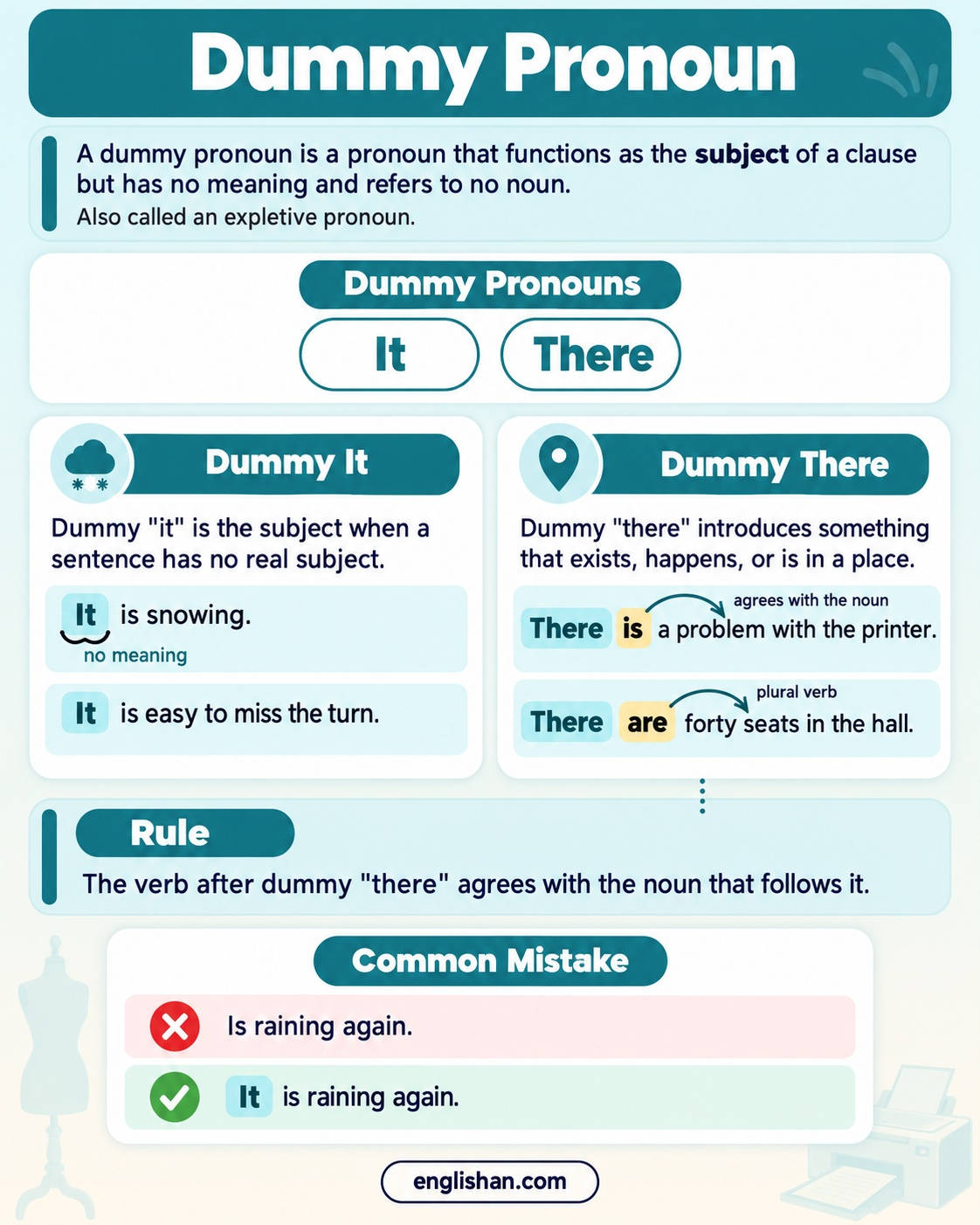
A dummy pronoun, also called an expletive pronoun, is a pronoun that functions as the subject of a clause but has no meaning and refers to no noun. There are two dummy pronouns in English: “it”, as in “It is snowing”, and “there”, as in “There is a key under the mat”.
In “It is snowing”, no person or thing performs the action, but the verb still has a subject. Both pronouns come before the verb as its subject, and the real information follows the verb: the weather, the time, or the thing that exists.
What Is A Dummy Pronoun?
A dummy pronoun is a pronoun that has no antecedent, the noun a pronoun normally refers to. In “I bought a lamp, and it was cheap”, the word “it” refers to “a lamp”. In “It was cold yesterday”, no noun in the sentence or the conversation was cold, so “it” refers to nothing.
Because the word has no meaning, no noun can replace it, and no question such as “What was cold?” has an answer. The word is in the sentence only so that the verb has a subject before it.
List Of Dummy Pronouns
There are only two dummy pronouns in English, and they introduce different kinds of sentences.
| Word | Uses | Sentence pattern |
|---|---|---|
| It | Weather, time, dates, and distance | It + verb or be + weather, time, or distance words |
| It | An opinion or fact about an action or idea | It + be + adjective + to-infinitive or that-clause |
| It | Focus on one part of a sentence | It + be + focused words + who or that clause |
| There | Something that exists, happens, or is in a place | There + be + noun |
| There | A number or an amount | There + be + number or amount + noun |
In every pattern, “it” or “there” comes before the verb, so the new information comes after the verb.
- It snowed all night in the mountains.
- There is a problem with the printer.
- It is easy to miss the turn.
- There are forty seats in the hall.
- It was Nadia who found the keys.
Dummy Pronoun It
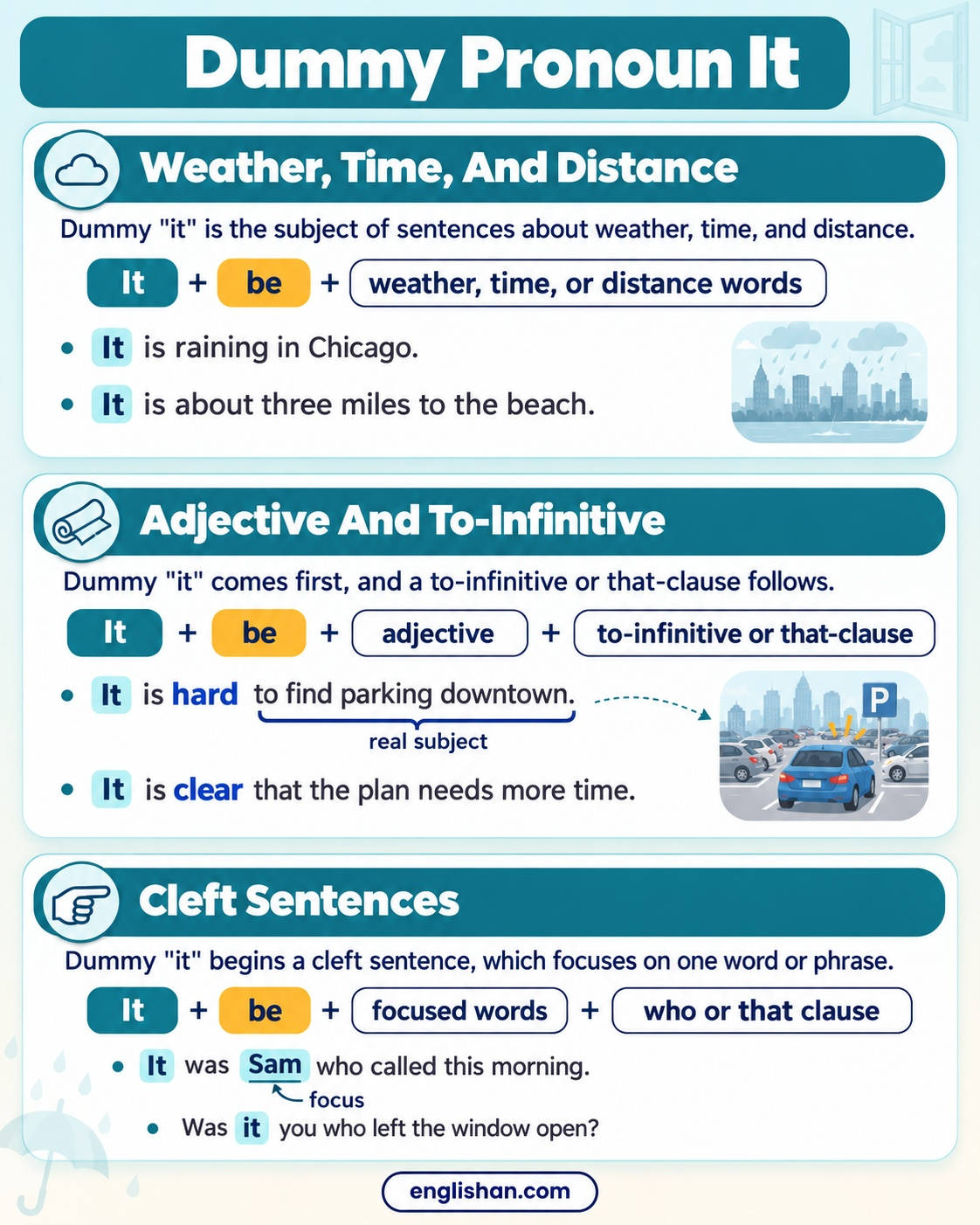
Dummy “it” functions as the subject when a sentence has no real subject, or when the real subject comes later in the sentence. There are three main uses of dummy “it”: for weather, time, and distance, before an adjective and a to-infinitive or that-clause, and in cleft sentences.
Weather, time, and distance: Dummy “it” is the subject of sentences about the weather, temperature, the time, the day or date, and distance. The verb is usually “be”, and weather verbs such as “rain” and “snow” also take dummy “it” as their subject.
- It is raining in Chicago.
- It was below freezing last night.
- How far is it to the airport?
- It‘s half past seven, so we should leave.
- Is it Friday tomorrow?
- It is about three miles to the beach.
The same “it” comes before “take” with a length of time, as in “It takes ten minutes to walk to the station”.
Adjective and to-infinitive: Dummy “it” comes first when the real subject is a to-infinitive or a that-clause, and the long subject moves to the end of the sentence. The pattern is “it” + “be” + adjective + to-infinitive or that-clause, so “To find parking downtown is hard” becomes “It is hard to find parking downtown”.
- It is hard to find parking downtown.
- It was kind of you to call.
- Is it true that the store closes early on Sundays?
- It is clear that the plan needs more time.
- It isn’t safe to swim here after dark.
A noun can also follow “be”, as in “It is a pity that you missed the show”. In informal speech, an “-ing” form sometimes replaces the to-infinitive: “It was nice meeting you.”
Cleft sentences: Dummy “it” begins a cleft sentence, a sentence divided into two parts to focus on one word or phrase. A form of “be” comes before the focused words, and a clause with “who” or “that” completes the sentence, so “Sam called” becomes “It was Sam who called”.
- It was Sam who called this morning.
- It is the blue folder that I need, not the red one.
- Was it you who left the window open?
- It was in Lisbon that they first met.
The verb “be” in a cleft sentence agrees with “it”, so it stays singular even before a plural noun.
It were the neighbors who complained. ❌
It was the neighbors who complained. ✅
The subject of “was” is “it”, which takes a singular verb.
Dummy Pronoun There
Dummy “there” is a pronoun that introduces something that exists, happens, or is in a place. It usually comes before a form of “be”, and the noun after the verb tells us what exists.
- There is a pharmacy next to the bank.
- There are three emails from your manager.
- Is there any milk in the fridge?
- There was a power cut during the storm.
- There will be a short break at eleven.
- Are there enough chairs for everyone?
The noun after dummy “there” is usually new information, so it takes “a”, “some”, “any”, “no”, a number, or no article. For a thing the listener already knows, the noun usually comes first instead, as in “The bank is on Main Street”. Dummy “there” also comes before “seem to be” and “appear to be”, as in “There seems to be a mistake in the bill”.
Verb Agreement After Dummy There
The verb after dummy “there” agrees with the noun that follows it, not with “there”. A singular or uncountable noun takes a singular verb, and a plural noun takes a plural verb.
- There is a cat on the roof.
- There are two cats on the roof.
- Was there much traffic this morning?
- There were hundreds of cars on the bridge.
- Has there been an accident on the highway?
- There have been three accidents this month.
With “a lot of”, “plenty of”, and “a number of”, the verb agrees with the noun after “of”: “There are a lot of people here”, but “There is a lot of noise”. When a list follows, the verb usually agrees with the first noun in the list, as in “There is a sofa and two armchairs in the room”. With the plural noun first, the verb is plural: “There are two armchairs and a sofa.”
In informal speech, “there’s” often comes before a plural noun, as in “There’s three messages for you”. In writing, a plural noun takes “there are”.
There is many reasons to stay. ❌
There are many reasons to stay. ✅
The noun “reasons” is plural, so the verb after “there” is plural too.
Dummy Subject Pronoun
A dummy subject pronoun is “it” or “there” used as the subject of a clause, which is the usual position of both words. It follows the same word order as any subject: before the verb in a statement, after the auxiliary in a question, and again in a question tag.
- Is it still raining?
- Was there a delay at the airport?
- It‘s getting late, isn’t it?
- There were no tickets left, were there?
Every English statement and question has a subject, even when the subject has no meaning, while a command such as “Close the door” has none. Leaving out “it” or “there” is a common error in statements and questions.
Is raining again. ❌
It is raining again. ✅
The clause has no other subject, so “it” comes before the verb even though it refers to nothing.
Identification Of Dummy Pronouns
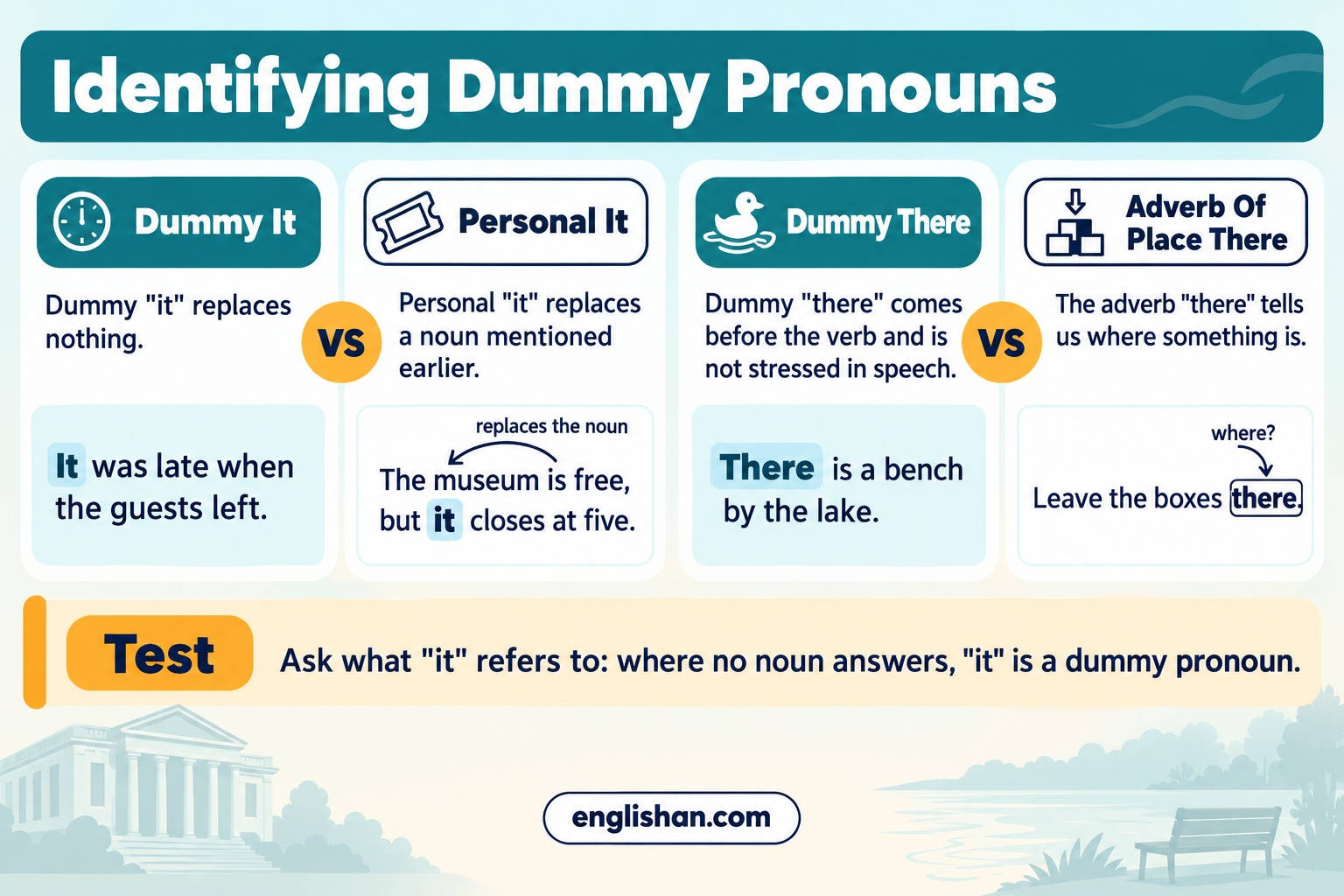
The words “it” and “there” are not always dummy pronouns. The word “it” can be a personal pronoun that replaces a noun, and the word “there” can be an adverb of place that means ‘in that place’.
Personal “it” replaces a noun mentioned earlier, while dummy “it” replaces nothing. To find the type, ask what “it” refers to: where no noun answers, “it” is a dummy pronoun.
- I found your phone, and it was under the sofa. (refers to “your phone”)
- It was late when the guests left. (dummy)
- The museum is free, but it closes at five. (refers to “the museum”)
- It is a long way to the coast. (dummy)
Dummy “there” comes before the verb and is not stressed in speech. The adverb “there” tells us where something is, usually comes after the verb, and can be replaced with “in that place”, which dummy “there” cannot.
- There is a bench by the lake. (dummy)
- Leave the boxes there. (adverb of place)
- There are two cafés there. (dummy, then adverb of place)
- We lived there for ten years. (adverb of place)
FAQs
Yes, "there" is a dummy pronoun when it introduces something that exists, as in "There is a cat in the garden". In that sentence, "there" is a pronoun with no meaning of place. In "The cat is over there", the same word is an adverb of place.
Yes, "expletive pronoun" and "dummy pronoun" are two names for "it" or "there" used as a subject with no meaning. In grammar, "expletive" means a word in the subject or object position that adds no meaning, not a swear word.
No, "they" is not a dummy pronoun, even in sentences such as "They say the bridge will reopen in May". In that use, "they" refers to people in general, so it has a meaning, while dummy "it" and "there" refer to nothing.
Yes, dummy "it" can be the object of verbs such as "find", "make", and "consider" when a to-infinitive or a that-clause follows: "I find it hard to sleep on planes." The real object is "to sleep on planes", and "it" comes in its place after the verb. Dummy "there" is used only as a subject.
Related:
- Types of Pronouns
- Interrogative Pronouns
- Distributive Pronouns
- Relative Pronouns
- Demonstrative Pronouns
- Subject and Predicate
- Common Pronoun Errors
- Pronoun and Verb Agreement
- Subject Pronouns
