

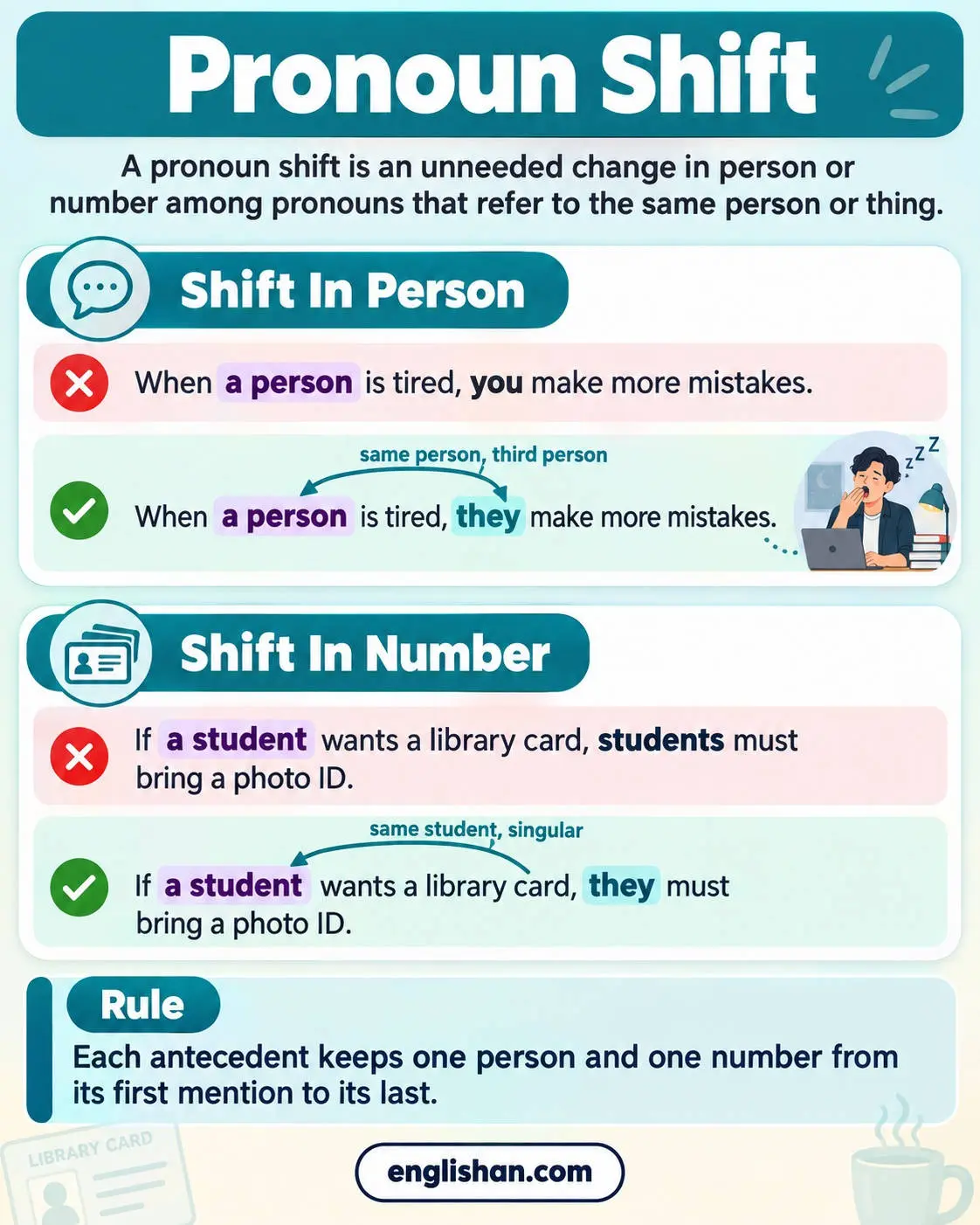
A pronoun shift is an unneeded change in person or number among pronouns that refer to the same person or thing. Person is the difference between the speaker (first person), the listener (second person), and anyone or anything else (third person). Number is the difference between singular and plural.
The error usually starts with a noun in the third person, such as “a customer”, followed later by “you” or by a plural pronoun. Pronouns that refer to different people can change freely, so the rule applies only to pronouns with the same antecedent, the noun or pronoun that a later pronoun replaces. Each antecedent keeps one person and one number from its first mention to its last.
What Is A Pronoun Shift?
A pronoun shift is a change of person or number among pronouns that refer to one antecedent within a sentence or a passage. Personal pronouns show person, and most of them show number as well, so the pronouns for one antecedent match it in both.
| Person | Singular | Plural |
|---|---|---|
| First person | I, me, my, mine, myself | We, us, our, ours, ourselves |
| Second person | You, your, yours, yourself | You, your, yours, yourselves |
| Third person | He, she, it, one, singular they, and their forms | They, them, their, theirs, themselves |
A noun is always third person, so “a driver” and “the neighbors” both take third person pronouns. There are two kinds of pronoun shift: a shift in person, as from “a driver” to “you”, and a shift in number, as from “he or she” to “they”.
Pronoun Shift In Person
A shift in person is a change between first, second, and third person for the same antecedent. The usual pattern is a third person noun, such as “a person” or “students”, followed by the second person “you” for the same people.
- When a customer returns a jacket, they need the receipt.
- When you return a jacket, you need the receipt.
- Students pass the course when they hand in every essay.
- I enjoy the gym in the morning because I see my friends there.
The pronoun “you” with the meaning ‘people in general’ is correct by itself, as in the second example. The shift happens only when “you” replaces a noun or pronoun that the sentence has already named, so “a customer” keeps “they” and a sentence that opens with “you” keeps “you”.
When a person is tired, you make more mistakes. ❌
When a person is tired, they make more mistakes. ✅
The antecedent “a person” is third person, so the pronoun that refers to it is third person too.
A personal story in the first person has the same rule. In everyday speech, “you” often replaces “I” in a story about the speaker’s own experience, but in written English the speaker stays “I”.
Last summer I worked at a hotel, and you had to start at six every morning. ❌
Last summer I worked at a hotel, and I had to start at six every morning. ✅
The sentence is about the writer’s own job, so the subject of both clauses is “I”.
One Vs You In General Statements
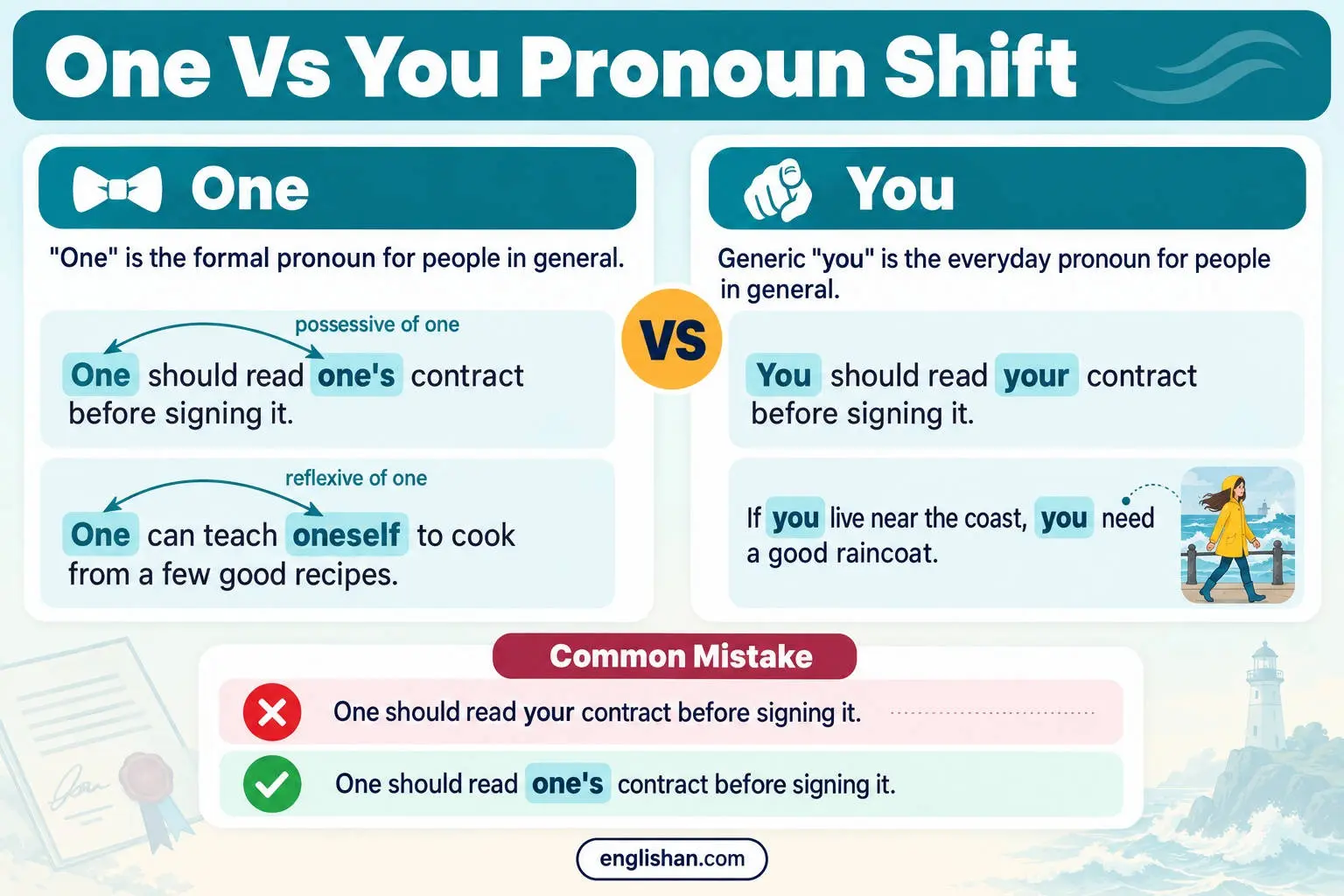
The pronouns “one” and “you” both refer to people in general, and a general statement keeps whichever pronoun it begins with. The pronoun “one” is formal, and generic “you” is the everyday form, so both are correct when they are used alone.
- One should read one’s contract before signing it.
- You should read your contract before signing it.
- One can teach oneself to cook from a few good recipes.
- If you live near the coast, you need a good raincoat.
The pronoun “one” has its own possessive, “one’s”, and its own reflexive, “oneself”. A sentence with “one” in the subject takes these forms, never “your” or “yourself”.
One should read your contract before signing it. ❌
One should read one’s contract before signing it. ✅
The possessive that matches “one” is “one’s”, so “your” is a shift to the second person.
If one wants to pass the driving test, you have to practice every day. ❌
If you want to pass the driving test, you have to practice every day. ✅
Changing every pronoun to “you” corrects the sentence, because “you” is already the subject of the second clause. The verb changes with the pronoun too, from “wants” to “want”.
Pronoun Shift In Number
A shift in number is a change between singular and plural for the same antecedent. It usually occurs in a general statement, when a singular noun (“a student”) later becomes a plural noun (“students”), or when “it” and “they” both refer to one group.
- A new employee receives a laptop on their first day.
- New employees receive a laptop on their first day.
- The company has changed its delivery policy.
- We lost our keys at the beach.
A singular noun and a plural noun for the same people are both correct, but a sentence keeps the one it starts with. The verb follows the choice as well, so “a student wants” becomes “students want”.
If a student wants a library card, students must bring a photo ID. ❌
If a student wants a library card, they must bring a photo ID. ✅
If students want a library card, they must bring a photo ID. ✅
The second clause refers to the same student, so it keeps the singular antecedent or the whole sentence changes to the plural.
A collective noun such as “team”, “committee”, or “company” usually takes “it” and a singular verb in American English. In British English, a collective noun can take “they” and a plural verb, but one sentence still keeps one of the two choices.
The committee has made its decision, and they will announce the result on Friday. ❌
The committee has made its decision, and it will announce the result on Friday. ✅
The pronouns “its” and “they” both refer to the committee, so the sentence keeps the singular “it”.
Pronoun Shift With They And Their
Singular “they” is a standard pronoun for one person whose gender is unknown or not stated, after a noun (“a patient”) or an indefinite pronoun such as “someone” or “everyone”. A sentence with singular “they” has no pronoun shift when “they” refers to the antecedent all through the sentence. Singular “they” takes a plural verb (“they are”), and its other forms are “them”, “their”, “theirs”, and “themselves”.
- Someone left their umbrella in the meeting room.
- Ask each guest whether they want tea or coffee.
- Everyone brought their own lunch to the picnic.
- If a patient feels dizzy, they should sit down.
The shift with “they” occurs when a passage uses “he or she” for an antecedent and then changes to “they”, or uses “his or her” and then “their”. Both choices are correct, so the passage keeps one of them from start to finish.
Each applicant must send his or her CV, and they must include two references. ❌
Each applicant must send their CV, and they must include two references. ✅
Each applicant must send his or her CV, and he or she must include two references. ✅
The applicant is one person, so the pronouns for that person stay either “his or her” and “he or she”, or “their” and “they”.
The full rules for “everyone”, “each”, and “nobody” with singular and plural pronouns belong to indefinite pronoun agreement.
Correct Pronoun Shift Vs Incorrect Pronoun Shift
A correct pronoun shift and an incorrect pronoun shift both change person or number inside one sentence or passage. A correct change follows a new antecedent, and an incorrect pronoun shift keeps the same antecedent.
- I told you that they had moved the meeting.
- We invited the neighbors, and they brought dessert.
- You and I should leave before it starts raining.
Every pronoun in these examples refers to a different person or thing, so each change of pronoun is correct. A direct quotation also keeps the speaker’s own pronouns, as in Maria said, “I am tired.”
To choose the pronoun, ask who or what each pronoun refers to. A new person or thing takes its own pronoun, and the same person or thing keeps the pronoun it already has.
Tom and I booked the trip early, so they got a cheaper price. ❌
Tom and I booked the trip early, so we got a cheaper price. ✅
The antecedent “Tom and I” includes the speaker, so it is first person plural and takes “we”.
Recognition And Correction Of Inappropriate Pronoun Shifts
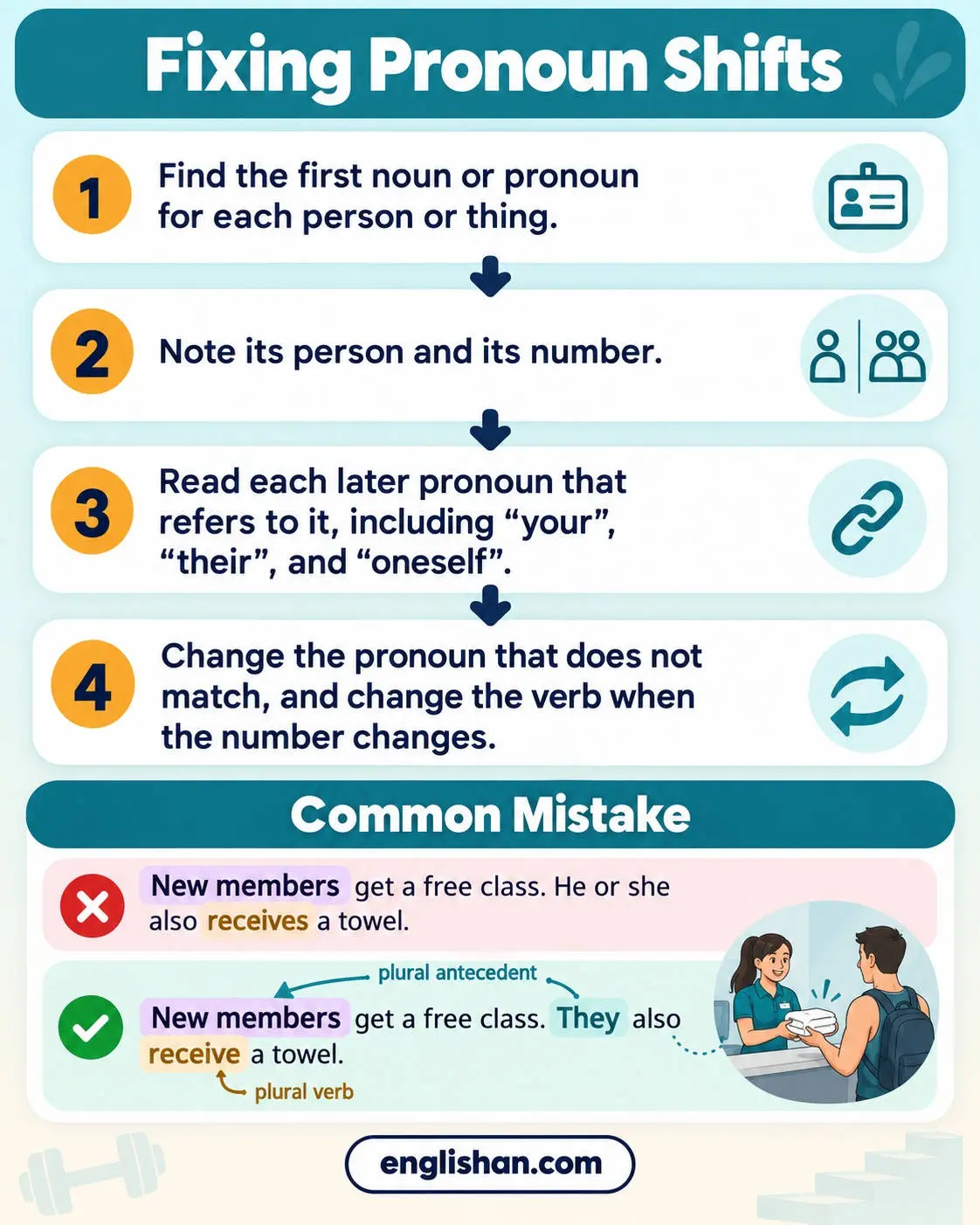
An inappropriate pronoun shift is corrected by comparing every pronoun with its antecedent, in four steps.
- Find the first noun or pronoun for each person or thing in the sentence or paragraph.
- Note its person (first, second, or third) and its number (singular or plural).
- Read each later pronoun that refers to it, including possessive forms such as “your” and “their” and reflexive forms such as “yourself” and “oneself”.
- Change the pronoun that does not match, or change the first mention so the whole passage matches the later pronouns, and change the verb when the number changes.
New members get a free class. He or she also receives a towel. ❌
New members get a free class. They also receive a towel. ✅
The antecedent “new members” is plural, so the pronoun in the second sentence is “they” and the verb is “receive”.
Each student keeps your notes in the blue folder. ❌
Each student keeps their notes in the blue folder. ✅
The possessive refers to “each student”, a third person antecedent, so it is “their”, not the second person “your”.
When a passenger misses the last bus, you have to pay for a taxi. ❌
When passengers miss the last bus, they have to pay for a taxi. ✅
The first mention changes to the plural, and the verb “miss” and the pronoun “they” follow it, so the whole sentence is third person plural.
FAQs
Yes, a pronoun shift can run across two or more sentences, because the pronouns in a paragraph often refer to the same antecedent. In "Volunteers meet at nine. You should bring water", the second sentence moves from the third person to the second, and "They should bring water" keeps the third person.
No, a change from "I" to "me" is a change of case, not of person or number. Both words are first person singular, so "I asked Ana to call me" has no shift. The form changes only with the job of the pronoun: "I" is a subject and "me" is an object.
Switching from "we" to "they" is a shift in person when both pronouns refer to the same group. A report about your own team keeps "we" for the team, as in "Our team met the deadline because we started early". The pronoun "they" is correct only for a different group, such as the client or another team.
Yes, possessive and reflexive forms keep the same person and number as the pronoun they match. The sentence "You should keep one’s receipts" mixes the second and third person, while "You should keep your receipts" keeps one person. The reflexive "yourself" goes with "you", and "oneself" goes with "one".
No, the pronoun changes in reported speech follow the change of speaker, so they are correct. When Sam says "I am late", the report is "Sam said he was late", because "he" refers to Sam from the reporter’s point of view.
Related:
- Pronoun Rules and Correct Usage
- Pronoun Antecedent Agreement
- Singular and Plural Pronouns
- First Person Pronouns
- Second Person Pronouns
- Pronoun Case
- Direct and Indirect Speech
- Common Pronoun Errors
- Vague Pronoun Reference