

Pronouns with prepositions take the object form, so a personal pronoun after a preposition is “me”, “you”, “him”, “her”, “it”, “us”, or “them”, as in “with her” and “for us“. The subject forms “I”, “he”, “she”, “we”, and “they” do not follow a preposition, even when the pronoun is the second word of a pair, as in “between you and me“.
Other pronoun types follow a preposition under their own conditions. A reflexive pronoun follows a preposition when it refers to the subject, a possessive pronoun follows “of” in phrases such as “a friend of mine”, and “whom” is the formal form directly after a preposition.
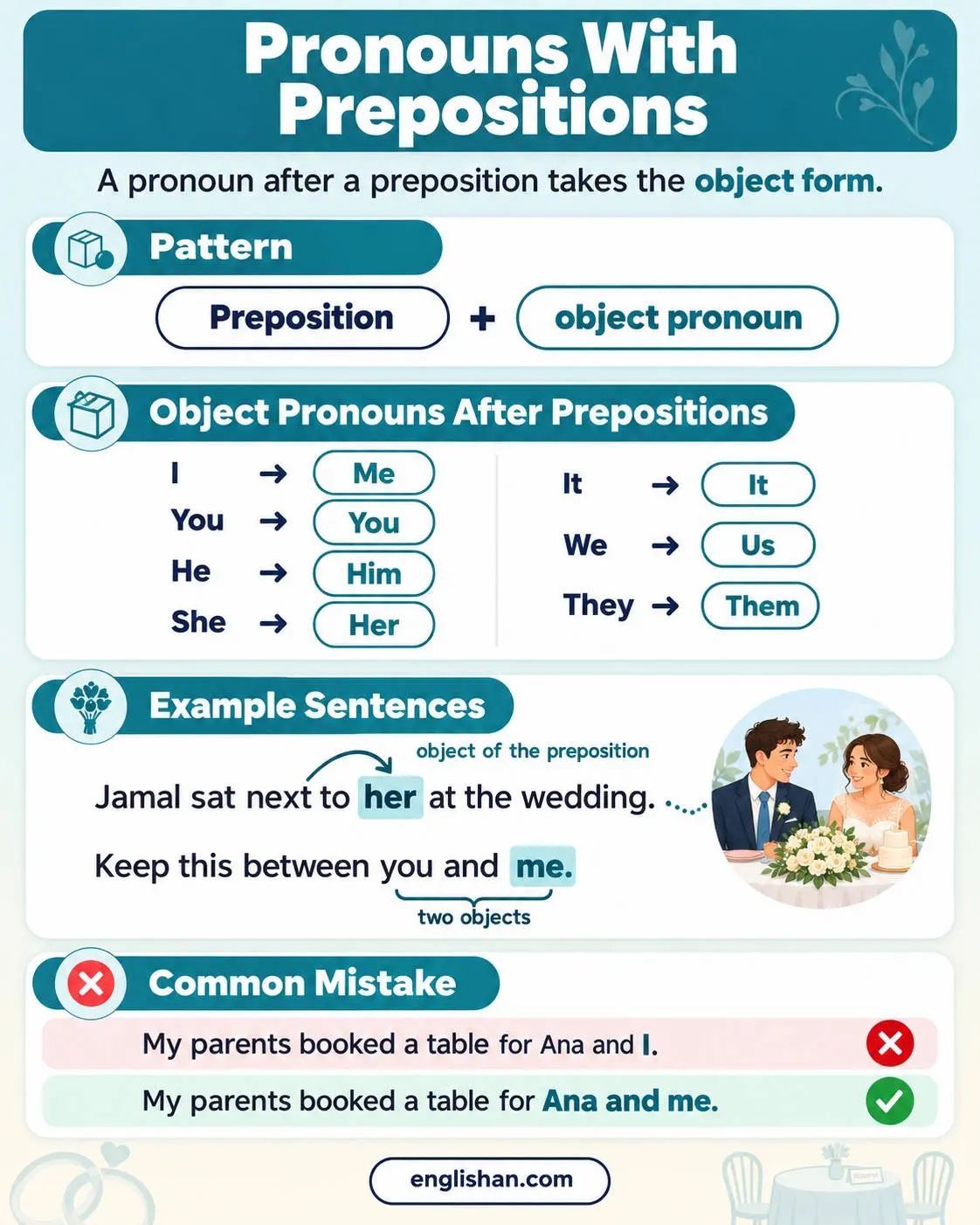
Object Pronouns After Prepositions
In pronouns with prepositions, the pronoun that comes after the preposition is its object, so it takes the object form. The object of a preposition is the noun or pronoun that completes a prepositional phrase, such as “us” in “for us” and “the station” in “near the station”.
| Subject pronoun | Object pronoun after a preposition | Example phrase |
|---|---|---|
| I | Me | Wait for me |
| You | You | A gift for you |
| He | Him | Next to him |
| She | Her | With her |
| It | It | About it |
| We | Us | Without us |
| They | Them | From them |
The object form follows short prepositions such as “at”, “to”, and “with”, and longer ones such as “instead of”, “because of”, and “next to”:
- Can you hold the door for me?
- Jamal sat next to her at the wedding.
- The package is from them, not from the bank.
- We talked about it over lunch.
- Is there a free seat near you?
- The meeting went ahead without us because of the storm.
The words “except”, “like”, and “but” in the meaning ‘except’ are also prepositions before a pronoun, so they take the object form as well: “Everyone except him had a ticket” and “They invited everyone but me.”
Of after quantifiers: A quantifier such as “all”, “both”, “some”, “most”, “none”, or “each” is followed by “of” and an object pronoun, as in “both of us” and “some of them“. The subject form never follows this “of”, so “all of we” is wrong and “all of us” is correct.
Us before a noun: The pronoun “us” keeps its object form when a plural noun follows it after a preposition. Remove the noun, and “to us” shows the correct form:
The teacher gave extra time to we students. ❌
The teacher gave extra time to us students. ✅
The pronoun is the object of “to”, so it takes the object form “us” whether or not the noun follows.
Two Pronouns After Prepositions
Pronouns with prepositions keep the object form in pairs. When a preposition is followed by two pronouns, or by a noun and a pronoun joined by “and” or “or”, each pronoun takes the object form. The preposition then has two objects:
- Keep this between you and me.
- My parents booked a table for Ana and me.
- The coach was angry with him and her.
- Is the invitation for us or for them?
- Send the photos to Ravi and me after the trip.
To choose the form, say the phrase with the pronoun alone. The phrase “for me” is correct, so “for Ana and me” is correct as well, and “between you and me” follows the same rule.
The usual mistake comes from a correct subject. The pair “Ana and I” is right before a verb, as in “Ana and I booked a table”, and the same words are then carried into a position after a preposition:
My parents booked a table for Ana and I. ❌
My parents booked a table for Ana and me. ✅
After the preposition “for”, both parts of the pair are objects, so the pronoun takes the object form.
In a pair, the polite order puts the other person first and the speaker last, as in “for Ana and me”. The same object rule applies to I vs me after a verb, as in “They invited Ana and me.”
Reflexive Pronouns With Prepositions
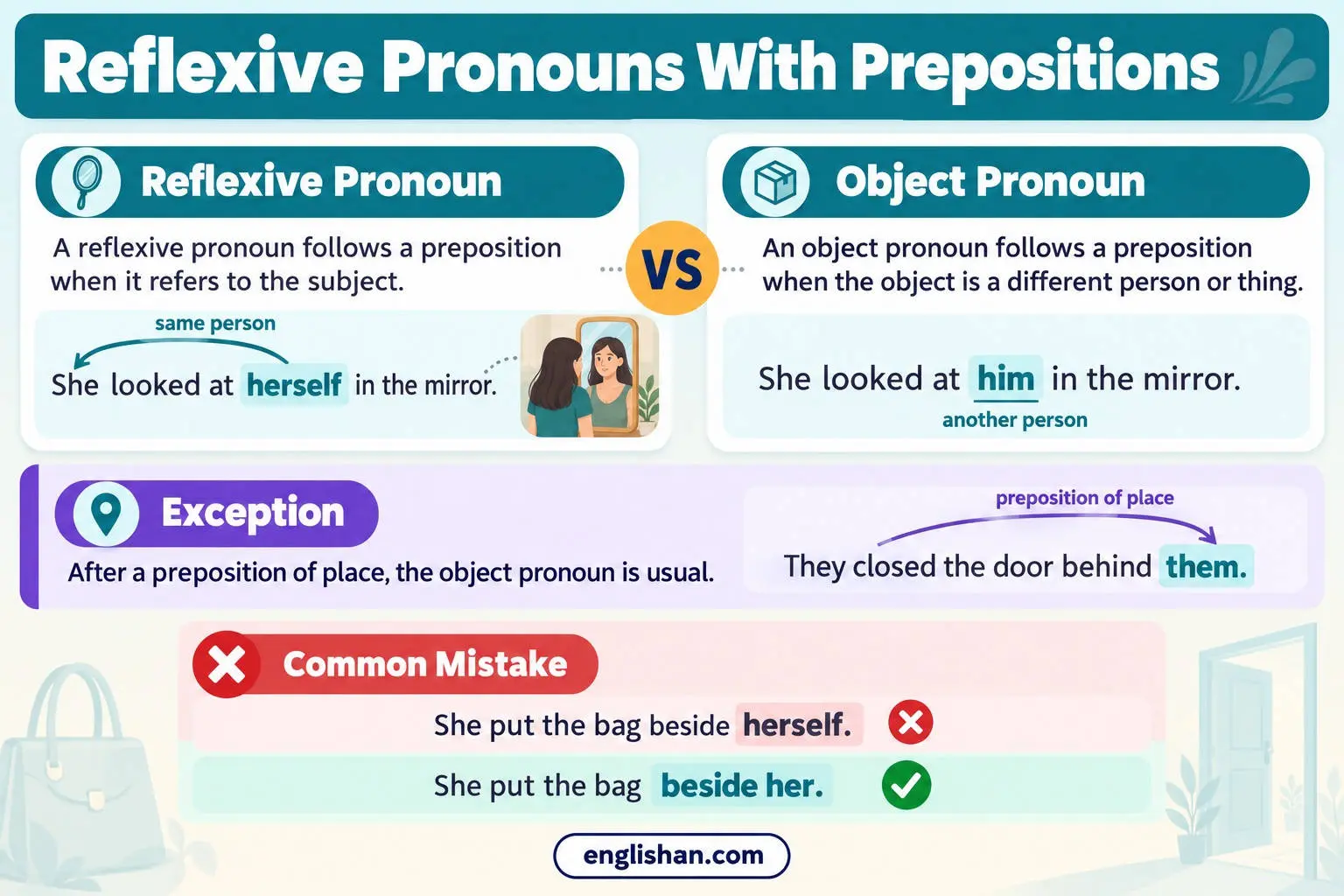
A reflexive pronoun follows a preposition when it refers to the subject of the same clause. When the object of the preposition is a different person or thing, the object pronoun follows instead:
- She looked at herself in the mirror. (herself = she)
- She looked at him in the mirror. (another person)
The reflexive pronouns are “myself”, “yourself”, “himself”, “herself”, “itself”, “ourselves”, “yourselves”, and “themselves”. With prepositions such as “at”, “for”, “to”, “about”, and “of”, the reflexive form follows when the subject and the object are the same person:
- Take care of yourself on the trip.
- Leo was annoyed with himself for missing the bus.
- We baked a cake for ourselves.
- Do you ever talk to yourself when you cook?
Prepositions of place: After a preposition of place, such as “beside”, “behind”, “near”, “around”, and “in front of”, and after “with” in the meaning ‘carrying’, the object pronoun is usual even when it refers to the subject:
- She put the bag beside her.
- They closed the door behind them.
- He looked around him before he crossed the road.
- I had no cash with me.
She put the bag beside herself. ❌
She put the bag beside her. ✅
After a preposition of place, the object pronoun “her” refers back to the subject “she”.
Myself for me: A reflexive pronoun after a preposition refers to the subject of its own clause. In “Send your questions to Dana or me”, the subject is “you”, so “myself” has no subject to refer to:
Send your questions to Dana or myself. ❌
Send your questions to Dana or me. ✅
The speaker is not the subject of the clause, so the pronoun after “to” takes the object form “me”.
Possessive Pronouns After Of
A possessive pronoun follows “of” after a noun with “a”, “an”, “this”, “that”, or a number, as in “a friend of mine“. The phrase means ‘one of my friends’, and the possessive pronouns in this position are “mine”, “yours”, “his”, “hers”, “ours”, and “theirs”:
- Kenji is an old friend of mine.
- Is that jacket of yours waterproof?
- A cousin of hers works at the airport.
- Two colleagues of ours are moving to Denver.
- That dog of theirs barks all night.
The object pronoun after “of” has a different meaning. The phrase “a photo of me” means a photo that shows me, while “a photo of mine” means a photo that belongs to me or that I took:
She is a friend of me. ❌
She is a friend of mine. ✅
The phrase shows whose friend she is, so “of” takes the possessive pronoun “mine”.
Relative Pronouns With Prepositions
A relative pronoun that is the object of a preposition has two positions for the preposition. In formal English, the preposition comes before “whom” or “which”. In everyday English, the preposition goes to the end of the clause, and the relative pronoun is “who”, “that”, or no pronoun at all:
- The client to whom I sent the report has replied. (formal)
- The client who I sent the report to has replied.
- We loved the hotel in which we stayed. (formal)
- We loved the hotel that we stayed in.
- Is that the hotel you stayed in?
Directly after a preposition, the relative pronoun is “whom” for people and “which” for things. In standard English, “who” and “that” do not come straight after a preposition:
The colleague with who I share an office is on leave. ❌
The colleague with whom I share an office is on leave. ✅
The colleague I share an office with is on leave. ✅
The preposition “with” comes directly before the pronoun, so the pronoun takes the object form “whom”, or the preposition moves to the end.
In questions: The same two positions apply to “who” as a question word. The question “To whom did you send the invoice?” is formal, and “Who did you send the invoice to?” is everyday English. The full choice of who vs whom in subjects and objects follows the same object rule.
Some of whom: After a number or a quantifier, a relative clause takes “of whom” for people and “of which” for everything else, as in “I have three brothers, two of whom live abroad” and “She wrote ten songs, most of which are about home.”
Pronouns With Prepositional Verbs And Phrasal Verbs
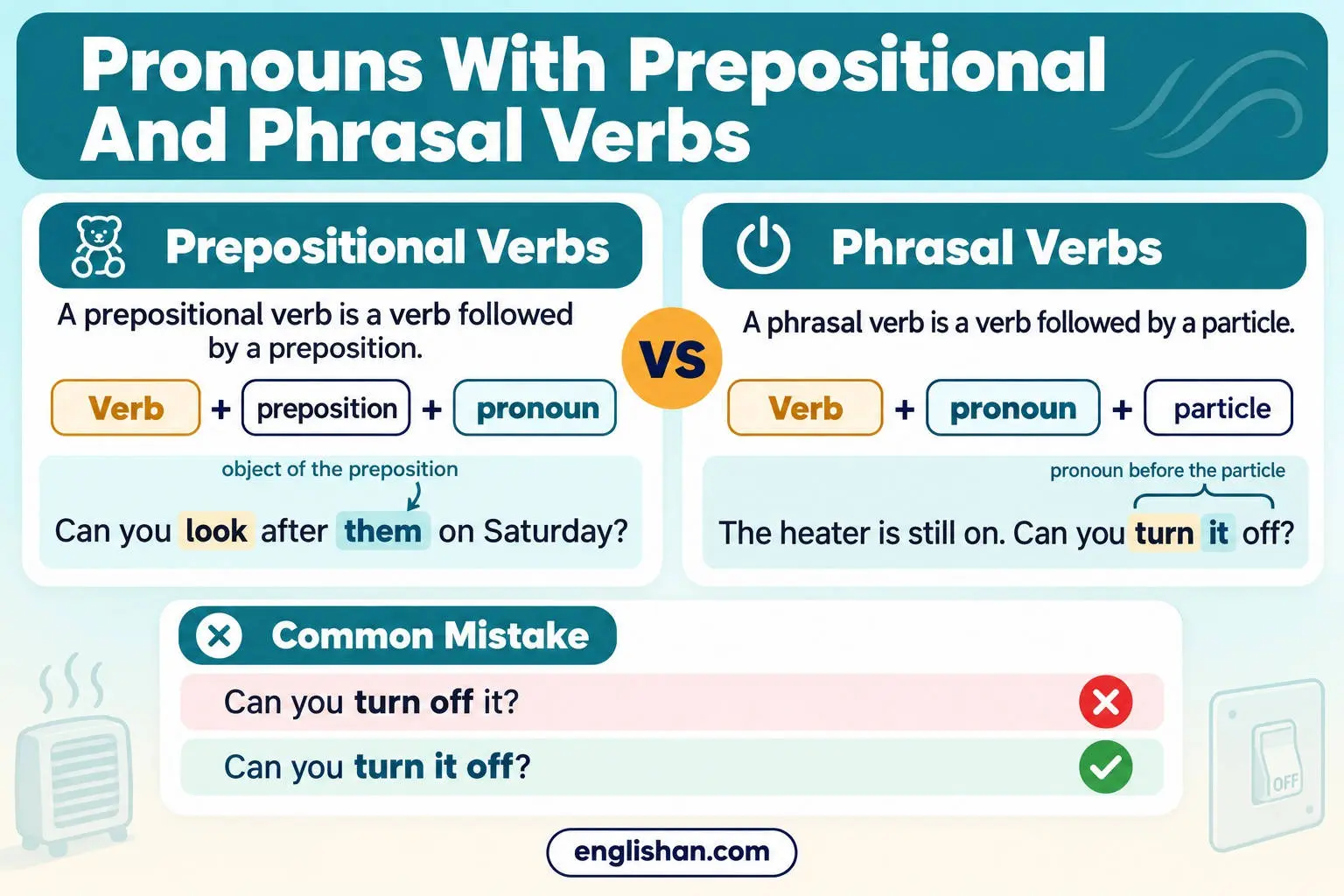
A prepositional verb is a verb followed by a preposition, such as “look after”, “listen to”, “depend on”, and “ask about”. The pronoun is the object of the preposition, so it comes after the preposition:
- Can you look after them on Saturday?
- I found a podcast I like, and I listen to it every morning.
- You can depend on us for the weekend.
- My grandmother asked about you at dinner.
A phrasal verb such as “turn off”, “pick up”, or “give back” is followed by a particle, a small adverb such as “off” or “up”, not a preposition. When the object of a separable phrasal verb is a pronoun, the pronoun goes between the verb and the particle:
- The heater is still on. Can you turn it off?
- I borrowed your charger, so I’ll give it back tomorrow.
- The kids finish school at three, and I pick them up.
A noun object can come before or after a particle, as in “turn the heater off” and “turn off the heater”, but a noun never goes between a verb and its preposition. Where a noun object can come before the small word, the small word is a particle, and a pronoun goes before it.
Can you turn off it? ❌
Can you turn it off? ✅
The pronoun object of a separable phrasal verb comes before the particle.
Can you look them after on Saturday? ❌
Can you look after them on Saturday? ✅
The pronoun is the object of the preposition “after”, so it follows the preposition.
FAQs
Prepositional pronouns are the pronoun forms that follow a preposition. In English, they are not a separate set: the pronouns after a preposition are the object pronouns "me", "you", "him", "her", "it", "us", "them", and "whom", as in "for her" and "to whom".
A question can end with a preposition when the pronoun moves to the front, as in "Who did you go with?", and this word order is standard in everyday English. In formal English, pronouns with prepositions keep the preposition at the front, followed by the object form: "With whom did you go?"
Both are correct, in different settings. In everyday English, "than" takes an object pronoun, as in "My sister is taller than me." In formal English, "than" is followed by a subject pronoun and a verb, as in "My sister is taller than I am."
The object form "me" is correct when "like" is a preposition, as in "She sings like me" and "People like us." "Like" followed by a subject and a verb is a conjunction in informal English, as in "Nobody cooks like I do," so the subject form follows it there.
Yes, a possessive pronoun can follow any preposition when it replaces a possessive adjective and a noun. In "Your bag is next to mine", the pronoun "mine" replaces "my bag", and in "My car is parked behind yours", the pronoun "yours" replaces "your car".
Related:
- Pronouns
- Pronoun Rules and Correct Usage
- Reflexive and Intensive Pronouns
- Separable and Inseparable Phrasal Verbs
- Subject vs Object Pronouns
- Pronoun Case
- Combining Sentences With Relative Pronouns
