

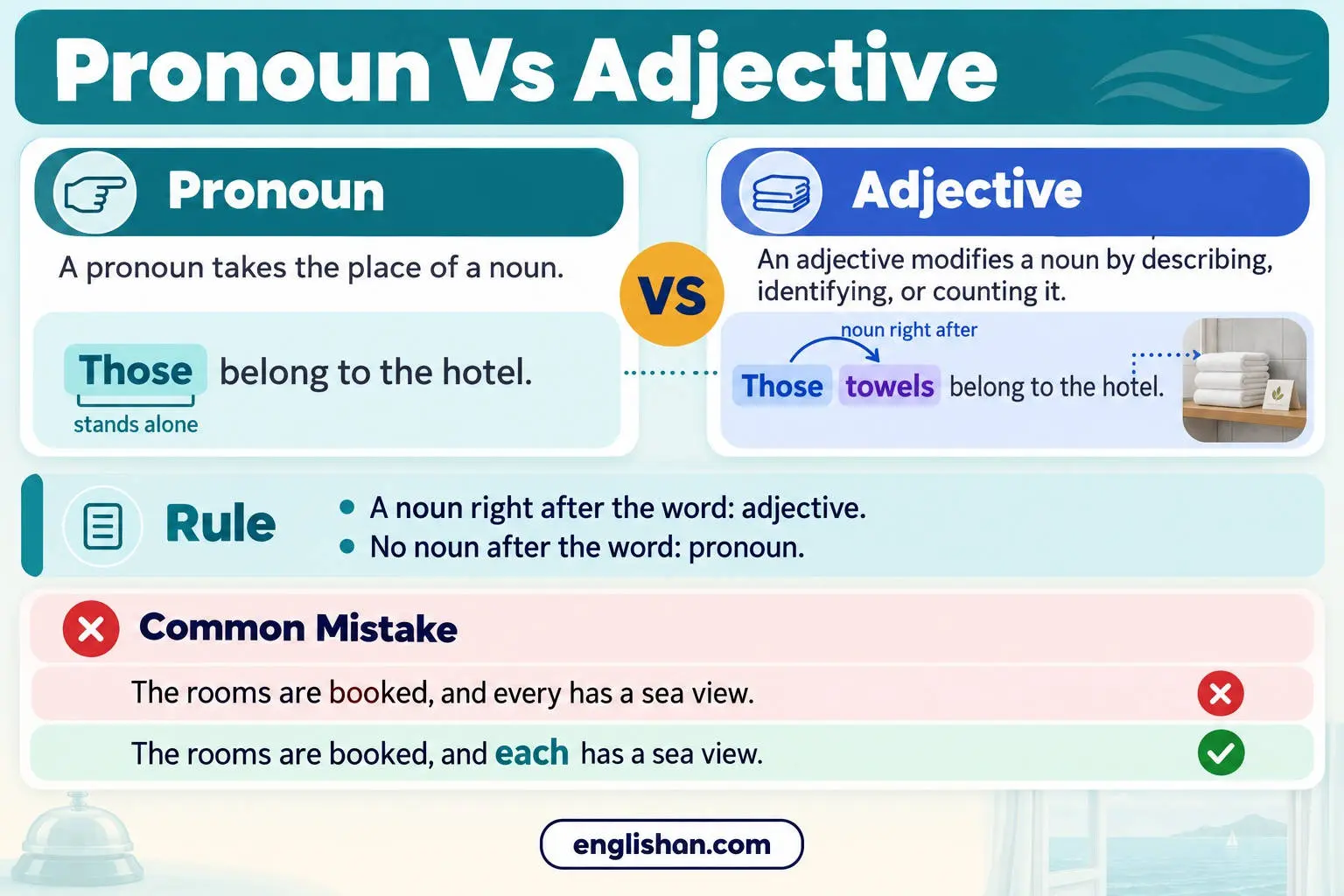
A pronoun is a word that takes the place of a noun, while an adjective is a word that modifies a noun by describing, identifying, or counting it. In pronoun vs adjective questions, the deciding point is position: a pronoun stands alone in place of the noun, while an adjective comes before the noun it modifies.
Some short words belong to both parts of speech, such as “these”, “what”, “either”, and “several”. A word like “neither” is a pronoun in “Neither fits me” and an adjective in “Neither jacket fits me”, because only the second sentence has a noun right after it.
What Is The Difference Between A Pronoun And An Adjective?
The pronoun vs adjective difference is a difference of function in the sentence. A pronoun takes the place of a noun, so it functions as a subject or an object by itself. An adjective modifies a noun, so a noun comes after it or, with a linking verb such as “be”, before it.
| Point | Pronoun | Adjective |
|---|---|---|
| Job | Replaces a noun | Describes or identifies a noun |
| Position | Stands alone as the subject or object | Comes before its noun, or after a linking verb |
| Common words | I, she, mine, someone, who | Old, heavy, my, every, no |
The same word can change sides in two sentences about one thing, as in this pair from a hotel room:
- Those belong to the hotel.
- Those towels belong to the hotel.
The word “those” is a pronoun in the first sentence and an adjective in the second, where it identifies the towels. Descriptive adjectives like “old” and “heavy” are never pronouns, so the overlap is limited to the small words that show which one, whose, or how many.
Words That Can Be Pronouns Or Adjectives
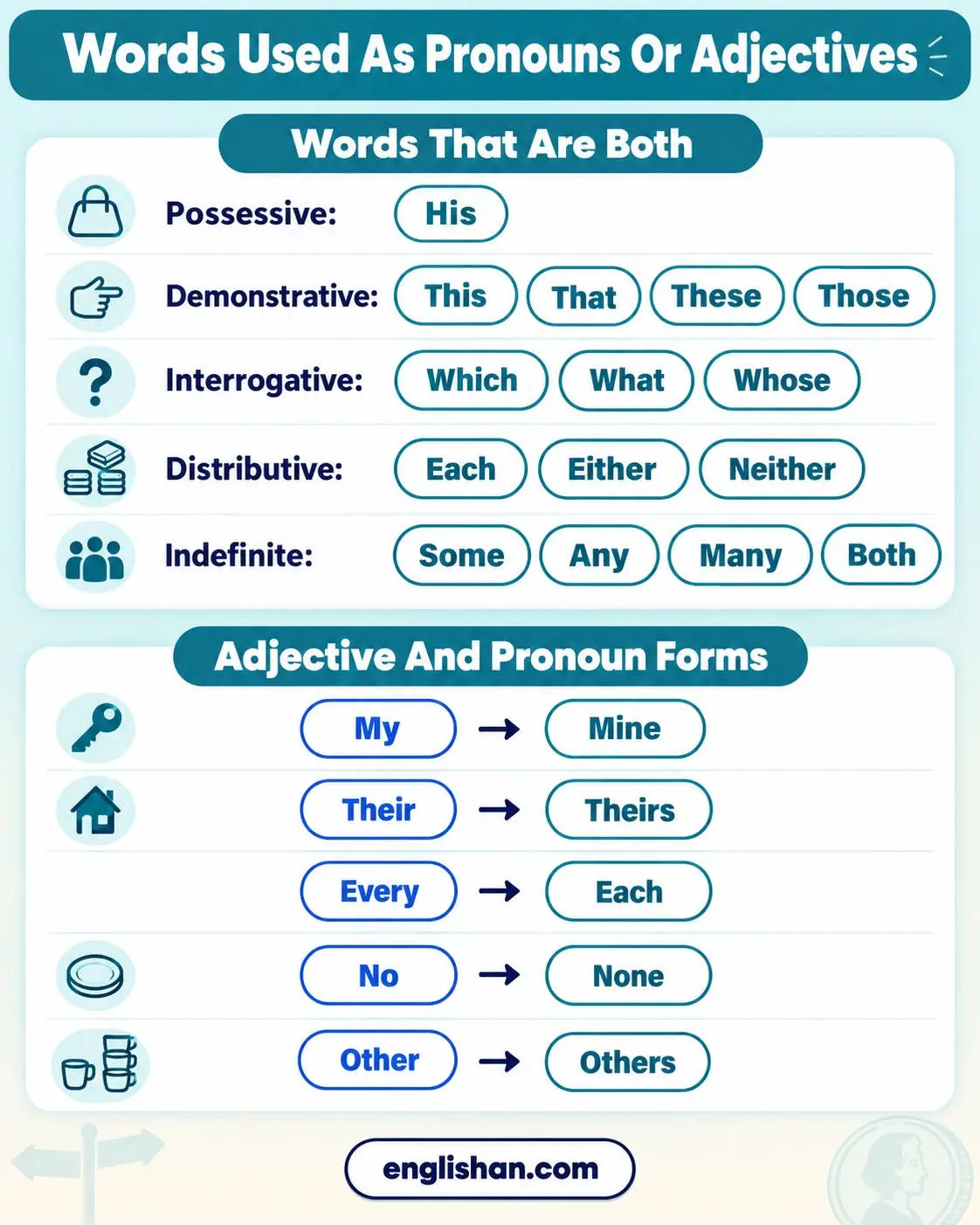
Yes, a pronoun can be an adjective when the same word comes before a noun. These words have one spelling for both uses:
| Word group | Words that are both |
|---|---|
| Possessive | His |
| Demonstrative | This, that, these, those |
| Interrogative | Which, what, whose |
| Distributive | Each, either, neither |
| Indefinite (quantity) | Some, any, all, both, many, much, few, little, several, enough, more, most, another |
A few adjectives take a different form as pronouns, and some words are adjectives only. The adjective form comes before a noun, and the pronoun form replaces the noun:
| Adjective only | Pronoun for the same meaning |
|---|---|
| My | Mine |
| Your | Yours |
| Her | Hers |
| Our | Ours |
| Their | Theirs |
| Every | Each, every one |
| No | None |
| Other (before a plural noun) | Others |
Personal pronouns like “I”, “she”, and “them” never come before a noun, and the articles “a”, “an”, and “the” never stand alone. Neither group belongs in the tables, because each has only one of the two uses.
Pronouns Used As Adjectives
A pronominal adjective, also called an adjective pronoun, is a word with a pronoun form that comes before a noun and shows which one, whose, or how many. The same word is also called a determiner, the word class that includes “the”, “my”, and “every”. A pronominal adjective identifies or counts the noun rather than describing its qualities, so in the pronoun vs adjective choice it follows the rules of determiners, not of descriptive adjectives like “new” or “heavy”:
- A pronominal adjective comes before any descriptive adjective, as in “these heavy boxes” and “each new player”.
- Pronominal adjectives have no “-er” or “-est” forms, except the quantity words “few” (fewer, fewest), “little” (less, least), and “many” and “much” (more, most).
- After a linking verb, a possessive word takes its pronoun form, so “The bike is mine” is correct, not “The bike is my”.
- Demonstrative and distributive adjectives agree with the noun in number: “this” and “each” take a singular noun, and “these” and “those” take a plural one.
Pronominal adjectives come in the same word groups as the pronouns themselves, and the question for all of them is whether a noun comes right after the word.
Possessive Pronoun Vs Adjective
Possessive adjectives come before a noun, and possessive pronouns stand alone in place of the noun and its owner. Most possessive words have two forms, so “my” becomes “mine” and “their” becomes “theirs” when no noun follows. The word “his” is the same before a noun and alone, while “her” alone is the object pronoun, not the possessive.
- My laptop is charging, so I borrowed hers.
- That jacket is his, and the scarf is hers.
Every pair, including “your” and “yours”, is set out in the lesson on possessive adjectives vs possessive pronouns.
Demonstrative Pronoun Vs Adjective
Demonstrative words have the same spelling as adjectives and as pronouns: “this” and “that” for one thing, “these” and “those” for more than one. Before a noun they are demonstrative adjectives, and on their own they are demonstrative pronouns. With the pronoun “one” after it, the word is an adjective again, as in “I’ll take this one.”
- That printer jams every morning.
- That is the printer I mean.
Number agreement, distance, and “this one” are taught in full under demonstrative adjectives vs demonstrative pronouns.
Interrogative Pronoun Vs Adjective
Interrogative adjectives come before a noun in a question, and the same words are interrogative pronouns when they stand alone. There are three interrogative words that are both adjectives and pronouns: “which”, “what”, and “whose”. The pronouns “who” and “whom” are never adjectives, so no noun comes after them.
- Which train goes to the airport?
- Which of these trains goes to the airport?
- What time does the meeting start?
- What did the manager say?
- Whose charger is this?
- Whose is this charger?
In the second question, “which” is a pronoun, because “of” comes after it, not a noun. The possessive question word is “whose” as an adjective and as a pronoun, and the contraction “who’s” is a common misspelling of it.
Who’s charger is this? ❌
Whose charger is this? ✅
The contraction “who’s” means ‘who is’, so a question about the owner takes “whose”.
Distributive Pronoun Vs Adjective
Distributive adjectives “each”, “either”, and “neither” come before a singular noun, and the distributive pronouns with the same spelling take a singular verb. The word “each” refers to the members of a group one at a time, while “either” and “neither” refer to one of two.
- Each guest received a room key.
- Each of the guests has a room key.
- Either date is fine for the dinner.
- I called two hotels, and neither had a free room.
The adjective “every” is close to “each” in meaning, but it is never a pronoun.
The rooms are booked, and every has a sea view. ❌
The rooms are booked, and each has a sea view. ✅
The pronoun for this meaning is “each” or “every one”, because “every” cannot stand alone.
Indefinite Pronoun Vs Adjective
Indefinite adjectives like “some”, “any”, “many”, and “several” show an amount or a number before a noun, and the same words are indefinite pronouns when the noun is left out. Examples from a busy morning at a bakery show both uses:
- Several customers asked for the lemon cake.
- Several asked for it again the next day.
- Are there any muffins left?
- Sorry, there aren’t any.
- Both bakers start work at five.
- Both of them start work at five.
Compound words like “someone”, “anything”, and “nobody” are indefinite pronouns only, because they already contain their noun. The words “no” and “other” have separate pronoun forms, “none” and “others”.
There were none muffins left. ❌
There were no muffins left. ✅
The adjective “no” comes before a noun, and the pronoun “none” stands alone or comes before “of”.
Others customers waited outside. ❌
Other customers waited outside. ✅
The adjective “other” has no “-s” before a plural noun, and “others” is the pronoun that replaces the noun.
Pronoun Or Adjective In A Sentence
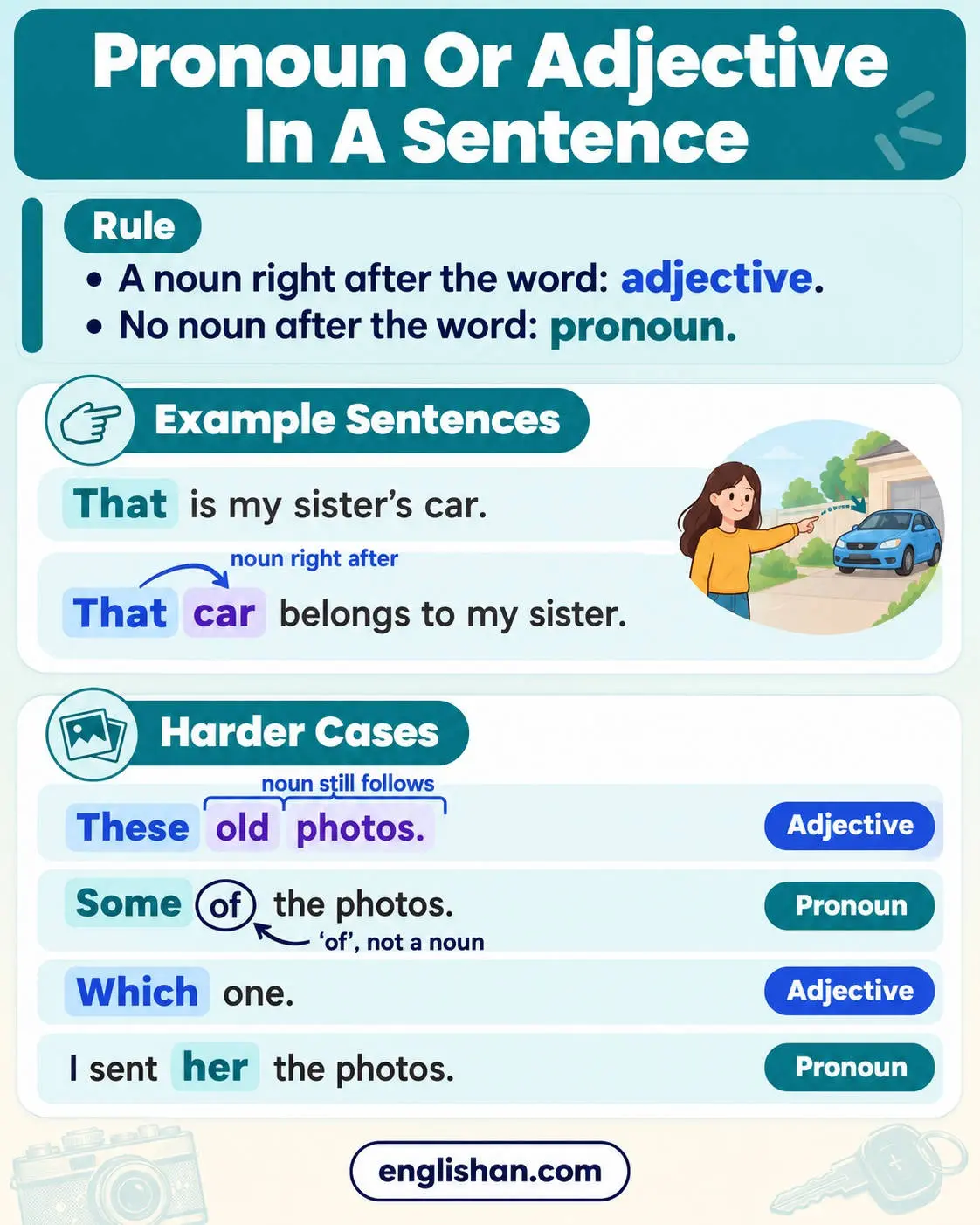
To settle a pronoun vs adjective question in a sentence, look at the word right after the one you are unsure of. A noun right after the word means it is an adjective, also called a determiner. If no noun follows, the word is a pronoun.
- That is my sister’s car.
- That car belongs to my sister.
The same rule applies in harder cases:
- A descriptive adjective between them: in “these old photos”, the noun “photos” still follows, so “these” is an adjective.
- “Of” after the word: in “some of the photos”, the word comes before “of”, not a noun, so “some” is a pronoun.
- The pronoun “one”: in “which one”, the word modifies “one”, so “which” is an adjective.
- “Her” before “the”: in “I sent her the photos”, the next word is “the”, so “her” is an object pronoun, while in “her photos” it is a possessive adjective.
FAQs
Yes, an adjective can describe a pronoun, usually after a linking verb such as "be", "seem", or "feel". In "She seems tired" and "They were happy", the adjective describes the subject pronoun.
Not before a personal pronoun, since "happy she" is not English. An adjective comes after an indefinite pronoun ending in "-one", "-body", or "-thing", as in "someone new" and "nothing special". The pronoun "one" takes its adjective before it, as in "the blue one".
Neither, in most sentences. In a question, "when" is an interrogative adverb ("When does the store open?"), and in a statement it is often a conjunction that joins two clauses ("Call me when you arrive"). It asks about time, so it does not replace a noun or come before one.
The word "one" is a pronoun when it replaces a noun, as in "I lost my pen, so I need a new one", and a number word that functions as an adjective before a noun, as in "one ticket". After "this", "that", or "which", the pronoun "one" stands for a singular count noun, as in "Which one do you want?"
Related:
- Types of Pronouns
- Noun vs Pronoun
- Indefinite Pronouns
- Who’s vs Whose
- What Do Pronouns Replace
- Relative vs Interrogative Pronouns
