

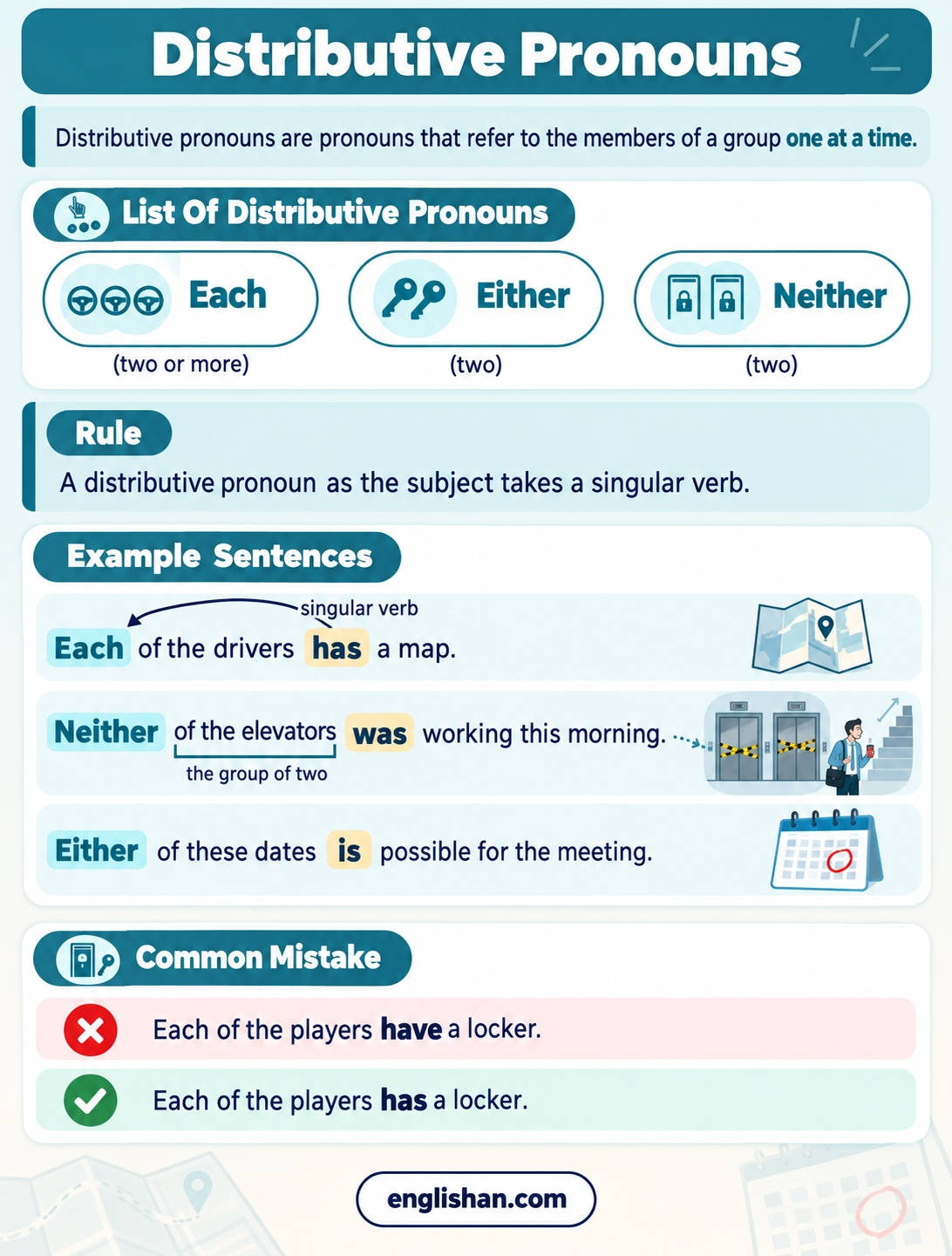
Distributive pronouns are pronouns that refer to the members of a group one at a time, not to the whole group together. There are three distributive pronouns in English: “each”, “either”, and “neither”.
A distributive pronoun replaces a noun phrase such as “each guest” or “either road” when the listener already knows the noun. The same three words can also come before a noun, and in that position they are distributive adjectives.
What Are Distributive Pronouns?
A distributive pronoun is a pronoun that replaces a noun and refers to the members of a group separately, so the sentence describes one member, then the next. The group follows “of” or is already known from the sentence before.
- The twins got new bikes, and each has a bell.
- There are two exits, and either leads to the parking lot.
- I tried on two jackets, but neither fit.
The meaning is clearest beside a pronoun for the whole group. The pronoun “all” refers to the rooms together, while “each” refers to them one by one:
- All of the rooms have a sea view.
- Each of the rooms has its own key.
The verb follows the meaning, with plural “have” after “all” and singular “has” after “each”.
List Of Distributive Pronouns
The list of distributive pronouns is short, and the words differ in the size of the group they refer to.
| Pronoun | Group size | Meaning | Example phrase |
|---|---|---|---|
| Each | Two or more | All members, taken one by one | Each of the guests |
| Either | Two | One or the other | Either of the roads |
| Neither | Two | Not one and not the other | Neither of the answers |
Several other words that refer to groups are not distributive pronouns. The word “every” is a distributive adjective only, so it comes before a noun. The words “both”, “all”, “any”, “none”, and “everyone” are indefinite pronouns, because they refer to a whole group together or to people and things in general.
Uses Of Distributive Pronouns
The choice of distributive pronoun depends on the number of members in the group and on whether the sentence is positive or negative.
The pronoun “each” refers to two or more members, one at a time. It is the only distributive pronoun for a group larger than two.
- The building has twelve floors, and each has a fire exit.
- I asked both sisters, and each gave a different answer.
The pronoun “either” refers to one member of a group of two, without saying which one. We use it in positive sentences, in questions, and after a negative verb such as “don’t”.
- You can take the bus or the train, and either is fine.
- Is either of your parents a teacher?
- I don’t like either of the two designs.
The pronoun “neither” means ‘not one and not the other’ of two. It already expresses the negative, so the verb after it stays positive.
- Neither of the printers works.
- I called both shops, but neither had the part.
Neither of my brothers didn’t come to the party. ❌
Neither of my brothers came to the party. ✅
A sentence with “neither” takes no second negative, so “didn’t” and “not” are wrong after it.
With a group of three or more, “any” replaces “either”, and “none” replaces “neither”.
You can choose either of the five colors. ❌
You can choose any of the five colors. ✅
The pronoun “either” refers to one of two, so a group of five takes “any”.
Examples Of Distributive Pronouns In Sentences
A distributive pronoun functions as a noun phrase, so it can be the subject of a verb, the object of a verb, or the object of a preposition. The position of the pronoun shows its function.
As the subject: The pronoun comes before the verb, often with “of” and the group after it.
- Each of the drivers has a map.
- Neither was ready on time.
- Either of these dates is possible for the meeting.
As the object: The pronoun comes after the verb or after a preposition.
- I bought two lamps but kept neither.
- She thanked each of the volunteers by name.
- The coach spoke to each in turn.
After a plural subject: The pronoun “each” can also come after a plural subject, after the verb “be”, or after an auxiliary verb.
- The children each have a lunch box.
- We were each given a badge.
- They have each paid twenty dollars.
Distributive Pronouns With Of
Distributive pronouns are often followed by “of” and a plural noun phrase that names the group. The noun after “of” takes a determiner such as “the”, “my”, or “these”, or the group is an object pronoun such as “us”, “you”, or “them”.
- Each of the apartments has two bedrooms.
- Either of my neighbors can water the plants.
- Neither of us knew the answer.
- I’ve read each of these reports twice.
The phrase “each one of” is also correct and adds emphasis, as in “Each one of the tickets was checked.”
Each of students passed the test. ❌
Each of the students passed the test. ✅
After “of”, the plural noun takes a determiner, so “of students” becomes “of the students”.
Singular Verb Agreement With Distributive Pronouns
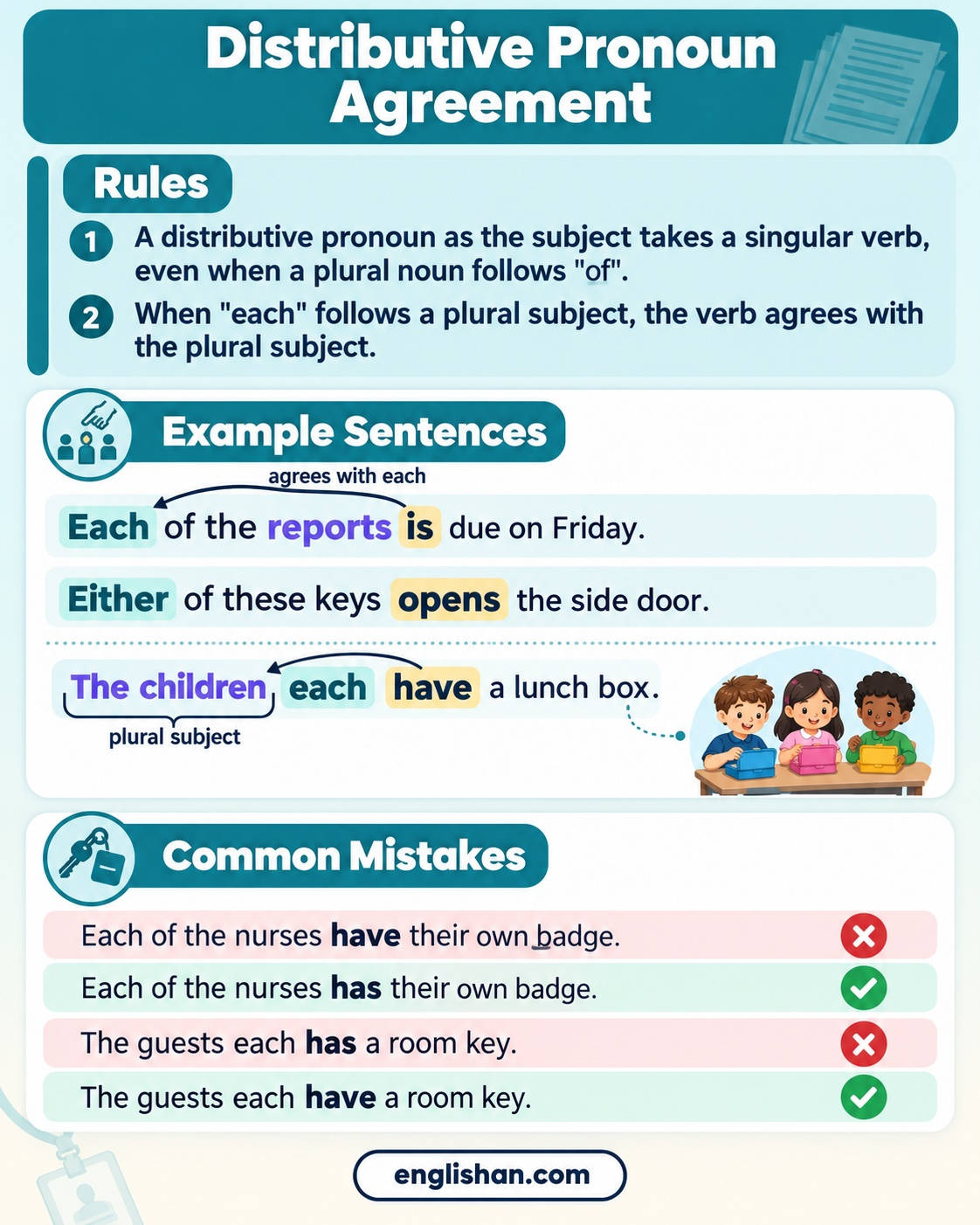
A distributive pronoun that is the subject of a sentence takes a singular verb, even when a plural noun follows “of”. The verb agrees with “each”, “either”, or “neither”, not with the plural noun closest to it.
- Each of the reports is due on Friday.
- Neither of the elevators was working this morning.
- Either of these keys opens the side door.
- Has either of you seen my charger?
Each of the players have a locker. ❌
Each of the players has a locker. ✅
The subject is “each”, which is singular, so the verb is “has”.
With “either of” and “neither of”, a plural verb is common in informal speech, as in “Neither of them were there.” In writing, the singular verb is the standard form: “Neither of them was there.”
The verb changes when “each” follows a plural subject. In that position, the verb agrees with the plural subject, and “each” adds only the meaning ‘one by one’.
The guests each has a room key. ❌
The guests each have a room key. ✅
The subject is “the guests”, so the verb is plural.
Pronoun Agreement After Distributive Pronouns
A pronoun later in the sentence often refers back to a distributive pronoun. The word it refers back to is its antecedent, and the later pronoun agrees with that antecedent in meaning.
The later pronoun is “its” for things, and “his” or “her” for a group of people of one known gender. With people in general, both “their” and “his or her” are standard. The pronoun “their” is the usual choice in speech and in most writing, and “his or her” is common in formal writing.
- Each of the laptops has its own charger.
- Neither of the boys remembered his passport.
- Either of the applicants can bring their portfolio.
- The manager gave each of the new staff his or her own desk.
Each of the nurses have their own badge. ❌
Each of the nurses has their own badge. ✅
The plural pronoun “their” does not change the verb, which still agrees with the singular subject “each”.
Distributive Pronouns Vs Distributive Adjectives
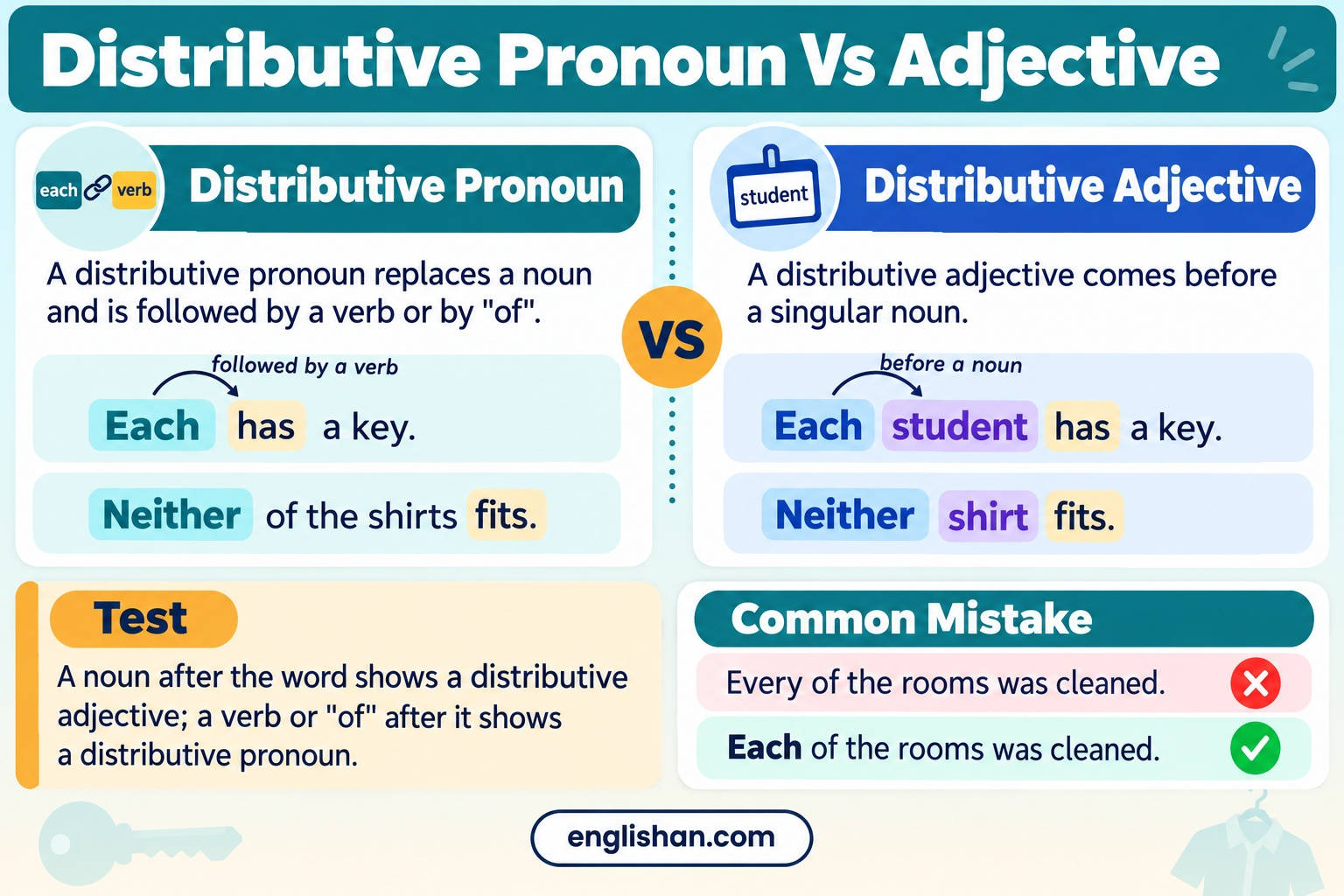
The words “each”, “either”, and “neither” are distributive pronouns when they replace a noun and distributive adjectives when they come before a noun. In both uses they refer to the members of a group one at a time and take a singular verb. A distributive pronoun is followed by a verb or by “of”, and a distributive adjective is followed by a singular noun.
- Each has a key. (pronoun)
- Each student has a key. (adjective)
- Neither of the shirts fits. (pronoun)
- Neither shirt fits. (adjective)
Distributive adjectives are also called distributive determiners. To find the word class, look at the next word: a noun after it shows a distributive adjective, and a verb or “of” after it shows a distributive pronoun.
The word “every” is a distributive adjective only. It always comes before a noun or before “one”, so it never replaces a noun by itself.
Every of the rooms was cleaned. ❌
Each of the rooms was cleaned. ✅
Before “of”, the correct word is the pronoun “each” or the phrase “every one”.
Distributive Pronouns Vs Indefinite Pronouns
Distributive pronouns and indefinite pronouns both refer to people or things without naming them. A distributive pronoun refers to the members of a known group one at a time, and an indefinite pronoun refers to people or things in general or to a whole group.
- Each of my colleagues sent a message. (members of a known group)
- Everyone sent a message. (people in general)
- Either of the two dates is possible. (one of two)
- Any of the five dates is possible. (one of several)
The indefinite pronouns “everyone” and “nobody” take a singular verb too, but they are not followed by “of” and a group. With a named group, the pronoun is “each of” or “none of”.
Everyone of my friends came. ❌
Each of my friends came. ✅
The pronoun “everyone” is not followed by “of”, so a sentence that names the group after “of” takes “each”.
Distributive Pronouns Vs Reciprocal Pronouns
A reciprocal pronoun shows that two or more people do the same action to the others in the group. The two reciprocal pronouns are “each other” and “one another”. A distributive pronoun refers to the members of a group one at a time, and the action does not pass between them.
- Each of the brothers sent a card. (one card from every brother)
- The brothers sent each other a card. (cards between the brothers)
The phrase “each other” is a reciprocal pronoun, not a distributive pronoun. It functions as an object and never as the subject of a sentence.
FAQs
The word "none" is an indefinite pronoun with a distributive meaning, because it refers to the members of a group one at a time in the same way as "neither". The two words differ in group size: "neither" refers to two, and "none" refers to three or more. Compare "Neither of my parents smokes" with "None of my cousins smokes."
A demonstrative pronoun shows which person or thing the speaker means, often by distance, as in "That is my seat." The demonstrative pronouns are "this", "that", "these", and "those". A distributive pronoun refers to the members of a group one at a time, as in "Each of us has a seat."
No, in "neither … nor" the word "neither" is part of a correlative conjunction, a pair of words that joins two parts of a sentence. An example is "Neither Sam nor Ana was late." The distributive pronoun "neither" replaces a noun and is often followed by "of", as in "Neither of them was late."
Not in that position: "each" after a price or an amount is an adverb meaning ‘for each one’. The pronoun "each" replaces a noun and functions as the subject or the object, as in "Each costs ten dollars."
Related:
- Pronouns
- Types of Pronouns
- Interrogative Pronouns
- Dummy Pronouns
- Either Or vs Neither Nor
- Common Pronoun Errors
- Indefinite Pronouns Singular or Plural
- Pronoun and Verb Agreement
- Pronoun Antecedent Agreement
- Pronoun vs Adjective
