

Pronoun antecedent agreement is the rule that a pronoun matches its antecedent in number, person, and gender. The antecedent is the noun or noun phrase that the pronoun replaces, so a singular antecedent such as “the bakery” takes “it” and “its”, and a plural antecedent such as “the bakers” takes “they” and “their”.
Most agreement errors come from antecedents whose number is not obvious at first sight. Nouns joined by “and” or “or”, collective nouns, and indefinite pronouns each follow their own rule, and a phrase between the antecedent and the pronoun can hide the real antecedent. In every case, the pronoun agrees with the word it replaces, which is not always the noun right before it.
What Is Pronoun Antecedent Agreement?
Pronoun antecedent agreement is the match between a pronoun and its antecedent: the same number, the same person, and, in the third person singular, the same gender. An antecedent is the word or group of words that a pronoun replaces, and it usually comes earlier in the sentence or in the sentence before.
- Marta called, and she wants the report by noon.
- The tickets are on the table, so don’t forget them.
- My neighbors sold their house last month.
- The printer is jammed again because it needs a new part.
To find the antecedent, ask which noun the pronoun replaces. In the last example, “it” replaces “the printer”, so the pronoun is singular and takes “needs”. A pronoun with two possible antecedents, as in “Sam told Leo that he was late”, is a vague pronoun reference rather than an agreement error, because “he” agrees with both nouns.
Pronoun Antecedent Agreement Rules
Pronouns must agree with their antecedents in three ways: in number, in person, and in gender. Number is singular or plural, person is first, second, or third, and gender separates “he”, “she”, and “it”. Personal pronouns, with their possessive and reflexive forms, change for all three, so agreement errors appear mostly in these forms.
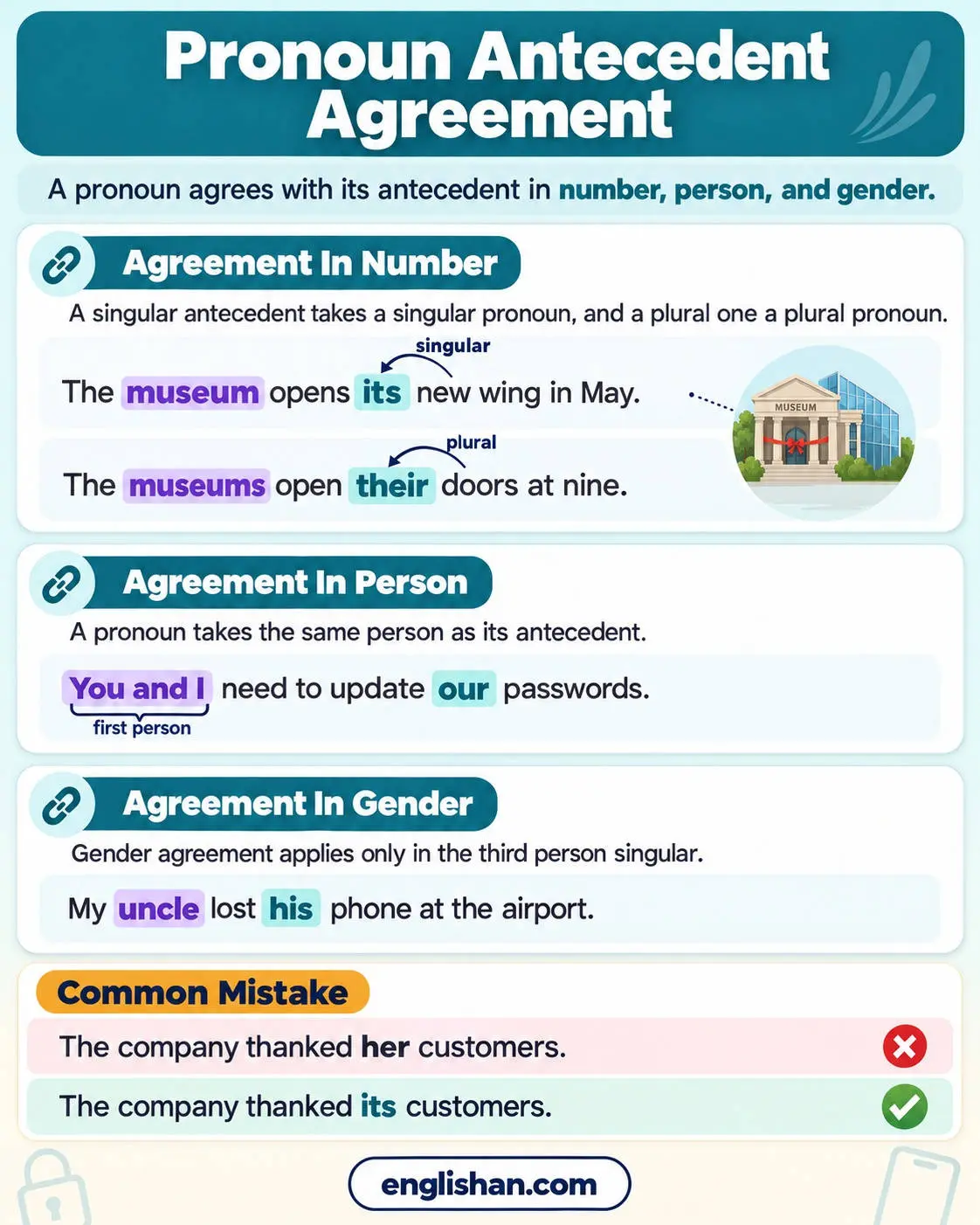
Agreement In Number
A singular antecedent takes a singular pronoun, and a plural antecedent takes a plural pronoun. Number agreement applies to the subject, object, possessive, and reflexive forms of the pronoun.
- The museum opens its new wing in May.
- The museums open their doors at nine.
- Daniel taught himself to cook.
- The kids made the cake themselves.
Some nouns end in “-s” but are singular, such as “news”, “physics”, and “the United States”, so they take “it”. Nouns for things with two parts, such as “jeans” and “scissors”, are plural and take “they” or “them”.
The news was bad, but they didn’t surprise me. ❌
The news was bad, but it didn’t surprise me. ✅
The noun “news” is singular, so the pronoun that replaces it is “it”.
Agreement In Person
A pronoun takes the same person as its antecedent. A noun antecedent is third person, so the pronoun that replaces it is “he”, “she”, “it”, or “they”. The exception is a noun of direct address, as in “Students, take your seats”, which takes “you” and “your”.
- Students who miss the exam must contact their teacher.
- I packed my own lunch.
- We introduced ourselves to the new manager.
When a compound antecedent mixes persons, the pronoun is first person if any part is first person, and second person if any part is second person. A compound of “you and I” takes “we” and “our”, and one of “you and Sam” takes “you” and “your”.
- You and I need to update our passwords.
- You and Sam can leave your bags here.
- Lena and I booked our flights together.
A pronoun shift is the error of starting a sentence in the third person and moving to “you” halfway through it.
A new employee should bring your ID on the first day. ❌
A new employee should bring their ID on the first day. ✅
The antecedent “a new employee” is third person, so the pronoun that replaces it is third person too.
Agreement In Gender
Gender agreement applies only in the third person singular. A male antecedent takes “he”, “him”, and “his”, a female antecedent takes “she”, “her”, and “hers”, and a thing takes “it” and “its”.
- My uncle lost his phone at the airport.
- The actress thanked her fans.
- The bridge reopened after its repairs.
An animal usually takes “it”, but a pet or an animal whose sex the speaker knows often takes “he” or “she”, as in “Our dog hurt her paw”. For a person whose gender is unknown or not stated, the antecedent takes “he or she” in formal writing or singular “they” in most other writing.
The company thanked her customers. ❌
The company thanked its customers. ✅
A company is a thing in grammar, so its possessive pronoun is “its”.
Compound Antecedents
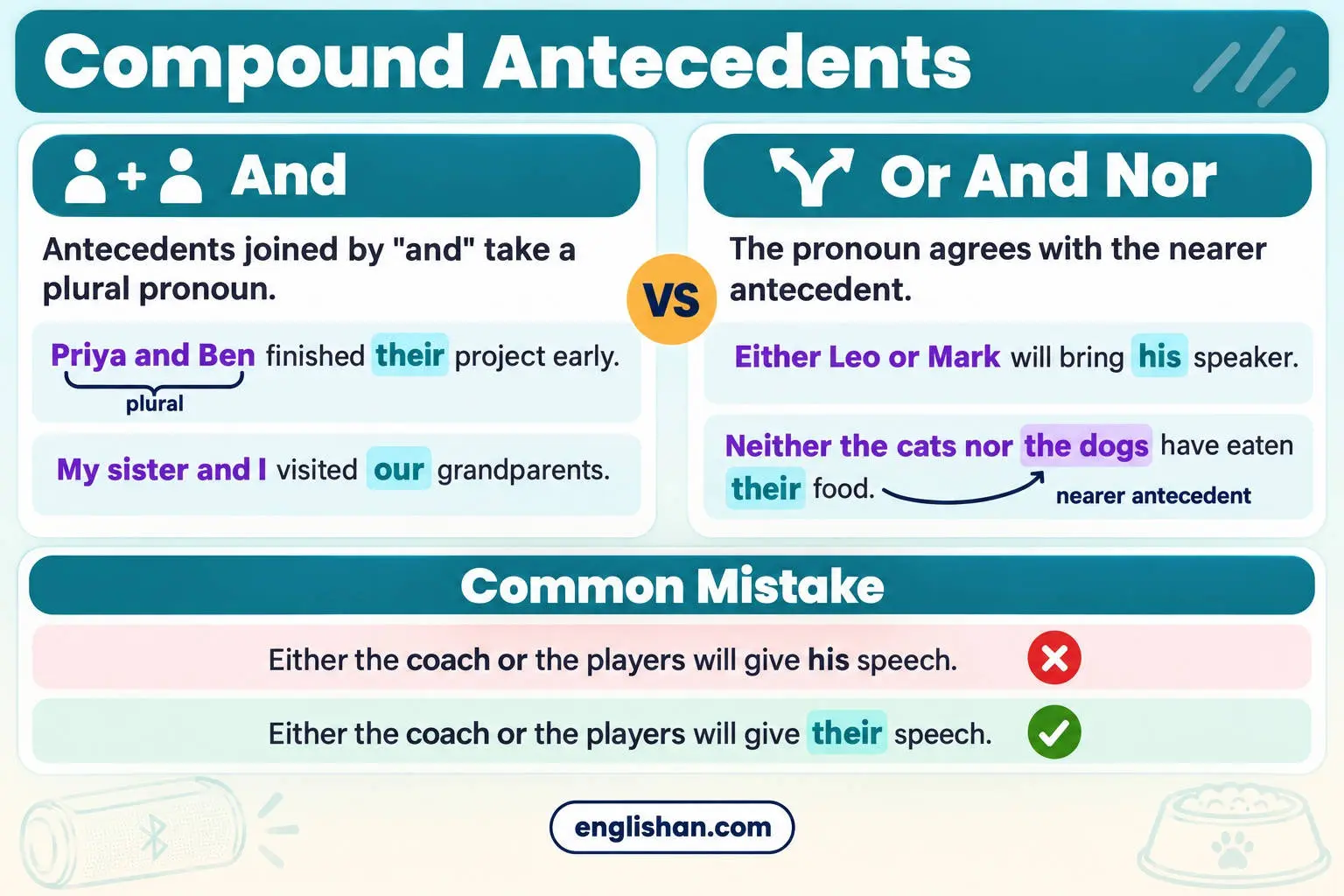
A compound antecedent is two or more nouns or pronouns joined by “and”, “or”, or “nor”. The number of the pronoun depends on the conjunction: “and” adds the nouns together, while “or” and “nor” join choices, so the pronoun agrees with only one of them. When the compound antecedent is also a compound subject, the same conjunction shows whether the verb is singular or plural.
Antecedents Joined By And
Antecedents joined by “and” take a plural pronoun, even when each noun is singular.
- Priya and Ben finished their project early.
- The table and the chairs have lost their shine.
- My sister and I visited our grandparents.
The exception is a compound that names one person or thing, such as “my friend and neighbor” for one person, or “macaroni and cheese” for one dish. A compound after “each” or “every” is singular too, as in “Every chair and table has its own number”.
Tom and Ana forgot his tickets. ❌
Tom and Ana forgot their tickets. ✅
The antecedent “Tom and Ana” names two people, so the pronoun is plural.
Antecedents Joined By Or And Nor
With antecedents joined by “or”, “either … or”, or “neither … nor”, the pronoun agrees with the antecedent nearer to it. With two singular antecedents the pronoun is singular, and with two plural antecedents it is plural.
- Either Leo or Mark will bring his speaker.
- Neither the cats nor the dogs have eaten their food.
- The manager or the interns will present their reports.
- Neither the interns nor the manager finished her report.
Where a singular and a plural antecedent are mixed, the plural antecedent usually goes second, so the pronoun after it is plural. The last example is correct, but “Neither the manager nor the interns finished their reports” is the more usual order.
Either the coach or the players will give his speech. ❌
Either the coach or the players will give their speech. ✅
The nearer antecedent is “the players”, which is plural, so the pronoun is “their”.
Collective Nouns As Antecedents
A collective noun names a group of people or things as one unit, such as “team”, “family”, “class”, “company”, and “government”. In American English, a collective noun is usually singular, so it takes “it” and “its”. In British English, a plural pronoun is also common when the sentence is about the members of the group.
- The team won its first game. (American English)
- The team are celebrating their win. (British English)
- Our committee has made its decision.
- My family brought their own chairs to the picnic.
The last example is about the members, who each bring a chair, so “their” is used in both varieties of English. Whichever number you choose, keep the verb and the pronoun in the same number in one sentence.
The jury has reached their verdict. ❌
The jury has reached its verdict. ✅
The verb “has” is singular, so the pronoun for “the jury” is singular too.
A number of: The phrase “a number of” means ‘several’ and takes a plural pronoun, as in “A number of guests left their coats”. The phrase “the number of” refers to the number itself and takes “it”, as in “The number of guests doubled, and it keeps growing”.
Indefinite Pronouns As Antecedents
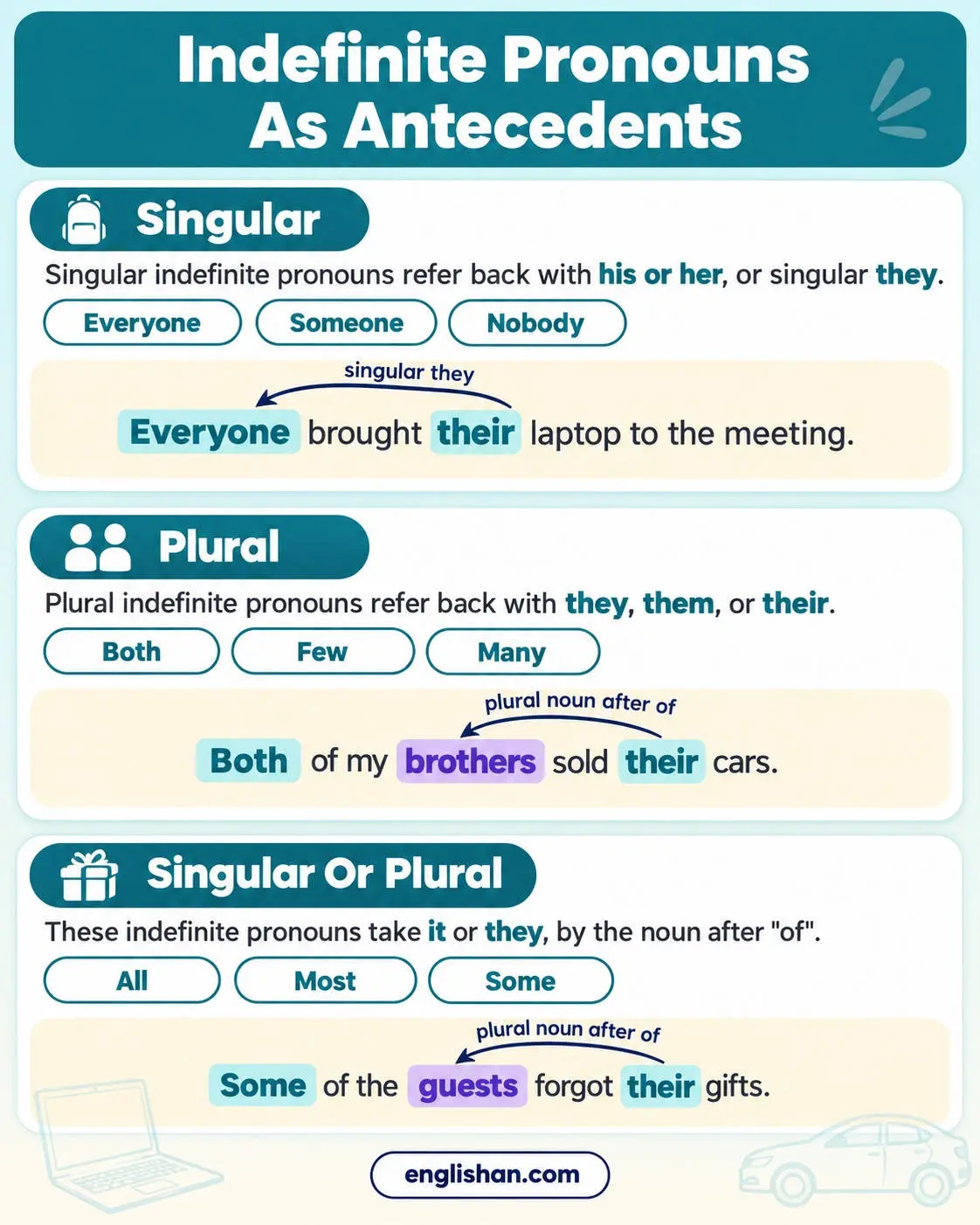
An indefinite pronoun is a pronoun such as “everyone”, “somebody”, or “each” that refers to people or things in general without naming them. When an indefinite pronoun is the antecedent, pronoun antecedent agreement follows the number of the indefinite pronoun.
| Indefinite pronoun | Number | Pronoun that refers back |
|---|---|---|
| Everyone, everybody, someone, somebody, anyone, anybody, no one, nobody | Singular | His or her, or singular “they” |
| Each, either, neither, one | Singular | It, his or her, or singular “they” |
| Everything, something, anything, nothing | Singular | It |
| Both, few, many, several | Plural | They, them, their |
| All, any, more, most, none, some | Singular or plural | It or they, depending on the noun after “of” |
- Everyone brought their laptop to the meeting.
- Everyone brought his or her laptop to the meeting. (formal writing)
- Something is wrong with the heater, so it needs a check.
- Both of my brothers sold their cars.
- Some of the milk has lost its freshness.
- Some of the guests forgot their gifts.
Indefinite pronouns for people, such as “everyone”, take a singular verb, but the pronoun that refers back to them is usually “they” or “their”. In formal writing, “his or her” is the traditional singular choice, and repeated “his or her” is often replaced with a plural antecedent: “All the students brought their laptops”. The verb after an indefinite pronoun has its own rules, which depend on whether the word is singular or plural, so “everyone” takes “is” and “both” takes “are”.
Each of the students: In “each of the students”, the antecedent is “each”, not “students”, so the pronoun is singular: “his or her” in formal writing and singular “their” in most other writing.
Each of the students handed in its essay. ❌
Each of the students handed in their essay. ✅
Each student is a person, so the pronoun cannot be “its”.
One: In formal writing, “one” for people in general is followed by “one’s”, as in “One should keep one’s promises”. In everyday English, “you” and “your” replace both forms.
Singular They And Pronoun Antecedent Agreement
Singular “they” is the pronoun “they” used for one person whose gender is unknown or not stated. It follows antecedents such as “someone”, “anyone”, “a student”, “the caller”, and “each applicant”, and it has the full set of forms: “they”, “them”, “their”, “theirs”, and usually “themselves”.
- Someone left their umbrella on the bus.
- If a customer calls, ask them to leave a number.
- The winner will collect their prize on Friday.
- Each applicant must sign the form themselves.
Singular “they” takes a plural verb, as singular “you” does: “they are”, “they were”, and “they have”, even for one person. The pronoun still refers to one person, so the antecedent stays singular, and its own verb stays singular: “The caller says they are outside”.
Someone called, but they was gone before I answered. ❌
Someone called, but they were gone before I answered. ✅
Singular “they” takes the plural verb form, so the past of “be” is “were”.
Antecedents With An Intervening Phrase
An intervening phrase is a phrase that comes between the antecedent and the pronoun, usually a prepositional phrase beginning with “of”, “with”, or “in”. The pronoun agrees with the antecedent, not with the noun inside the phrase.
- A box of old photos lost its lid.
- Members of the club paid their fees.
- The price of the new phones has lost its appeal for buyers.
- The owner of the two shops runs her business from home.
In pronoun antecedent agreement, the noun closest to the pronoun is often the wrong one. Ask which noun the pronoun really replaces, and leave out the phrase between them: “the box lost its lid”.
The list of guests had lost their first page. ❌
The list of guests had lost its first page. ✅
The antecedent is “the list”, which is singular, so the pronoun is “its”, even though “guests” comes right before it.
FAQs
Singular: "everything" means all things as one whole, so it takes a singular verb and the pronoun "it". The sentence "Everything is ready, and it looks great" is correct. The plural "they" does not refer back to "everything".
In "The bus was late because it broke down", the antecedent of "it" is "the bus". An antecedent can be a name, a noun phrase, or another pronoun, as in "Everyone did their best", where "everyone" is the antecedent of "their".
Usually, but not always. In a sentence that opens with a dependent clause, the pronoun can come first: "When she got home, Maria made dinner". This order is usual when the pronoun is in a clause at the start of the sentence and the antecedent is the subject of the main clause.
Yes, "which", "this", and "that" can refer back to a whole clause or sentence. In "He missed the bus, which made him late", the antecedent of "which" is the clause "he missed the bus". A pronoun with a whole clause as its antecedent is singular, so it takes a singular verb.
Yes, in two ways. The relative pronoun "who" replaces a person and "which" replaces a thing, while "that" replaces either. The verb after the relative pronoun agrees with its antecedent: "the girl who sings" but "the girls who sing".
Related:
- Pronouns
- Types of Pronouns
- What Do Pronouns Replace
- Singular and Plural Pronouns
- Third Person Pronouns
- Indefinite Pronouns Singular or Plural
- Pronoun and Verb Agreement
- Pronoun Rules and Correct Usage
- Common Pronoun Errors