

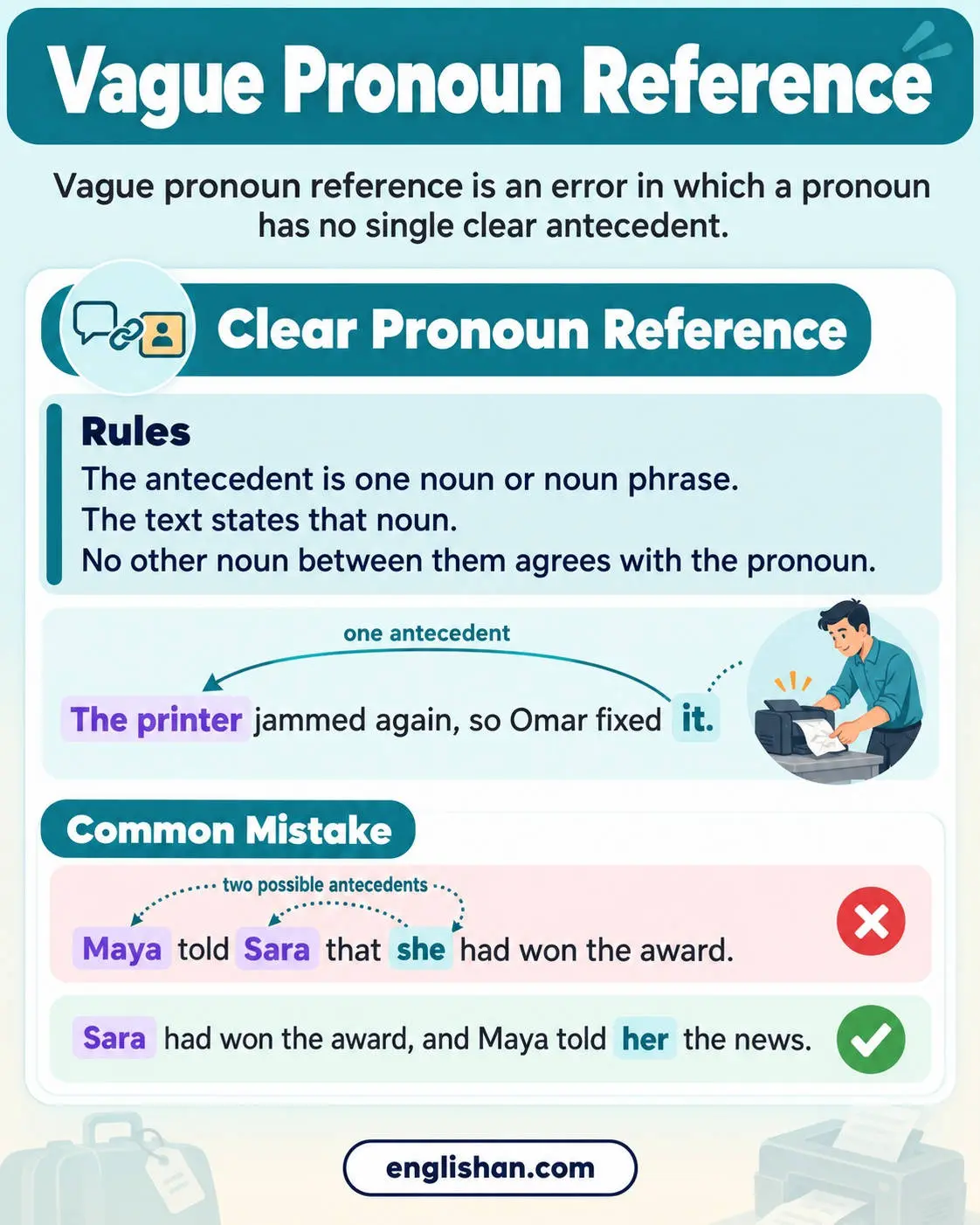
Vague pronoun reference is an error in which a pronoun has no single clear antecedent, the noun or noun phrase the pronoun replaces. A pronoun such as “she”, “it”, or “this” has no meaning of its own, so the reader takes its meaning from the antecedent.
Clear pronoun reference is the opposite case: the pronoun refers to one noun that the reader finds at once, usually in the same sentence or the sentence before. Pronoun clarity depends on that one noun, because a pronoun with two possible antecedents, or with none, leaves the reader to guess who or what the sentence is about.
What Is Vague Pronoun Reference?
A vague pronoun reference is a pronoun whose antecedent is unclear, missing, or too far away. Pronoun reference is the link between a pronoun and its antecedent. The link is clear under three conditions: the antecedent is one noun or noun phrase, the text states that noun, and no other noun between them agrees with the pronoun.
- Our neighbor lent us her ladder.
- The printer jammed again, so Omar fixed it.
- The twins missed the bus because they overslept.
In each of these sentences only one noun agrees with the pronoun. The pronoun “her” can refer only to “our neighbor”, and “it” only to “the printer”, because “Omar” is a person and takes “he”. A sentence with two nouns of the same number and gender loses that certainty.
Vague Pronoun Words
Any pronoun can become vague, but some pronouns appear in vague pronoun reference far more often than others. The table lists each one with the condition for unclear reference.
| Pronouns | Reference becomes unclear when |
|---|---|
| He, him, his, she, her | Two people of the same gender come before the pronoun |
| It, its | Two singular things come before it, or no noun is stated |
| They, them, their | Two plural nouns come before it, or the group is never named |
| This, that, these, those | The pronoun refers to a whole idea with several parts |
| Which | The clause before has a noun and a whole idea, and either can be the antecedent |
The words “this”, “that”, “these”, and “those” are demonstrative pronouns. The word “which” is a relative pronoun, and both kinds often refer to a whole clause, so they are the usual words in broad reference.
Types Of Vague Pronoun Reference
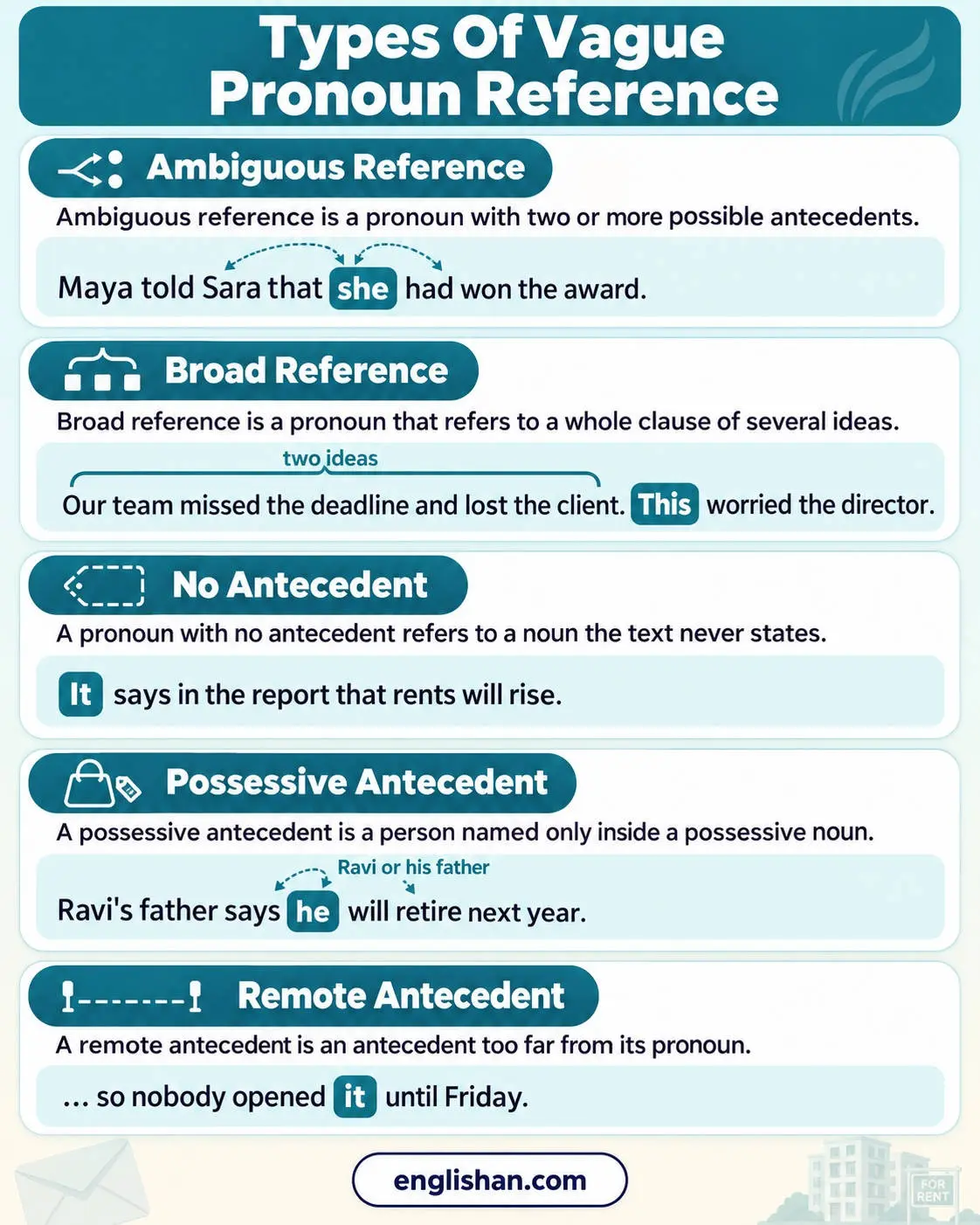
There are five main types of vague pronoun reference: ambiguous reference, broad reference, a pronoun with no antecedent, a possessive noun as the antecedent, and a remote antecedent. Each type breaks one of the conditions for clear reference, so each one has its own fix.
Ambiguous Pronoun Reference
Ambiguous pronoun reference is a pronoun with two or more possible antecedents. The nouns before the pronoun agree with it in number and gender, so the grammar of the sentence does not choose between them.
- Maya told Sara that she had won the award.
- When the manager met the new designer, he looked nervous.
- The laptop fell onto the tablet, and it cracked.
- Leave the cups on the trays until they are dry.
A reader cannot rely on word order here. The pronoun does not always refer to the subject of the sentence, and it does not always refer to the nearest noun, so in “Maya told Sara that she had won the award” either woman can be the winner.
Maya told Sara that she had won the award. ❌
Sara had won the award, and Maya told her the news. ✅
When two nouns agree with the pronoun, rephrase the sentence so only one noun can be the antecedent.
Broad Pronoun Reference
Broad pronoun reference is an error in which “this”, “that”, “which”, or “it” refers to a whole idea when the clause before contains more than one idea. The reader knows the pronoun refers to something in the earlier clause but not to which part of it.
- Our team missed the deadline and lost the client. This worried the director.
- Nadia’s flight was delayed, and her bag went to Lisbon. That ruined her first day.
- The school changed the timetable and the uniform, which upset many parents.
A pronoun that refers to a single clear idea is standard English. In “The train was late, which annoyed everyone”, “which” refers to the whole clause “the train was late”, and no other reading exists. The reference turns broad only when the earlier clause offers two or more ideas, or a noun and a clause, as possible antecedents.
Our team missed the deadline and lost the client. This worried the director. ❌
Our team missed the deadline and lost the client. This loss worried the director. ✅
With a noun after it, “this” becomes a demonstrative adjective, and the noun names the exact idea the sentence refers to.
Pronouns With No Antecedent
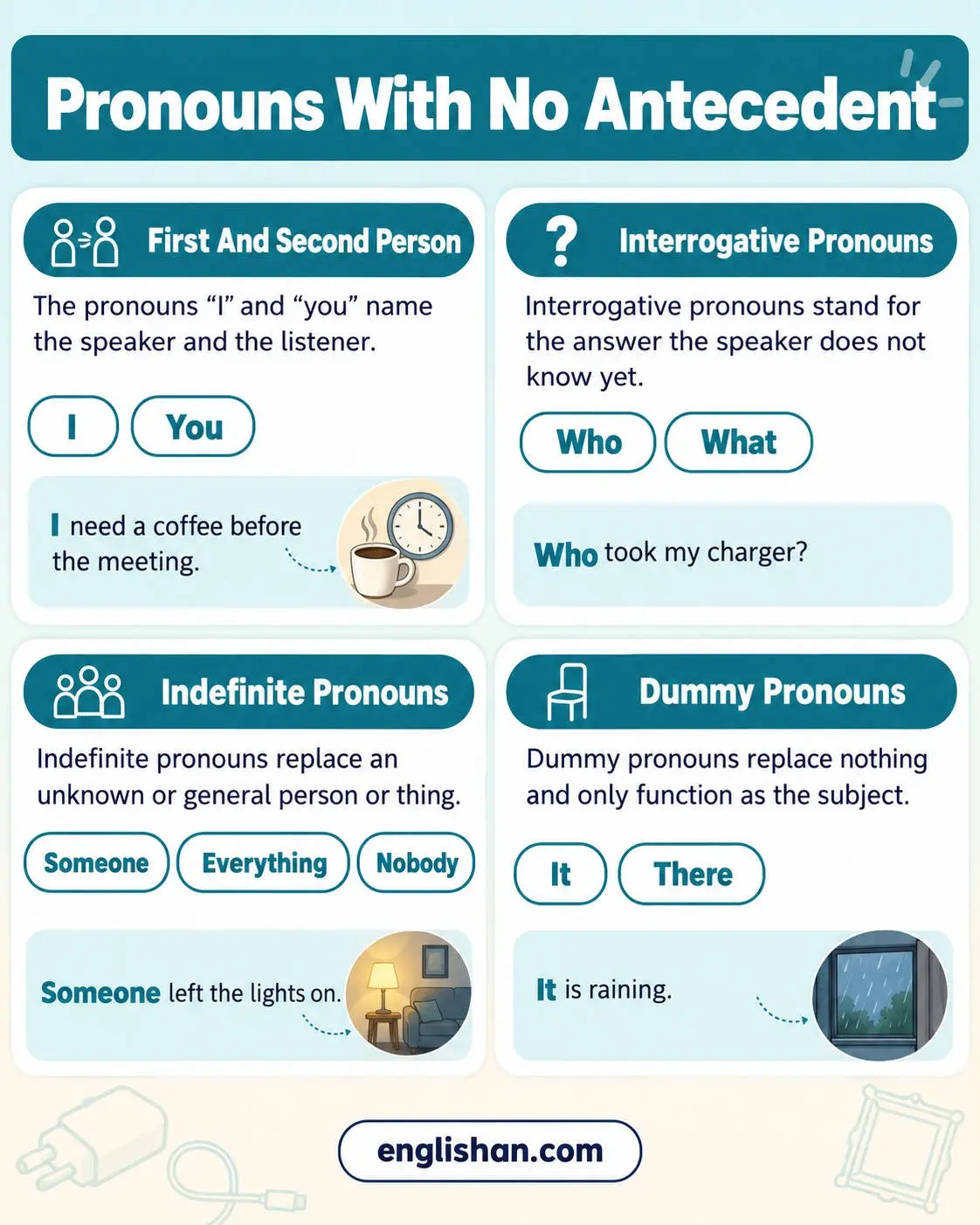
A pronoun with no antecedent refers to a noun that the text never states. The two common forms are “they” for an unnamed group, as in “They say…”, and “it” for an unnamed source, as in “It says in the article…”.
- They say the new bridge opens in May.
- At the bank, they charged me a fee for the transfer.
- It says in the report that rents will rise.
- My aunt is a nurse, and I want to study it too.
The last example has an implied antecedent: “it” refers to nursing, but the sentence contains only “nurse”, a person. A pronoun replaces a noun the text contains, not a noun the reader builds from another word.
It says in the report that rents will rise. ❌
The report says that rents will rise. ✅
Make the source or the group the subject of the sentence, so the noun replaces the pronoun with no antecedent: “The bank charged me a fee” and “The city council says the bridge opens in May”.
Possessive Nouns As Antecedents
A possessive noun such as “Leo’s” or “the company’s” can be the antecedent of a pronoun in standard English. In “Nina’s brother lent her his car”, “her” refers to Nina, and the sentence is clear because Nina is the only woman in it.
- In Leo’s report, he argues that the plan costs too much.
- Ravi’s father says he will retire next year.
- The company’s director said it would hire ten new staff.
The reference becomes unclear in two conditions. First, the possessive noun comes before another noun of the same gender, so “he” in “Ravi’s father says he will retire” can mean Ravi or his father. Second, the person is named only inside the possessive, while the subject pronoun refers to that person, as in “In Leo’s report, he argues…”. In formal writing, the usual fix names the person as a full noun.
In Leo’s report, he argues that the plan costs too much. ❌
In his report, Leo argues that the plan costs too much. ✅
Make the person the subject of the clause, with the possessive “his” before “report”, so the antecedent of every pronoun is a full noun.
Remote Antecedents
A remote antecedent is an antecedent too far from its pronoun, usually two or more sentences back, with other nouns in between. A pronoun is clearest in the same sentence as its antecedent or in the sentence after it.
- A letter from the bank arrived on Monday. My parents were away, and the neighbors were on holiday, so nobody opened it until Friday.
- The museum bought a painting last spring. Visitors, guides, and students crowded the rooms all summer. In October, it went on display.
In the second example “it” agrees with “the painting” and “the museum”, and three plural nouns stand between the pronoun and both of them. By the time the reader reaches “it”, the antecedent is out of view.
The museum bought a painting last spring. Visitors, guides, and students crowded the rooms all summer. In October, it went on display. ❌
The museum bought a painting last spring. Visitors, guides, and students crowded the rooms all summer. In October, the painting went on display. ✅
When a pronoun is more than a sentence away from its antecedent, repeat the noun.
Fixes For Unclear Pronoun Reference
There are three main fixes for unclear pronoun reference: repeat the noun, rephrase the sentence, or add a noun after “this” or “that”. The fix depends on the type of error.
| Fix | Type of error it fixes |
|---|---|
| Repeat the noun | Ambiguous reference, remote antecedent |
| Rephrase the sentence | Ambiguous reference, no antecedent, possessive antecedent |
| Add a noun after “this” or “that” | Broad reference |
In “The engineer called the supplier after he missed the delivery”, the pronoun “he” agrees with both men. Repeating the noun or rephrasing the sentence leaves one reading:
- The engineer called the supplier after the supplier missed the delivery. (repeated noun)
- The supplier missed the delivery, so the engineer called him. (rephrased)
In the rephrased sentence, “him” cannot refer to “the engineer”, the subject of its own clause, because that reading takes “himself”. A demonstrative pronoun takes the third fix, a noun after it, as in “Our flight was canceled twice. This delay cost us a whole day.”
Pronoun Clarity And Agreement
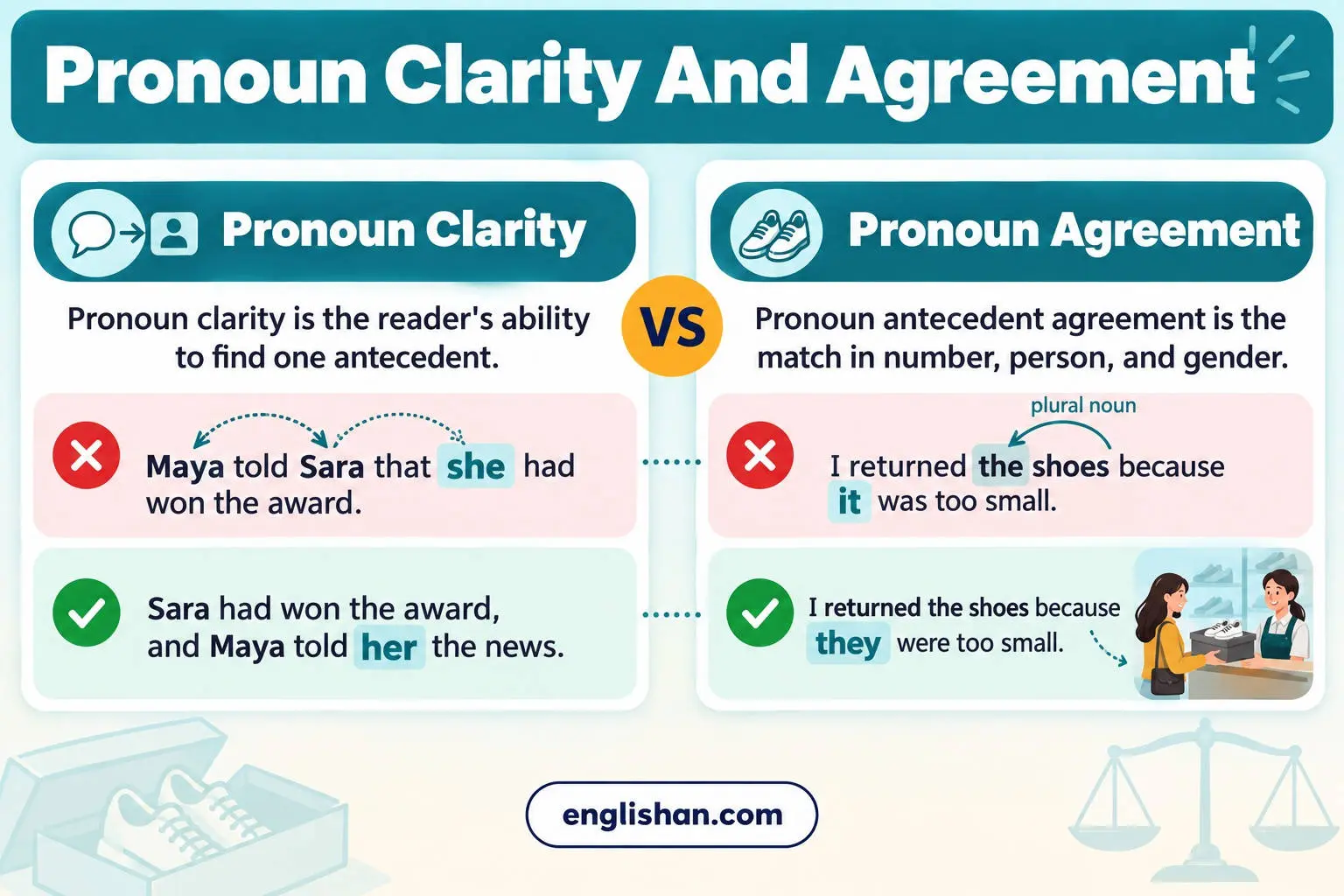
Pronoun clarity and agreement are both rules about a pronoun and its antecedent. Pronoun antecedent agreement is the match in number, person, and gender, so a singular noun takes a singular pronoun. Pronoun clarity is the reader’s ability to find one antecedent.
A pronoun can agree and still be unclear. In “Maya told Sara that she had won”, “she” agrees with both women, so the sentence passes agreement and fails clarity. A pronoun can also have a clear antecedent and fail agreement:
I returned the shoes because it was too small. ❌
I returned the shoes because they were too small. ✅
The only possible antecedent is “the shoes”, a plural noun, so the pronoun takes the plural form “they”.
FAQs
Ambiguous pronoun reference is one type of vague pronoun reference: the pronoun has two possible antecedents. Vague reference is the wider term for any pronoun without one clear antecedent, including broad "this" or "which", a pronoun with no antecedent, and a remote antecedent.
Find the noun each pronoun replaces. The reference is vague when two nouns agree with the pronoun or when the pronoun refers to a whole clause with several ideas. It is also vague when the text states no antecedent, or when the antecedent is more than a sentence away.
No, a pronoun replaces a noun or a noun phrase, not a verb. In "Ben swims every morning because it relaxes him", "it" has no noun antecedent, so the clear version is "because swimming relaxes him". The words "this", "that", "which", and "it" can refer to the idea of a whole clause, as in "She apologized, which surprised me".
Not when "this" refers to one clear idea or comes before a noun, as in "This rule applies to every pronoun". A sentence that opens with "this" has broad reference when the sentence before contains several ideas, and a noun after "this" fixes it.
Related:
- Types of Pronouns
- What Do Pronouns Replace
- Demonstrative Adjectives vs Demonstrative Pronouns
- Dummy Pronouns
- Pronoun Rules and Correct Usage
- Pronoun Shift
- Common Pronoun Errors
- Ambiguity