

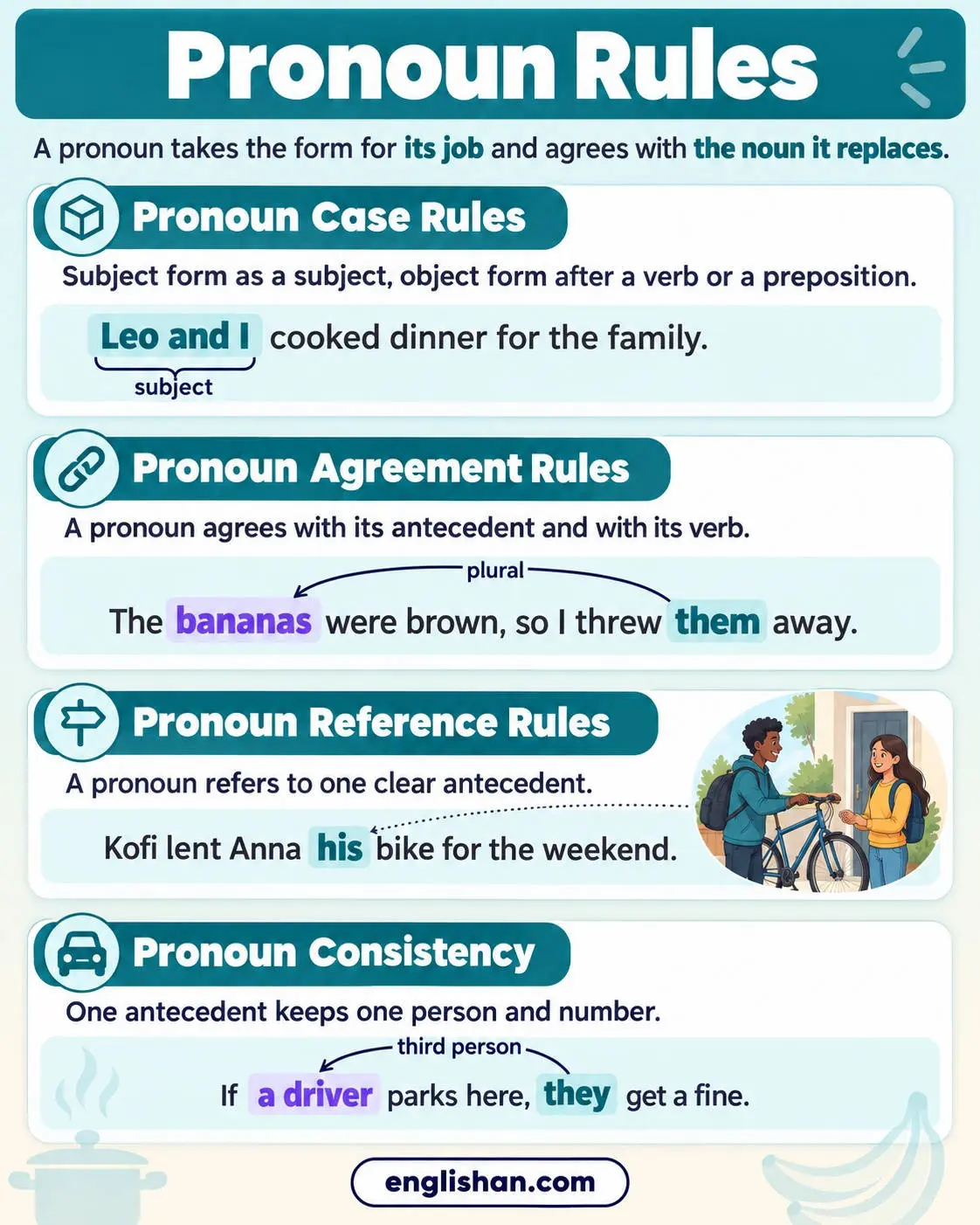
Pronoun rules are the grammar rules for choosing the correct form of a pronoun and for matching it to the noun it replaces. A pronoun changes its form for its job in the sentence, as “I” and “me” do, and it agrees with its noun and with its verb in number and person.
There are three main kinds of pronoun rules: rules of form and case, rules of agreement, and rules of reference and consistency. Form and case rules apply to the choice between “she” and “her” or between “my” and “mine”. Agreement rules match a pronoun to the noun it replaces and to its verb, and reference rules require one clear noun for each pronoun across a sentence or a passage.
What Are Pronoun Rules?
Pronoun rules apply to three points in a sentence: the form of the pronoun, the words it agrees with, and the noun it refers to. A pronoun replaces a noun or a noun phrase, called its antecedent, so pronoun rules come from two questions: what job the pronoun has in its clause, and which noun it replaces.
- She sent me the photos last night.
- The museum reopened its café in June.
- Everyone in my class has a locker.
- When customers call, they need an order number.
The case of a pronoun depends on its job, so “she” is the subject of “sent” and “me” is its object. The number, person, and gender of a pronoun come from its antecedent, so “its” refers to one museum and “they” keeps the plural of “customers”. Case rules answer the first question, and the agreement and reference rules answer the second.
Pronoun Rules Chart
The table gives the core pronoun rules, with a correct and an incorrect form for each.
| Rule | Correct | Incorrect |
|---|---|---|
| Subject form for a subject | Ana and I left early | Me and Ana left early |
| Object form after a verb or a preposition | A gift for Sam and me | A gift for Sam and I |
| Who for a subject, whom after a preposition | The doctor to whom I spoke | The doctor to who I spoke |
| No apostrophe in a possessive pronoun | The choice is yours | The choice is your’s |
| Possessive pronoun alone, possessive adjective before a noun | My car, the car is mine | Mine car |
| Reflexive pronoun for the same person as the subject | I hurt myself | Myself and Sam will go |
| One subject for each verb | My brother works nights | My brother he works nights |
| Pronoun agrees with its antecedent | The shoes were small, so I returned them | The shoes were small, so I returned it |
| Verb agrees with its subject pronoun | She works from home | She work from home |
| Singular verb after a singular indefinite pronoun | Everyone is here | Everyone are here |
| One clear antecedent for each pronoun | Sara won, and Maya told her | Maya told Sara that she won |
| Same person and number for one antecedent | When a person is tired, they rest | When a person is tired, you rest |
Pronoun Case Rules
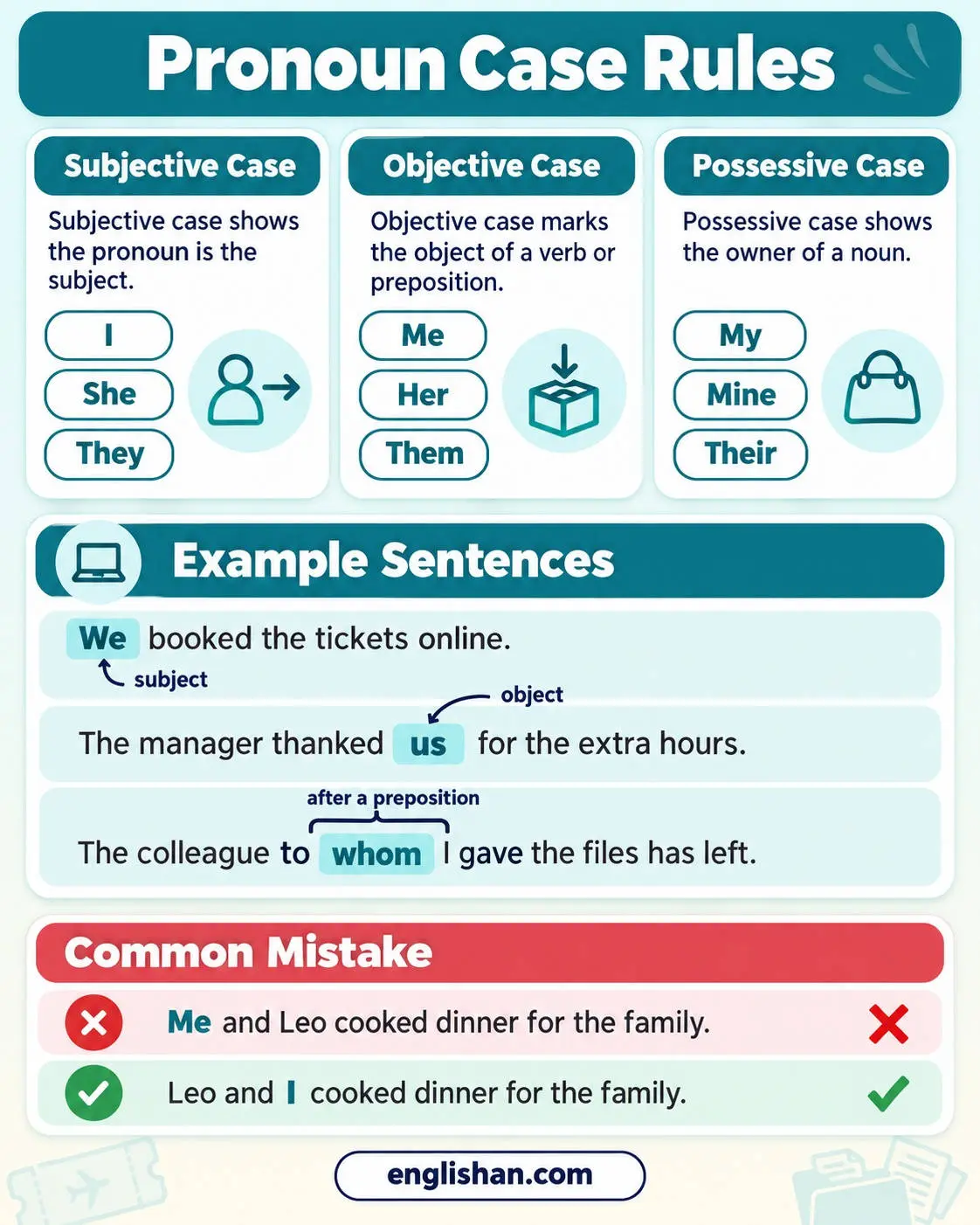
Case is the form of a pronoun that shows its job in the sentence: subject, object, or owner. There are three cases: the subjective case (“I”, “she”, “they”), the objective case (“me”, “her”, “them”), and the possessive case (“my”, “mine”, “their”). Only the personal pronouns and “who” have separate forms for these jobs, so pronoun case errors involve pairs like “he” and “him” or “who” and “whom”.
Subject And Object Pronouns
Use a subject pronoun as the subject of a verb and an object pronoun as the object of a verb. The subject pronouns are “I”, “you”, “he”, “she”, “it”, “we”, and “they”, and the object pronouns are “me”, “you”, “him”, “her”, “it”, “us”, and “them”.
- We booked the tickets online.
- Did they reply to your message?
- The manager thanked us for the extra hours.
- Can you drive her to the airport tomorrow?
Pronouns in pairs: In a pair joined by “and” or “or”, each pronoun takes the form it takes alone. Remove the other person and read the sentence again: “Leo and I cooked” becomes “I cooked”, and “They invited Leo and me” becomes “They invited me”.
Me and Leo cooked dinner for the family. ❌
Leo and I cooked dinner for the family. ✅
The pair is the subject of “cooked”, so the pronoun takes the subject form “I”.
After than and be: Everyday English takes the object form in “taller than me” and “It’s me”. Formal writing takes the subject form, as in “taller than I am” and “It was I who called”, so the choice of I vs me in these positions depends on the setting.
Difference Between Who And Whom
The pronoun “who” is the subject of a verb, and “whom” is the object of a verb or a preposition. To choose the form, answer the question with “he” or “him”: “he” matches “who”, and “him” matches “whom”.
- Who left the lights on? (He left them on.)
- Whom did the panel choose? (The panel chose him.)
- The nurse who treated me was very kind.
- The colleague to whom I gave the files has left.
In everyday English, “who” is also standard as the object of a verb, as in “Who did you invite?”. Directly after a preposition, though, the standard form is “whom”, and who vs whom follows the same case rule as “he” and “him”.
The colleague to who I gave the files has left. ❌
The colleague to whom I gave the files has left. ✅
The pronoun comes directly after the preposition “to”, so it takes the object form “whom”.
Object Pronouns After Prepositions
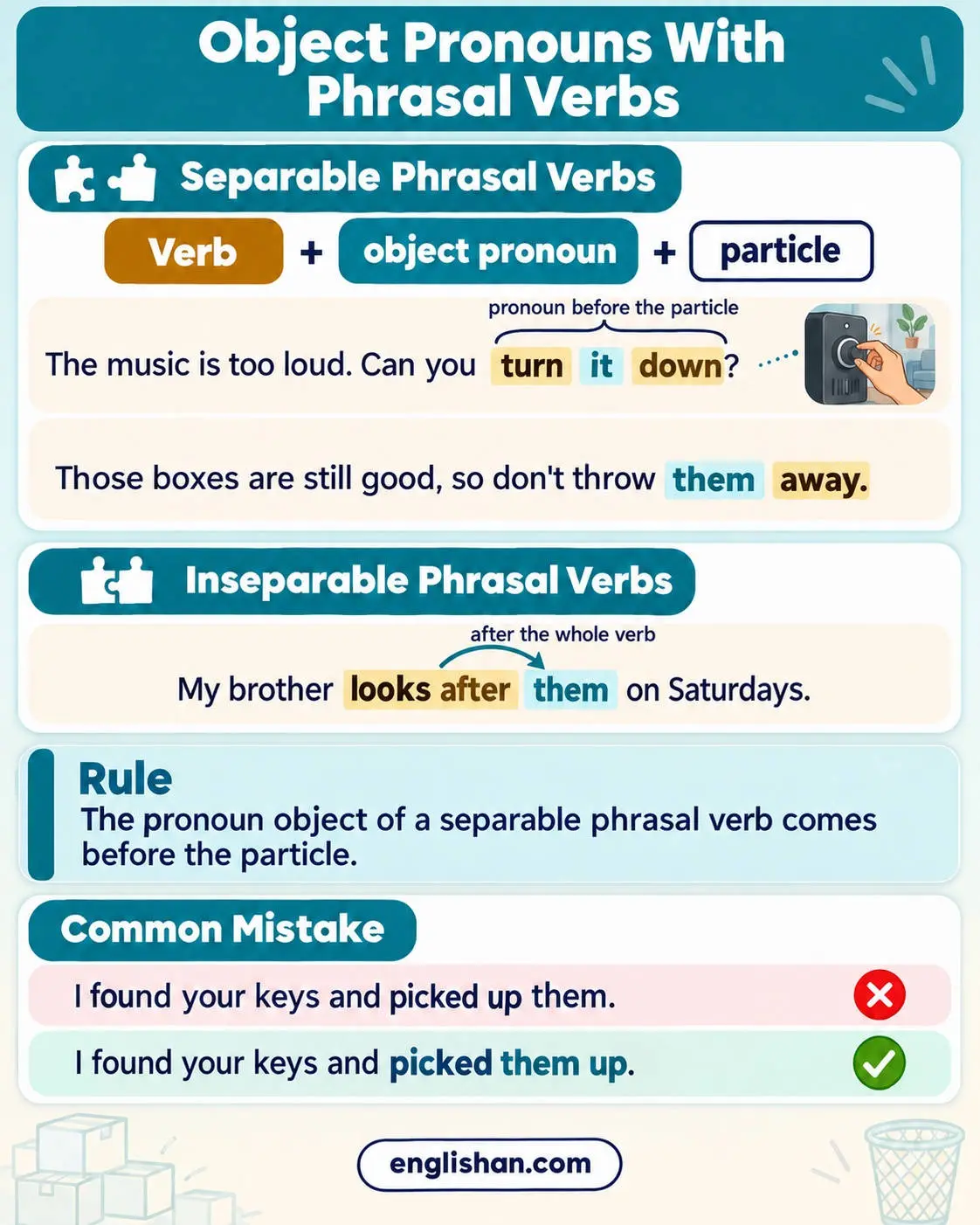
A pronoun after a preposition is the object of that preposition, so it takes the object form, as in “with her”, “for us”, and “between you and me”. The rule also applies in pairs and after “except”, “like”, and “but” in the meaning ‘except’.
- Sit next to me at dinner.
- There is a message for you and him.
- Everyone except them knew the address.
- Keep this between you and me.
Among pronouns with prepositions, a possessive pronoun follows “of” in phrases such as “a friend of mine”, where the object form “me” is wrong.
The landlord sent the keys to my wife and I. ❌
The landlord sent the keys to my wife and me. ✅
After the preposition “to”, both parts of the pair are objects, so the pronoun is “me”.
Possessive Pronoun Rules
Possessive pronouns stand alone and replace a noun phrase. The possessive pronouns are “mine”, “yours”, “his”, “hers”, “ours”, and “theirs”, and none of them takes an apostrophe. A possessive adjective such as “my”, “your”, “its”, or “their” comes before a noun, as in “my car”, while the possessive pronoun replaces the noun, as in “The car is mine”.
- This umbrella is yours, and that one is mine.
- Our flat is smaller than theirs.
- The dog hurt its front leg.
- Is this seat hers?
No apostrophe comes before the “-s” of “yours”, “hers”, “ours”, and “theirs”, because that “-s” belongs to the word itself. The form “it’s” is the short form of “it is” or “it has”, and the possessive of “it” is “its”, with no apostrophe.
The team won it’s last match. ❌
The team won its last match. ✅
The word shows possession, not “it is”, so it takes no apostrophe.
Reflexive Pronoun Rules
Reflexive pronouns are the forms with “-self” in the singular and “-selves” in the plural, such as “myself”, “herself”, and “themselves”. As an object, a reflexive pronoun refers to the same person or thing as the subject of its own clause.
- Nina taught herself Spanish.
- The kids made themselves sandwiches.
- Did you hurt yourself on the stairs?
- He is proud of himself after the race.
When the object is a different person, the object pronoun follows instead, so “Nina taught her Spanish” means Nina taught another woman. After a preposition of place, such as “behind” or “next to”, the object pronoun is usual even for the subject, as in “He closed the door behind him“. A reflexive pronoun also adds emphasis, as in “I fixed the sink myself“, and “by myself” means ‘alone’.
Myself for me: The form “myself” in place of “me” is common in speech, but formal writing keeps “me” when “I” is not the subject of the clause.
Please send the files to Omar or myself. (formal writing) ❌
Please send the files to Omar or me. ✅
The subject of “send” is “you”, so the object form “me” follows the preposition “to”.
Double Subject Pronouns
A double subject is a noun and a pronoun for the same person or thing, both as the subject of one verb. A subject pronoun replaces the noun subject, so a clause takes the noun or the pronoun, not both.
- My sister lives in Leeds.
- She lives in Leeds.
- The new printer prints in color.
- It prints in color.
The double subject is heard in relaxed conversation, where a speaker names the person and then begins the clause with a pronoun. Written English keeps one subject for each verb, and the same rule applies inside a relative clause, so “the car that I bought it” drops “it” because “that” already replaces the object.
The teacher she gave us extra homework. ❌
The teacher gave us extra homework. ✅
The noun phrase “the teacher” is already the subject of “gave”, so the pronoun “she” is cut.
Pronoun Agreement Rules
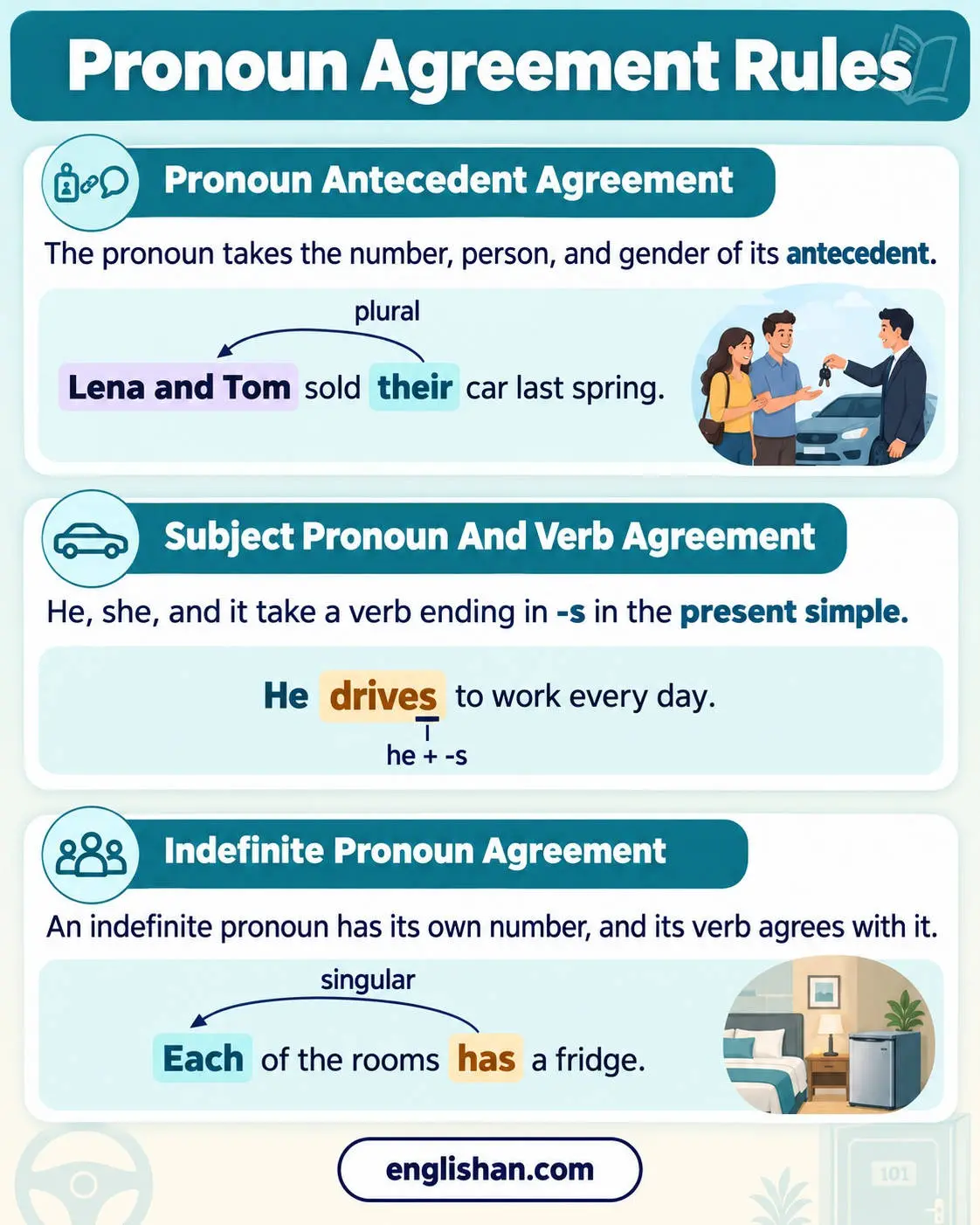
The pronoun rules for agreement cover two words in a sentence: its antecedent, and its verb when the pronoun is the subject. Agreement with the antecedent is in number, person, and gender, and agreement with the verb is in person and number.
Pronoun Antecedent Agreement
In pronoun antecedent agreement, the pronoun takes the number, person, and gender of its antecedent. A singular antecedent takes a singular pronoun, and a plural antecedent takes a plural pronoun.
- My grandmother keeps her recipes in a tin.
- The windows are dirty, so I’ll wash them today.
- Lena and Tom sold their car last spring.
- The hotel has changed its check-in time.
A compound antecedent joined by “and” is usually plural, while with “or” or “nor”, the pronoun matches the nearer noun. In American English, a collective noun like “team” usually takes “it”.
The bananas were brown, so I threw it away. ❌
The bananas were brown, so I threw them away. ✅
The antecedent “the bananas” is plural, so the pronoun is “them”.
Subject Pronoun And Verb Agreement
A present tense verb changes its form to match the person and number of its subject pronoun. In the present simple, “he”, “she”, and “it” take a verb ending in “-s” and the forms “is”, “has”, and “does”. The pronoun “I” takes “am”, and “you”, “we”, and “they” take “are” and the base form.
- I am ready to leave.
- He drives to work every day.
- It doesn’t rain much here in summer.
- You were right about the weather.
- They have two children.
The pronoun “you” takes a plural verb even for one person, and singular “they” does too, as in “Someone called, and they were upset”. In pronoun and verb agreement, only a few forms change, because modal verbs such as “can” and past forms other than “was” and “were” stay the same after every pronoun.
He don’t like coffee. ❌
He doesn’t like coffee. ✅
A third person singular pronoun takes “doesn’t” in the present simple.
Indefinite Pronoun Agreement
An indefinite pronoun has its own number, and its verb agrees with it. Most indefinite pronouns are singular, such as “everyone”, “nobody”, “something”, and “each”, while “both”, “few”, “many”, “others”, and “several” are plural. The pronouns “all”, “any”, “more”, “most”, “none”, and “some” agree with the noun after “of”.
- Everybody wants a window seat.
- Each of the rooms has a fridge.
- Several of my friends are vegetarian.
- Most of the soup is cold.
- Most of the guests are here.
In indefinite pronoun agreement, a later pronoun keeps the same number: “his or her” in formal writing or singular “their” after “everyone”, and “their” after “both”.
Nobody have seen the new film yet. ❌
Nobody has seen the new film yet. ✅
The pronoun “nobody” is singular, so the verb is “has”.
Pronoun Reference Rules
A pronoun refers to one clear antecedent that the text states, usually in the same sentence or the sentence before. Reference is unclear when two nouns agree with the pronoun, when “this” or “which” refers to a whole idea with several parts, or when the text never names the antecedent.
- The bakery opened at seven, and it was full by eight.
- Kofi lent Anna his bike for the weekend.
- The heating broke on Friday, and this problem lasted all weekend.
The error is a vague pronoun reference, and the fix is to repeat the noun, rephrase the sentence, or add a noun after “this” or “that”, as in the last example.
Jon told Pedro that he needed a haircut. ❌
Pedro needed a haircut, and Jon told him so. ✅
The pronoun “he” agrees with both men, so the corrected sentence leaves only one possible antecedent for “him”.
Pronoun Consistency
Pronouns for one antecedent stay in the same person and number throughout a sentence or a passage. A change of person or number for one antecedent is a pronoun shift, while a new pronoun for a different person is correct.
- When a guest checks in, they receive a key card.
- When you check in, you receive a key card.
- One should keep one’s passport in a safe place.
- The club has raised its fees, and it plans a new pool.
The pronoun “you” in the meaning ‘people in general’ is correct alone, as in the second example. The shift happens when “you” refers back to a noun such as “a driver”, which is third person.
If a driver parks here, you get a fine. ❌
If a driver parks here, they get a fine. ✅
The antecedent “a driver” is third person, so the pronoun that refers to it stays in the third person.
FAQs
There are about twelve core pronoun rules in English, in three main kinds: form and case, agreement, and reference and consistency. Some of these core rules can be split into smaller ones, such as separate rules for "than me" and "It’s me", and each smaller rule still follows the job of the pronoun or its antecedent.
A singular noun takes a singular pronoun: "he", "she", or "it" as a subject, and "him", "her", "it", "his", "hers", or "its" in the other positions. For one person whose gender is unknown or not stated, formal writing takes "he or she", and most other writing takes singular "they", as in "A visitor left their scarf".
Yes, singular "they" refers to one person whose gender is unknown or not stated, often after "someone", "everyone", or a noun such as "the caller". It takes a plural verb, as in "Someone is at the door, and they are knocking", and its other forms are "them", "their", "theirs", and usually "themselves".
Not before a personal pronoun in an ordinary sentence, so "the tall he" is not possible. An adjective describes a personal pronoun after a linking verb instead, as in "She is tall", and fixed phrases such as "poor you" and "lucky me" are the exceptions. An indefinite pronoun takes an adjective after it, as in "something new".
Last, by convention: the other person usually comes first, as in "Sam and I" and "for Sam and me". The order is a matter of politeness, so "I and Sam" is grammatical but unusual. The form of the pronoun still follows its job in the sentence, not its position in the pair.
Related:
- Pronouns
- Subject vs Object Pronouns
- Possessive Adjectives vs Possessive Pronouns
- Combining Sentences With Relative Pronouns
- Common Pronoun Errors
- Types of Pronouns