

Second person pronouns are personal pronouns that refer to the person or people being addressed: the listener in speech or the reader in writing. The second person pronouns in English are “you”, “yours”, “yourself”, and “yourselves”, and the possessive adjective “your” belongs with them.
Most personal pronouns change their form for number and for their function in the sentence, as “I” changes to “we” and “me”. The pronoun “you” keeps one form for one person and for a group, and one form as the subject and the object, so the situation shows who “you” means in each sentence.
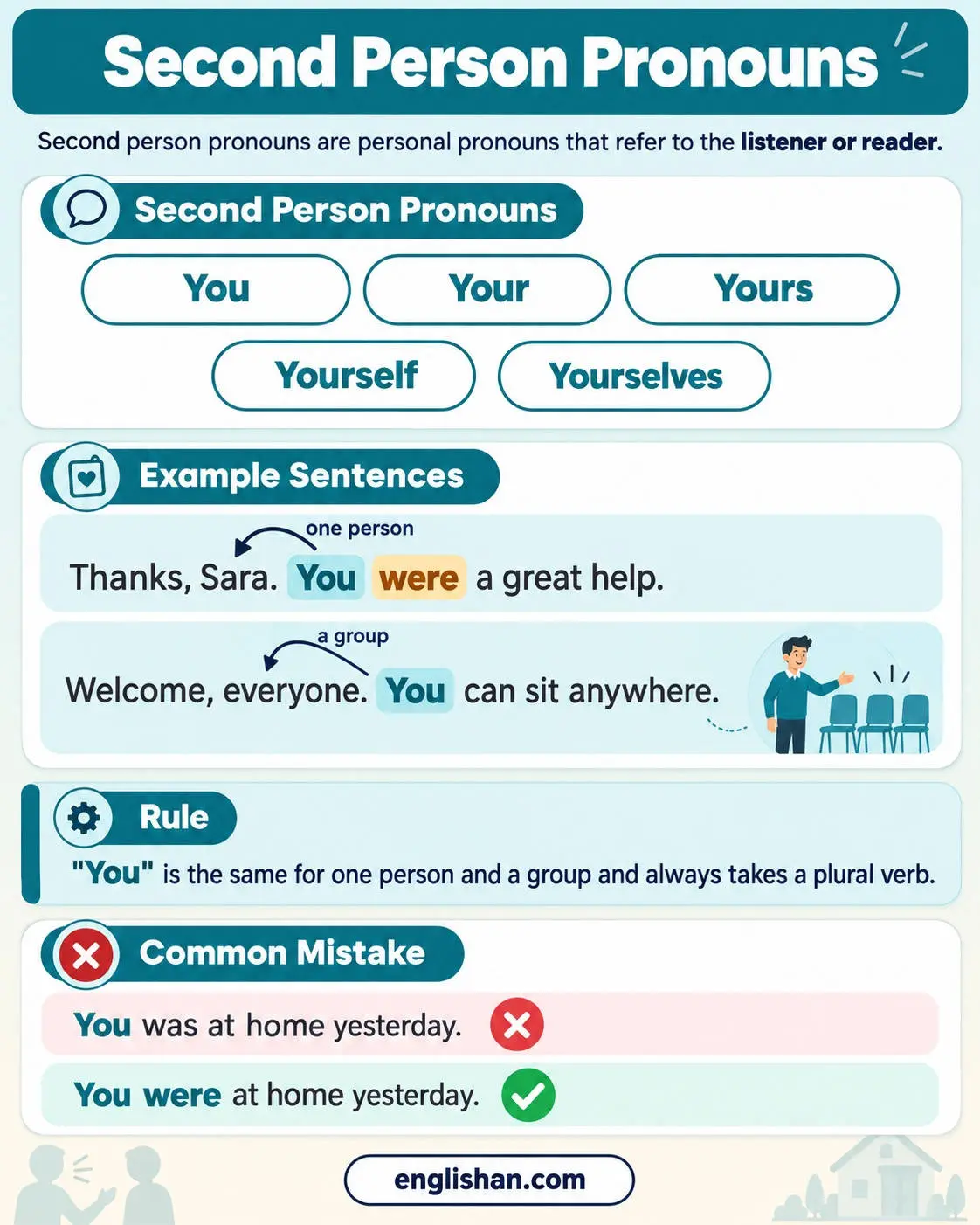
What Are Second Person Pronouns?
A second person pronoun is a personal pronoun that refers to the person or people the speaker is talking to. There are three persons in English grammar: the first person (the speaker), the second person (the listener), and the third person (everyone else). First person pronouns such as “I” and “we” include the speaker. Third person pronouns such as “she” and “they” replace nouns for other people, animals, and objects.
The meaning of “you” changes with the speaker. When Maya tells Leo, “You left your keys here”, the word “you” means Leo, and when Leo answers, “Thanks, you saved my morning”, the same word means Maya. In both sentences, “you” refers to whoever is listening at that moment.
List Of Second Person Pronouns
The second person has fewer forms than the first or the third person, because “you”, “your”, and “yours” do not change for number.
| Form | Function in the sentence | Number |
|---|---|---|
| You | Subject pronoun | Singular and plural |
| You | Object pronoun | Singular and plural |
| Your | Possessive adjective, before a noun | Singular and plural |
| Yours | Possessive pronoun, without a noun | Singular and plural |
| Yourself | Reflexive pronoun | Singular |
| Yourselves | Reflexive pronoun | Plural |
- You are next in line.
- The manager wants to see you.
- Your taxi is outside.
- The blue umbrella is yours.
- Did you cut yourself on the glass?
- Enjoy yourselves at the wedding.
The word “your” is a possessive adjective because it always comes before a noun, and like “yours”, it shows that something belongs to the listener.
Second Person Personal Pronouns
There are four kinds of second person personal pronouns by function: subject, object, possessive, and reflexive. Subject, object, and possessive are the three forms of pronoun case, and the reflexive form ends in “-self” or “-selves”. Because the subject and the object are both “you”, the position of “you” in the sentence shows its function.
Second Person Subject Pronoun
The subject pronoun “you” functions as the subject of a verb. In a statement it comes before the verb, and in a question it comes after the auxiliary verb.
- You look tired today.
- You don’t need a ticket for the museum.
- Have you finished the report?
- Where did you park the car?
The subject “you” also joins an auxiliary verb in a contraction: “you’re” for “you are”, “you’ve” for “you have”, “you’ll” for “you will”, and “you’d” for “you had” or “you would”.
Second Person Object Pronoun
The object pronoun is also “you”, with no change of form. It comes after a verb or a preposition, as in “I’ll call you tonight” and “This parcel is for you”.
- The teacher asked you a question.
- We can meet you at the station.
- Is anyone sitting next to you?
- I’ll send you the photos after the trip.
The reflexive “yourself” is not a polite form of the object pronoun. It refers back to “you” only when “you” is the subject of the same clause.
The tickets are for Anna and yourself. ❌
The tickets are for Anna and you. ✅
The subject of the sentence is “the tickets”, so the object of “for” takes the object form “you”.
Second Person Possessive Pronoun
The possessive pronoun “yours” replaces a noun and stands alone, while the possessive adjective “your” always comes before a noun. The form “yours” usually comes at the end of a clause or after “of”, as in “a friend of yours”.
- Is this phone yours?
- Your bags are in the hall.
- Our garden is smaller than yours.
- Is Ben a friend of yours?
- Yours is the last name on the list.
The possessive adjective “your” and the contraction “you’re” sound the same, but only “you’re” contains a verb.
Your late for the meeting. ❌
You’re late for the meeting. ✅
Before an adjective such as “late”, the verb “are” is missing, so the correct form is “you’re”, short for “you are”.
Second Person Reflexive Pronouns
The reflexive pronouns “yourself” and “yourselves” refer back to “you” when “you” is both the subject and the object of the same action. The singular form “yourself” is for one person, and the plural “yourselves” is for two or more people.
- Did you hurt yourself?
- Please help yourselves to the snacks.
- You should be proud of yourself.
- Kids, behave yourselves at Grandma’s house.
As reflexive and intensive pronouns, the same forms also add emphasis to “you”, usually at the end of the clause, as in “You said it yourself” or “You can fix the shelf yourselves“.
Second Person Pronouns Singular And Plural
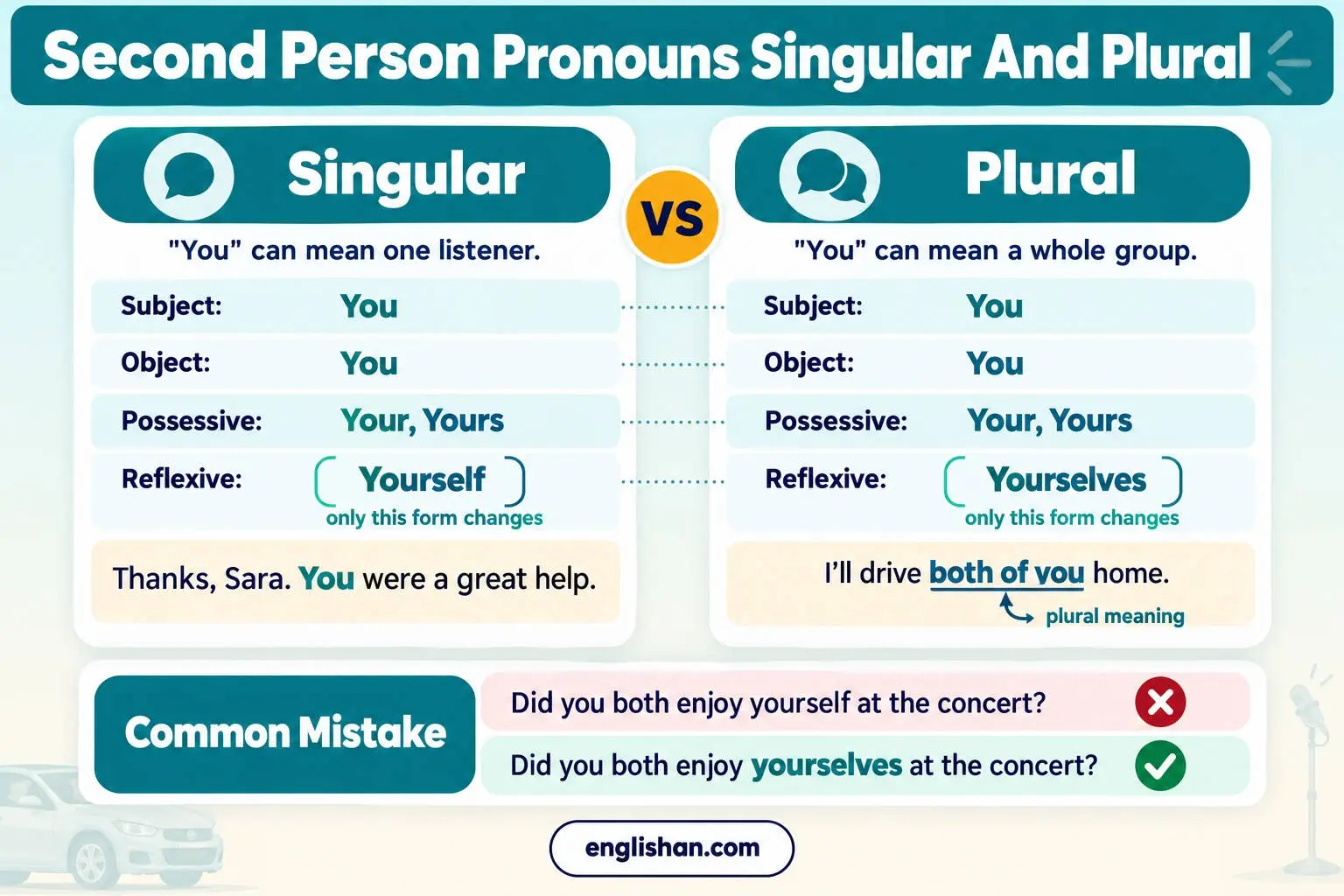
The singular and the plural second person pronoun is the same word, “you”, so “you” can mean one listener or a whole group. The situation usually shows the number, and words such as “both of you”, “all of you”, and “you two” mark a plural meaning.
- Thanks, Sara. You were a great help. (one person)
- Welcome, everyone. You can sit anywhere. (a group)
- I’ll drive both of you home.
- All of you need to sign the form.
- Are you two coming to the party?
Among the singular and plural pronouns, “you” has no separate plural subject or object form, while “I” has “we”, and “he”, “she”, and “it” have “they”. The number does show in the reflexive, where a plural “you” takes “yourselves”.
Did you both enjoy yourself at the concert? ❌
Did you both enjoy yourselves at the concert? ✅
The phrase “you both” refers to two people, so the reflexive is plural.
In informal speech, speakers in some regions use a separate plural, such as “y’all” in the southern United States and “you guys” in much of North America, while standard English keeps “you” for both numbers.
Verb Agreement With You
The pronoun “you” always takes the plural form of the verb, even when it refers to one person. With “be”, the forms are “you are” in the present and “you were” in the past, and with other verbs, “you” takes the base form with no “-s”.
- You are my oldest friend. (one person)
- You are all welcome here. (a group)
- Were you at the gym this morning?
- You have a missed call from the dentist.
- Do you know the way to the hotel?
Question tags follow the same agreement, as in “You were there, weren’t you?”, where the tag repeats “were” in the negative.
You was at home yesterday. ❌
You were at home yesterday. ✅
After “you”, the past of “be” is “were” for one person or many, and “you was” is nonstandard.
Uses Of Second Person Pronouns
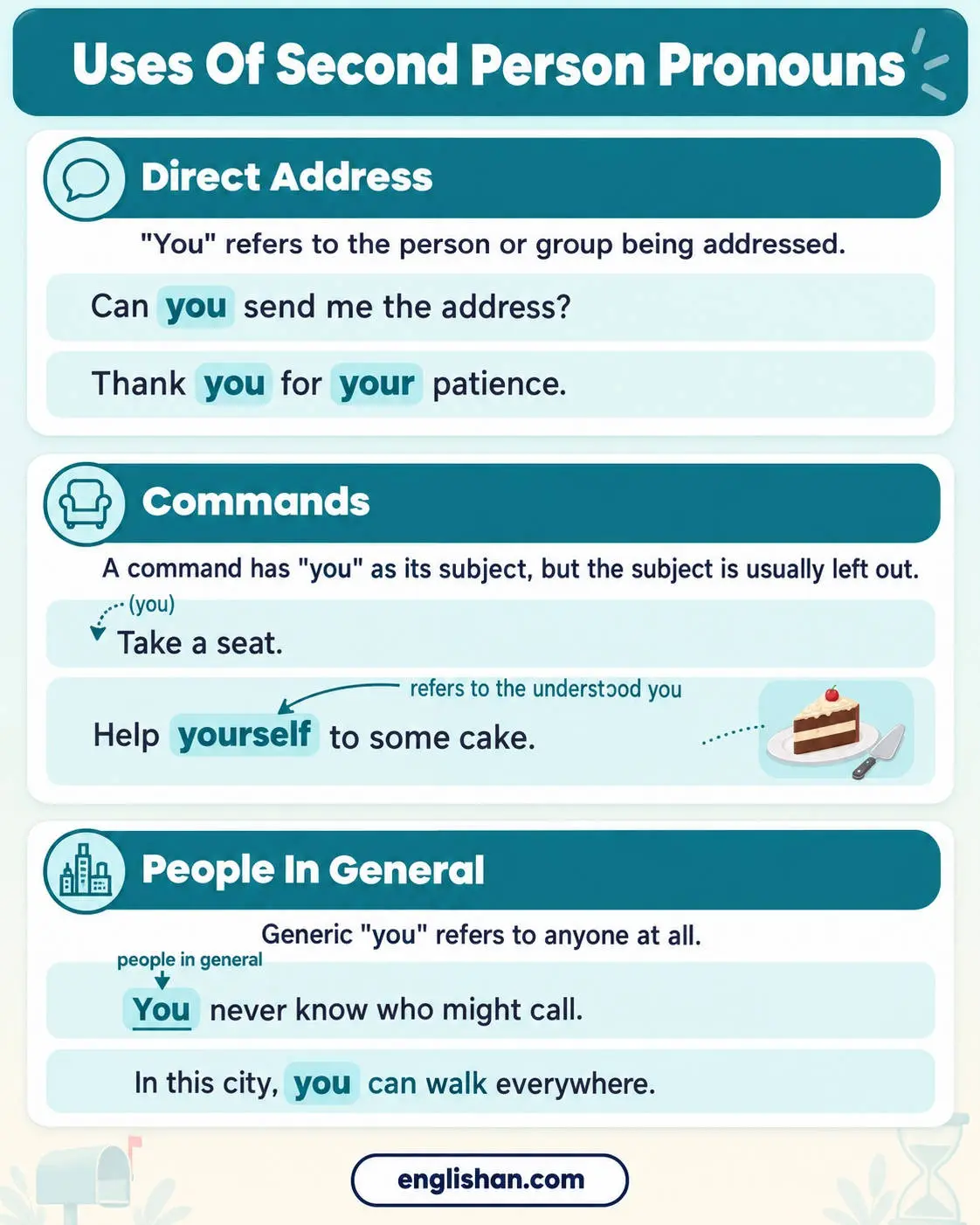
There are three main uses of second person pronouns: to address the listener or reader, as the understood subject of a command, and to talk about people in general.
Direct address: Most often, “you” refers to the particular person or group being addressed in a conversation, a message, an email, or a set of instructions.
- Can you send me the address?
- Thank you for your patience.
- You need to restart the computer after the update.
Commands: A command in the imperative mood has “you” as its subject, but the subject is usually left out. The command “Close the window” means “You close the window”, so a reflexive after a command is “yourself” or “yourselves”.
- Take a seat.
- Help yourself to some cake.
- Don’t forget your keys.
- You stay here, and I’ll get the car.
The subject “you” is spoken in a command only for emphasis or contrast, as in the last example.
People in general: In a general statement, “you” refers to anyone at all rather than to the listener, as in “You can’t park here after six”. The formal pronoun “one” has the same meaning, so “One must show a passport at the border” is a formal version of “You must show a passport at the border”.
- You never know who might call.
- In this city, you can walk everywhere.
- Too much sugar is bad for you.
- You learn a lot from your mistakes.
Generic “you” follows the grammar of the personal “you”: a plural verb, “your” as the possessive, and “yourself” as the reflexive, as in “You have to look after yourself”. A sentence keeps one generic pronoun from start to finish.
One should always lock your door. ❌
You should always lock your door. ✅
The subject “you” takes the possessive “your”, and the subject “one” takes “one’s”.
Identification Of Second Person Pronouns
A pronoun is second person only when it is a form of “you” and refers to the listener, the reader, or people in general. The pronoun “we” can include the listener, as in “We should leave soon”, but it is a first person pronoun because it also includes the speaker. The pronoun “they” is a third person pronoun in both its singular and plural meanings, because it refers to people outside the conversation.
- You and Tom can share a room. (second person)
- We can share a room. (first person, speaker included)
- They can share a room. (third person)
Before a noun or a number, “you” stays second person, as in “you two” and “you students”, because it still refers to the people being addressed.
FAQs
There are four second person pronouns in standard English: "you", "yours", "yourself", and "yourselves". With the possessive adjective "your", the second person has five forms.
No, "your" is a possessive adjective, also called a possessive determiner, because it always comes before a noun, as in "your phone". The possessive pronoun is "yours", which stands without a noun: "The phone is yours."
Usually not, because the listener is present in the conversation. An antecedent is the noun a pronoun refers back to, and a first person or second person pronoun refers to a person in the conversation instead. A name can still come before "you" in direct address, as in "Ana, you were right".
The reflexive pronoun "yourself" is singular and "yourselves" is plural, although "you" has one form for both. Use "yourself" for one listener, as in "Help yourself, Anna", and "yourselves" for two or more, as in "Help yourselves, everyone".
Related:
- Pronouns
- Types of Pronouns
- Homophones in English Grammar
- Common Pronoun Errors
- Pronoun Shift
- Pronoun and Verb Agreement
