

First person pronouns are personal pronouns that refer to the speaker or writer, either alone or together with other people. The singular forms refer to one person, the speaker, and the plural forms refer to a group that includes the speaker.
Within each number, the form changes with the job of the pronoun in the sentence, so “I” is the subject in “I called the bank” and “me” is the object in “The bank called me”. Pairs such as “my sister and I” follow the same choice between subject and object, and the other person in the pair does not change the form.
What Are First Person Pronouns?
First person pronouns are the pronouns a speaker or writer uses to refer to themselves, alone or as part of a group. First person is the grammatical person of the speaker, so a first person pronoun always includes the person who produces the sentence:
- I need a new phone charger.
- Can you help me with this form?
- We moved to Chicago last spring.
- The neighbors invited us to dinner.
Pronouns for the listener, such as “you”, are second person pronouns, and pronouns for anyone or anything else, such as “she” and “they”, are third person pronouns. All three persons belong to the personal pronouns, which change form for person, for number, and for their job in the sentence.
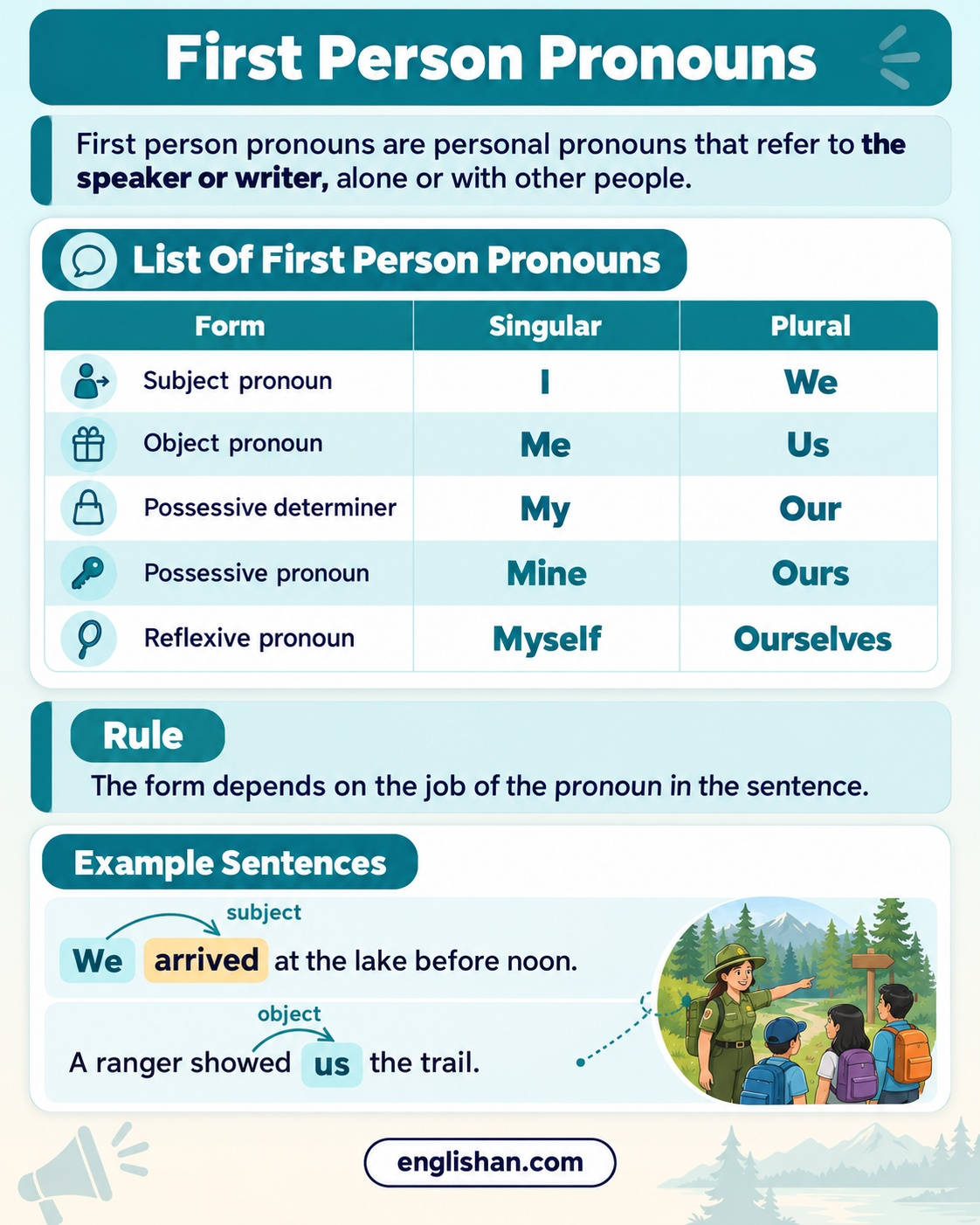
List Of First Person Pronouns
There are ten first person forms, five singular and five plural, and the correct form depends on the job of the pronoun in the sentence.
| Form | Singular | Plural |
|---|---|---|
| Subject pronoun | I | We |
| Object pronoun | Me | Us |
| Possessive determiner | My | Our |
| Possessive pronoun | Mine | Ours |
| Reflexive pronoun | Myself | Ourselves |
The singular forms appear in one scene, a camping trip told by one speaker:
- I packed the tent.
- My brother helped me with the poles.
- My sleeping bag is blue.
- The red sleeping bag is mine.
- I cooked dinner by myself.
The plural forms follow the same pattern when the speaker talks about the whole family on the trip:
- We arrived at the lake before noon.
- A ranger showed us the trail.
- Our campsite was near the water.
- The green tent is ours.
- We put up the tent ourselves.
The forms “my” and “our” are possessive determiners, also called possessive adjectives, because they come before a noun. The other eight forms replace a noun or a noun phrase, so they function as pronouns on their own.
First Person Singular Pronouns
First person singular pronouns refer to one person, the speaker or writer, with no one else included. The subject form “I” takes its own forms of “be”: “am” in the present and “was” in the past.
- I am on the train now.
- I was at the dentist all morning.
- On Fridays, I work from home.
- I have two brothers and a sister.
Although “I” is one person, the present simple verb after it has no “-s”, unlike the verb after “he”, “she”, or “it”.
I has a meeting at ten. ❌
I have a meeting at ten. ✅
The subject “I” takes the base form “have”, and only a third person singular subject takes “has”.
First Person Plural Pronouns
First person plural pronouns refer to a group that includes the speaker or writer, so “we” means ‘the speaker and one or more other people’. The group can be two people, a family, a class, or a company the speaker works for, and the verb after “we” is plural.
- We are ready to order.
- We were at the airport by six.
- The hotel upgraded us to a bigger room.
- We deliver to most of the city on weekends. (said by a shop worker)
The pronoun “we” can also refer to people in general, with the speaker included, as in “We need sleep to stay healthy”. In that meaning the verb is still plural: “we need”, not “we needs”.
Before a noun such as “students” or “nurses”, the form still follows the job of the whole phrase. The subject takes “we”, as in “We nurses work long shifts”, and the object takes “us”, as in “The hospital gave us nurses a day off”.
Us students need more time for the project. ❌
We students need more time for the project. ✅
The phrase “we students” is the subject of “need”, so it takes the subject form “we”. Without the noun, the sentence reads “We need more time”, with the same subject form.
Uses Of First Person Pronouns
There are four uses of first person pronouns in a sentence: as a subject, as an object, to show possession, and as a reflexive pronoun. Each use has its own singular and plural form, and the pronoun changes form with its job, not with its position in the sentence.
First Person Subject Pronouns
The first person subject pronouns are “I” and “we”, and they function as the subject of a verb, the person who does the action. The pronoun “I” is always written as a capital letter, in any position in the sentence.
- I booked a table for eight o’clock.
- We don’t have class on Monday.
- Can I pay by card?
- After the concert, we took a taxi home.
A subject pronoun usually comes before the verb. In a question, the auxiliary verb comes before it instead, as in “Can I pay by card?” and “Are we late?”
First Person Object Pronouns
The first person object pronouns are “me” and “us”, and they function as the object of a verb or the object of a preposition. They usually come after the verb or after the preposition.
- The teacher asked me a question.
- Please call us when you land.
- Sara sat next to me on the bus.
- These tickets are for us.
After the verb “be” and after “than”, the object form is standard in everyday English: “It’s me” and “She is taller than me”. In formal English, or when a verb follows, the subject form comes there instead, as in “She is taller than I am”. The suggestion form “let’s” is short for “let us”, with “us” as the object of “let”.
First Person Possessive Pronouns
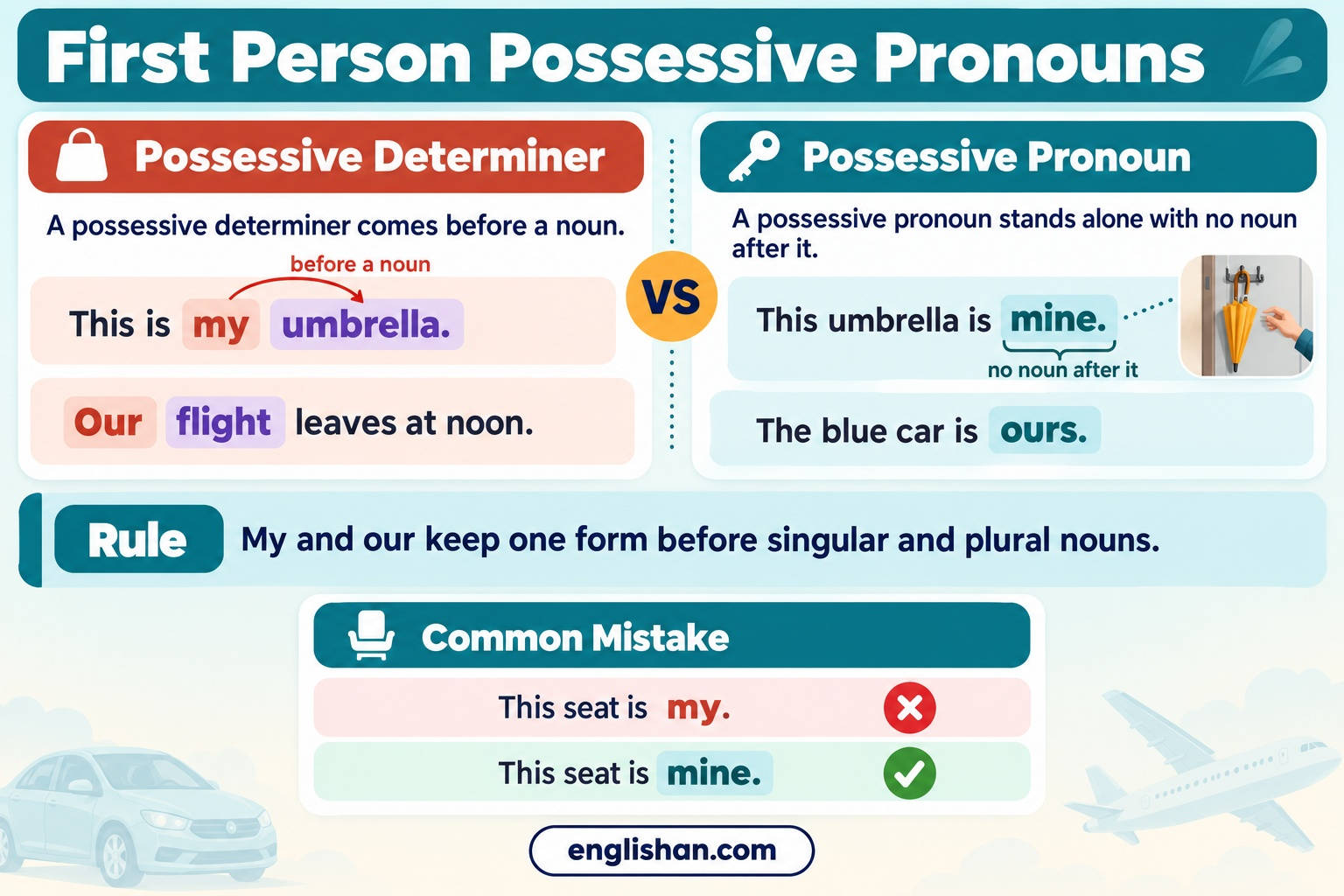
The first person possessive forms show that something belongs to the speaker, and there are two kinds. The possessive determiners “my” and “our” come before a noun, and the possessive pronouns “mine” and “ours” stand alone with no noun after them.
- This is my umbrella.
- This umbrella is mine.
- Our flight leaves at noon.
- The blue car is ours.
- A friend of mine lives in Boston.
Before singular and plural nouns alike, “my” and “our” keep one form, as in “my key” and “my keys”. With no noun after the word, only the possessive pronoun is correct.
This seat is my. ❌
This seat is mine. ✅
No noun follows the word, so the possessive pronoun “mine” is correct, not the determiner “my”.
The decision is our’s. ❌
The decision is ours. ✅
Possessive pronouns already show possession, so “ours” is written without an apostrophe.
First Person Reflexive Pronouns
The first person reflexive pronouns are “myself” and “ourselves”, and they function as the object when the object is the same person as the subject. The form “myself” refers back to “I”, and “ourselves” refers back to “we”, in the same clause.
- I cut myself on a broken glass.
- We introduced ourselves to the new neighbors.
- I taught myself to play the guitar.
- We enjoyed ourselves at the wedding.
The same forms also function as emphatic pronouns, which stress that the speaker did the action personally, as in “I painted the kitchen myself”. With “by”, the reflexive form means ‘alone’, as in “We drove there by ourselves”.
Please send the report to Anna or myself. ❌
Please send the report to Anna or me. ✅
As a reflexive pronoun, “myself” needs “I” as the subject of the same clause, and without it the object form “me” is correct.
My Friend And I Vs My Friend And Me
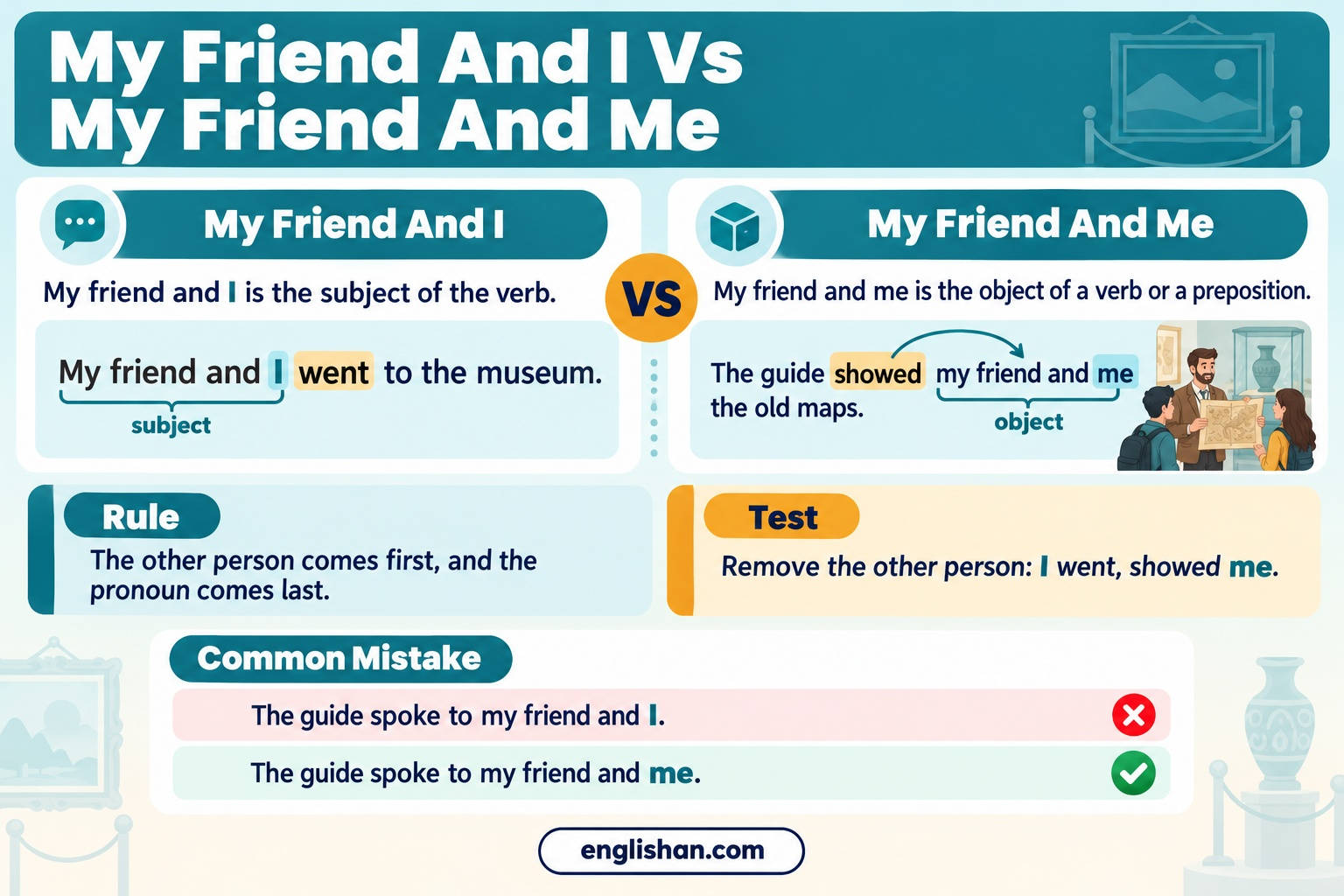
In a pair joined by “and” or “or”, the pronoun takes the same form it takes alone. The phrase “my friend and I” is a subject, and “my friend and me” is an object. To choose the form, remove the other person and read the sentence again: “My friend and I went” becomes “I went”, and “showed my friend and me” becomes “showed me”.
The guide spoke to my friend and I. ❌
The guide spoke to my friend and me. ✅
The pair is the object of the preposition “to”, so the pronoun is “me”.
FAQs
No, "you" is a second person pronoun, because it refers to the listener or reader, not to the speaker. The first person forms are "I" and "we" and their other forms, while "you" has the same form for one listener and for several.
Yes, "myself" is the first person singular reflexive pronoun, and "ourselves" is the plural. It refers back to "I" in the same clause, as in "I taught myself to swim", so it cannot replace "me" when "I" is not the subject: "Call Sam or me", not "Call Sam or myself".
Yes, "my" is the first person singular possessive form, and it is a possessive determiner, because it comes before a noun, as in "my phone". Its plural is "our", and the forms that stand alone without a noun are "mine" and "ours".
The plural of "mine" is "ours", the first person plural possessive pronoun, as in "The house is ours". Like "mine", "ours" stands alone with no noun after it and is written without an apostrophe.
Related:
- Compound Subject
- Third Person Pronouns
- Types of Pronouns
- Pronoun Case
- Singular and Plural Pronouns
- I vs Me
- Pronoun Shift