

Singular and plural pronouns are pronouns grouped by number: a singular pronoun replaces a noun for one person or thing, and a plural pronoun replaces a noun for two or more. The pronoun “she” can replace “my sister”, for example, while “they” replaces “my sisters”.
A personal pronoun changes form for number, and also for person and case. A pronoun agrees in number with the noun it replaces, and a subject pronoun also agrees with its verb, as in “she is” and “they are”. The number of a pronoun therefore depends on its noun, though a few pronouns keep one form for both numbers.
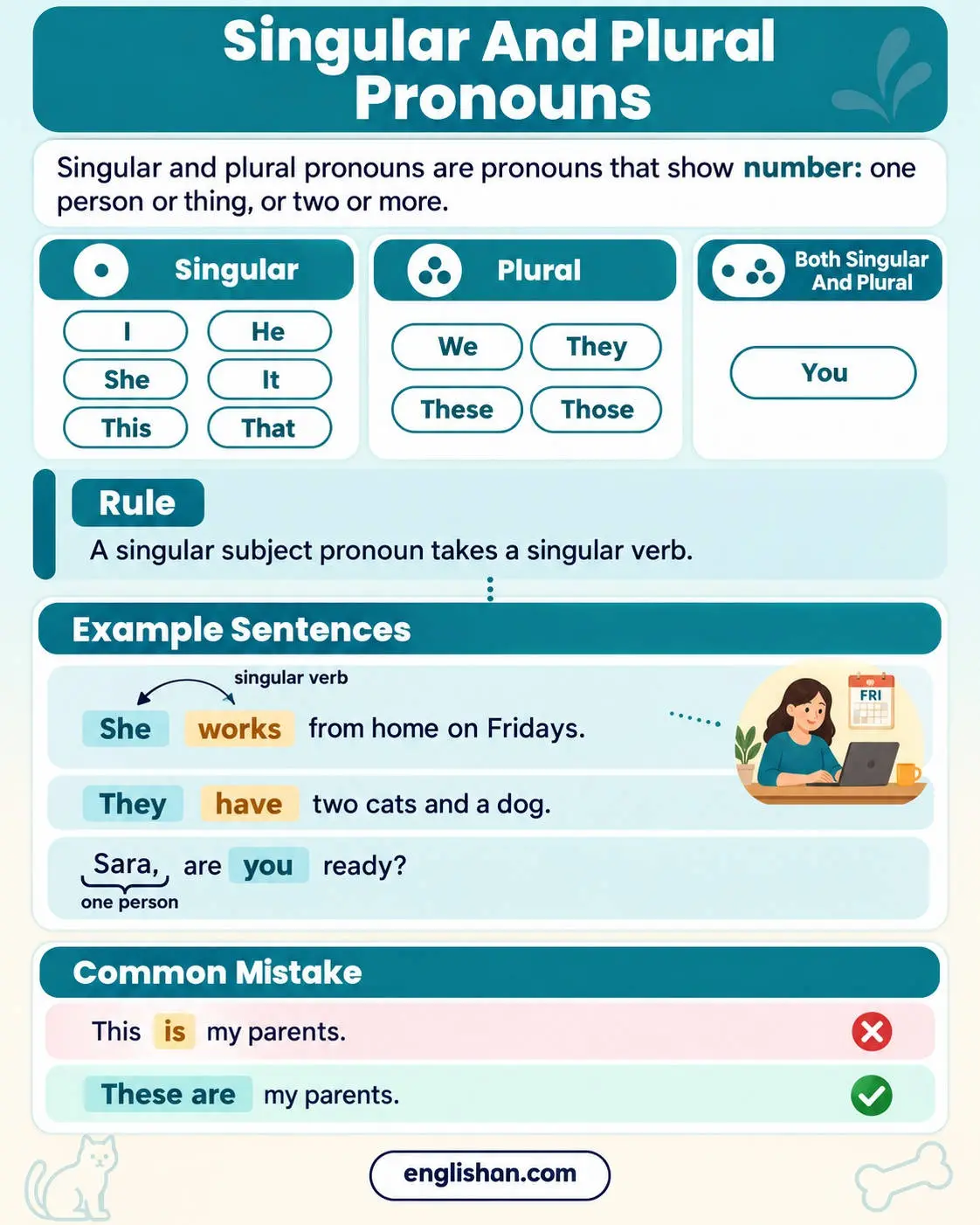
What Are Singular And Plural Pronouns?
A singular pronoun refers to a singular antecedent, and a plural pronoun refers to a plural antecedent. The antecedent is the noun or noun phrase that the pronoun replaces, so the pronoun takes its number from that antecedent.
- My brother lost his keys, so he borrowed mine.
- The printer is old, but it still prints well.
- The windows were dirty, so I cleaned them.
- Ana and I missed the bus, so we walked.
The subject “Ana and I” names two people, so the plural pronoun “we” replaces it, even though “Ana” and “I” are each singular.
Some nouns look singular in meaning but are plural in grammar. Nouns for things with two parts, such as “jeans”, “scissors”, and “glasses”, take plural pronouns.
My new jeans were too long, so I shortened it. ❌
My new jeans were too long, so I shortened them. ✅
The noun “jeans” is plural, so the pronoun that replaces it is “them”.
List Of Singular And Plural Pronouns
There are three types of singular and plural pronouns with a separate form for each number: personal pronouns, reflexive pronouns, and demonstrative pronouns.
Singular And Plural Personal Pronouns
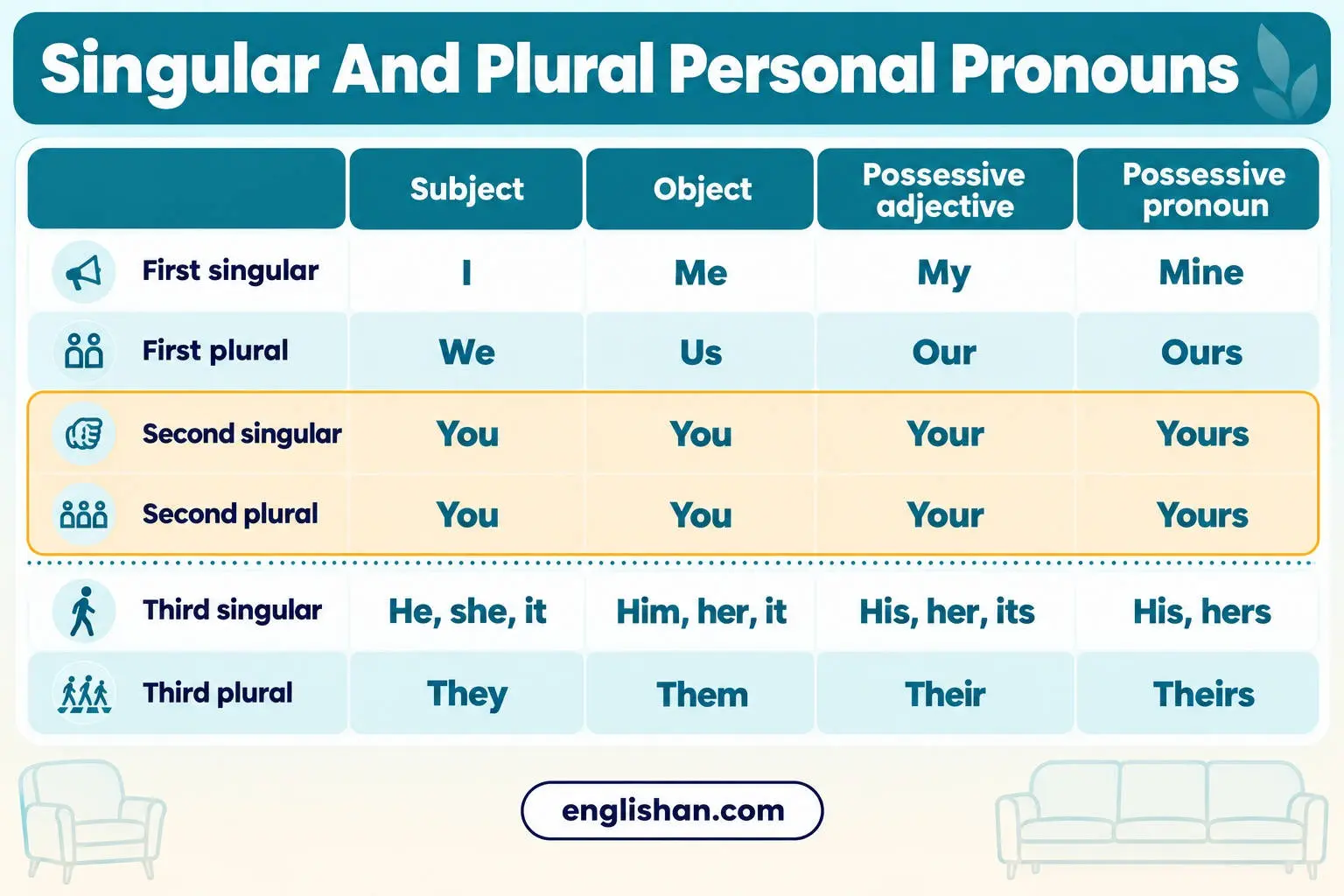
Personal pronouns refer to particular people and things: the speaker, the listener, and the people or things the speaker talks about. Every personal pronoun has a person, a number, and a case, and the chart lists each form in both numbers.
| Person | Number | Subject | Object | Possessive adjective | Possessive pronoun |
|---|---|---|---|---|---|
| First | Singular | I | Me | My | Mine |
| First | Plural | We | Us | Our | Ours |
| Second | Singular | You | You | Your | Yours |
| Second | Plural | You | You | Your | Yours |
| Third | Singular | He, she, it | Him, her, it | His, her, its | His, hers |
| Third | Plural | They | Them | Their | Theirs |
Subject pronouns come before the verb, as in “They called”. Object pronouns come after a verb or a preposition, as in “called us” and “with them“. A possessive adjective comes before a noun, as in “our car”, while a possessive pronoun replaces the noun, as in “The car is ours“.
- I need a ride, so can you drive me?
- We booked the table, and the waiter seated us by the window.
- She lent him her umbrella.
- Those seats aren’t theirs, so they moved.
First person pronouns refer to the speaker, alone or with other people. Second person pronouns replace the name of the listener, for one listener or a group. Third person pronouns replace any other noun, and only the third person singular has separate forms for a male (“he”), a female (“she”), and a thing or animal (“it”).
Singular And Plural Reflexive Pronouns
A reflexive pronoun is a pronoun ending in “-self” or “-selves” that refers back to the subject of the same clause. Singular reflexive pronouns end in “-self”, and plural reflexive pronouns end in “-selves”.
| Person | Singular | Plural |
|---|---|---|
| First | Myself | Ourselves |
| Second | Yourself | Yourselves |
| Third | Himself, herself, itself | Themselves |
- I taught myself to swim last summer.
- The door locks itself at night.
- We introduced ourselves to the new neighbors.
- Help yourselves to coffee, everyone.
In the second person, the reflexive form shows the number that “you” does not show. The singular form “yourself” refers to one listener, and the plural form “yourselves” refers to two or more.
The players were proud of theirselves. ❌
The players were proud of themselves. ✅
The third person plural reflexive is formed from “them”, so “theirselves” is not standard English.
Singular And Plural Demonstrative Pronouns
A demonstrative pronoun is a pronoun that shows which person or thing the speaker means, usually by distance. The singular forms are “this” and “that”, and the plural forms are “these” and “those”.
| Distance | Singular | Plural |
|---|---|---|
| Near the speaker | This | These |
| Far from the speaker | That | Those |
- This is my seat.
- These are your tickets for Saturday.
- Is that your car across the street?
- I don’t want these shoes, so can I try those?
When a demonstrative pronoun introduces people or things with the verb “be”, it agrees with the noun after the verb.
This is my parents. ❌
These are my parents. ✅
The noun after the verb is plural, so the pronoun is “these” and the verb is “are”.
Pronouns That Are Both Singular And Plural
Some pronouns keep one form for both numbers, so the noun they replace or the context shows the number. The relative pronouns “who”, “which”, and “that” have one form too. A verb after a relative pronoun agrees with the noun before it, as in “the man who lives next door” and “the people who live next door”. The personal pronoun “you”, and in some sentences “they”, also refer to one person or to several with the same form.
Singular And Plural You
The pronoun “you” refers to one listener or to two or more listeners, and its subject, object, and possessive forms are the same in both numbers. As the subject, “you” always takes the plural verb form (“you are”, “you were”, “you have”), even when it refers to one person.
- Sara, are you ready? (one person)
- Are you both ready? (two people)
- I’ll see you all on Monday. (a group)
Speakers often add “both”, “all”, or “you two” after “you” to show the plural, and in informal American speech “you guys” refers to a group.
You was right about the weather. ❌
You were right about the weather. ✅
The past form of “be” after “you” is “were”, for one person and for a group.
They As A Singular Pronoun
The pronoun “they” also refers to one person when the speaker does not know or does not say whether the person is male or female. Singular “they” is standard after “someone”, “anyone”, “everyone”, and “nobody”, and after a noun such as “a student” or “the caller”.
- Someone left their umbrella in the meeting room.
- If a customer calls, tell them I’ll be back at two.
- Everyone thinks they did well on the test.
Singular “they” takes the same verb forms as plural “they”, and its reflexive form is usually “themselves”.
A student said they was sick. ❌
A student said they were sick. ✅
The verb after singular “they” is plural in form, so the past of “be” is “were”.
Singular And Plural Indefinite Pronouns
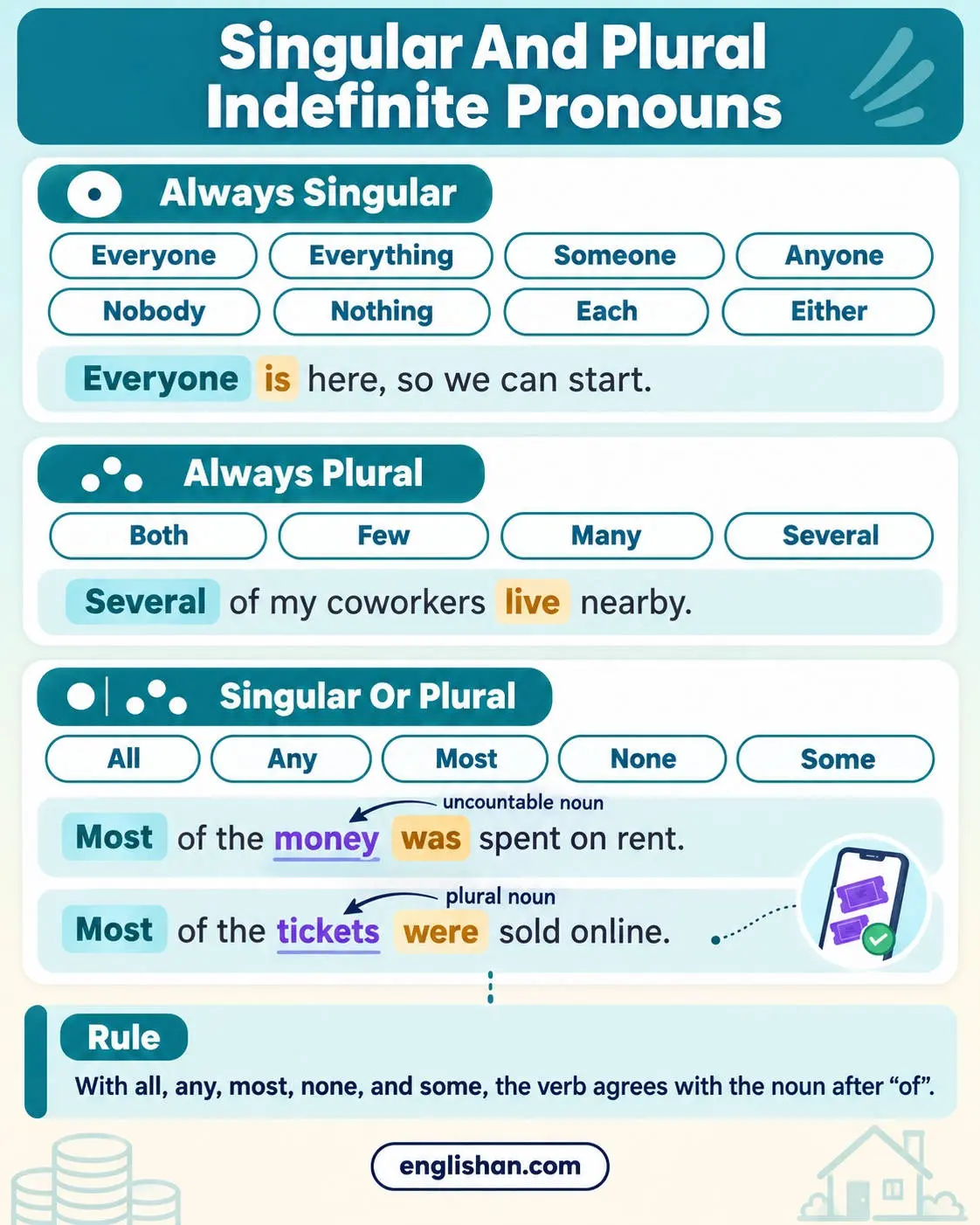
Indefinite pronouns refer to people or things in general without naming them. Among singular and plural pronouns, an indefinite pronoun is always singular, always plural, or singular or plural, depending on the word.
| Number | Indefinite pronouns |
|---|---|
| Always singular | Anyone, anybody, anything, everyone, everybody, everything, someone, somebody, something, no one, nobody, nothing, each, either, neither, one, another, much |
| Always plural | Both, few, many, several, others |
| Singular or plural | All, any, more, most, none, some |
- Everyone is here, so we can start.
- Nobody knows the answer.
- Both are correct.
- Several of my coworkers live nearby.
- Most of the money was spent on rent.
- Most of the tickets were sold online.
With pronouns that can be singular or plural, the verb agrees with the noun after “of”: an uncountable or singular noun takes a singular verb, and a plural noun takes a plural verb. The pronoun “none” with “of” and a plural noun takes a plural verb in everyday English and a singular verb in formal writing, as in “None of the lights are on” and “None of the lights is on”.
The words “each”, “either”, and “neither” are also distributive pronouns, and they take a singular verb even when “of” and a plural noun follow.
Everyone have a copy of the agenda. ❌
Everyone has a copy of the agenda. ✅
The pronoun “everyone” refers to a whole group, but it is singular, so it takes “has”.
Verb Agreement With Singular And Plural Pronouns
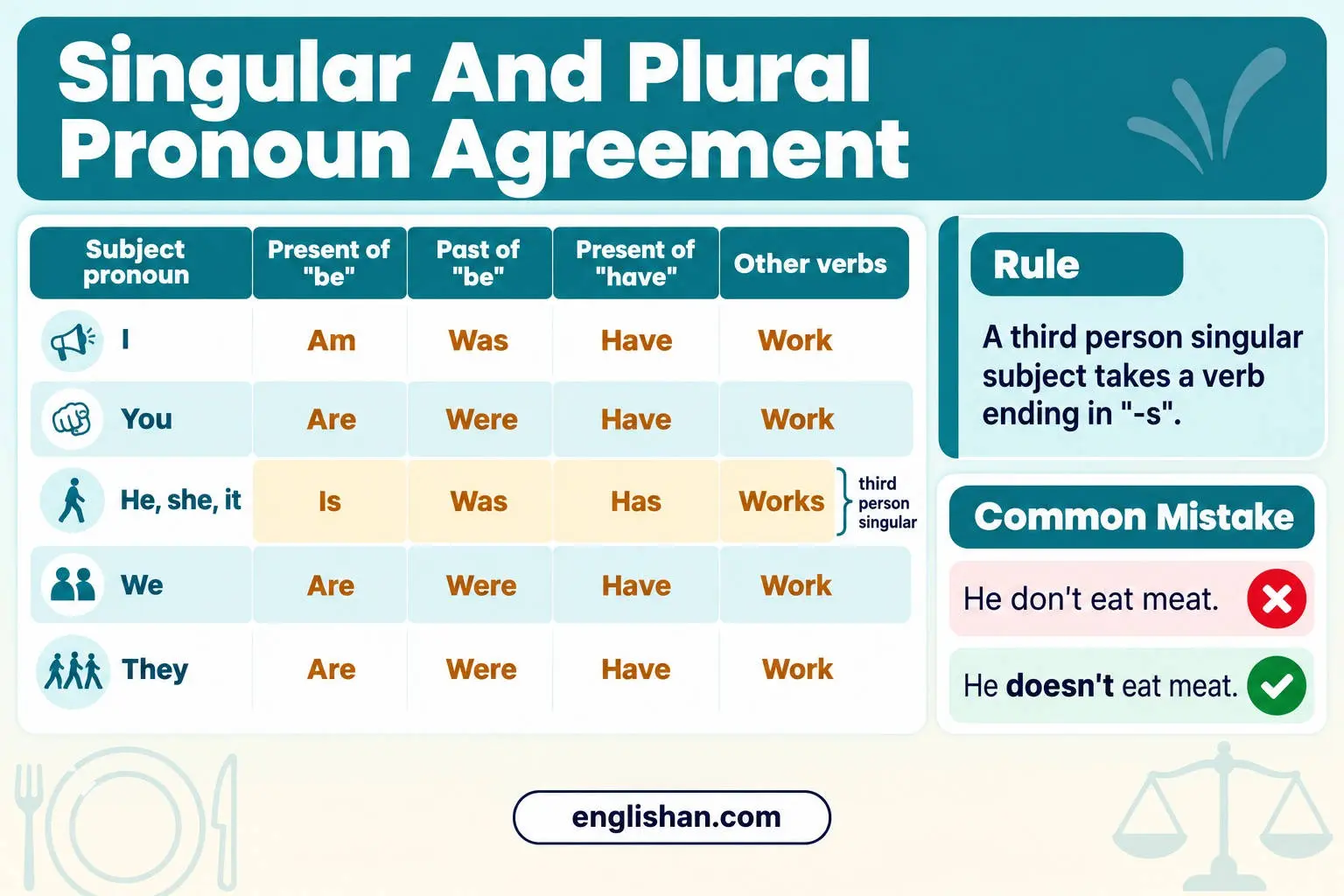
A subject pronoun agrees with its verb in number. In the present simple, a third person singular subject takes a verb ending in “-s”, and the other subject pronouns take the base form. The third person singular includes “he”, “she”, “it”, and the singular indefinite pronouns.
| Subject pronoun | Present of “be” | Past of “be” | Present of “have” | Other verbs |
|---|---|---|---|---|
| I | Am | Was | Have | Work |
| You | Are | Were | Have | Work |
| He, she, it | Is | Was | Has | Works |
| We | Are | Were | Have | Work |
| They | Are | Were | Have | Work |
- She works from home on Fridays.
- It doesn’t matter.
- Does he know the address?
- We were late for the concert.
- They have two cats and a dog.
In questions and negatives, the auxiliary verb agrees with the subject, so “does” and “doesn’t” follow a third person singular pronoun, and “do” and “don’t” follow the others. A subject of two pronouns joined by “and” is plural, so it takes a plural verb, as in “She and I are cousins”.
He don’t eat meat. ❌
He doesn’t eat meat. ✅
A third person singular subject takes “doesn’t”, not “don’t”.
Collective nouns: A collective noun such as “team” or “company” names a group of people, and in American English it usually takes a singular verb and “it”, as in “The company has changed its logo”. A plural verb and “they” are also common in British English when the sentence is about the members, as in “The team are celebrating their win”. In formal writing, the verb and the pronoun after a collective noun keep the same number.
FAQs
Plural in form: "are" is the present form of "be" after "we", "they", and "you". The pronoun "you" takes "are" even for one person, and singular "they" does too. The singular forms of "be" in the present are "am" after "I" and "is" after "he", "she", and "it".
Both, depending on the sentence. In a question, subject "who" usually takes a singular verb: "Who wants dessert?" Before a plural noun, "be" is plural: "Who are your neighbors?" As a relative pronoun, "who" takes the number of the noun before it, so "the girl who sings" and "the girls who sing".
That depends on the noun after "of". With an uncountable noun, "any" takes a singular verb, as in "Is any of the soup left?" With a plural noun, a plural verb is usual, as in "Are any of your friends coming?"
Either, because a possessive pronoun shows the number of the owner, not the number of the thing owned. The pronoun "mine" refers to one owner and "ours" to two or more, but either can replace a singular or a plural noun. The verb agrees with the noun the possessive pronoun replaces: "Mine is blue" for one bag and "Mine are blue" for two bags.
Related:
- Pronouns
- Types of Pronouns
- Pronoun Case
- Indefinite Pronouns Singular or Plural
- Pronoun and Verb Agreement
- Pronoun Antecedent Agreement
