

Pronoun and verb agreement is the rule that a verb agrees with its subject pronoun in person and number. In the present simple, a verb after “he”, “she”, or “it” ends in “-s”, as in “She works nights”, and the verb “be” has three present forms: “am”, “is”, and “are”.
Only a few verb forms change for the subject: the forms of “be”, “has”, “does”, and the “-s” ending of the present simple. Those forms appear in most present tense sentences, so the agreement rules apply mainly to the present tense and to the verb “be”.
What Is Pronoun And Verb Agreement?
Pronoun and verb agreement is the match between a subject pronoun and the form of its verb. A subject pronoun is a pronoun that functions as the subject of a verb, such as “I”, “she”, or “they”. The verb takes the form for the person of that pronoun, first, second, or third, and for its number, singular or plural.
- I am at the station now.
- She has a meeting at ten.
- They live on the third floor.
- Does he take sugar in his coffee?
- We were late for the film.
The third person singular “she” takes “has”, while “they” takes the base form “live” with no ending.
A pronoun also matches the noun it replaces in number, as in “The players lost their match”. That match between a pronoun and its noun is pronoun-antecedent agreement, and it follows separate rules from the agreement between a pronoun and its verb.
Pronoun Verb Agreement Chart
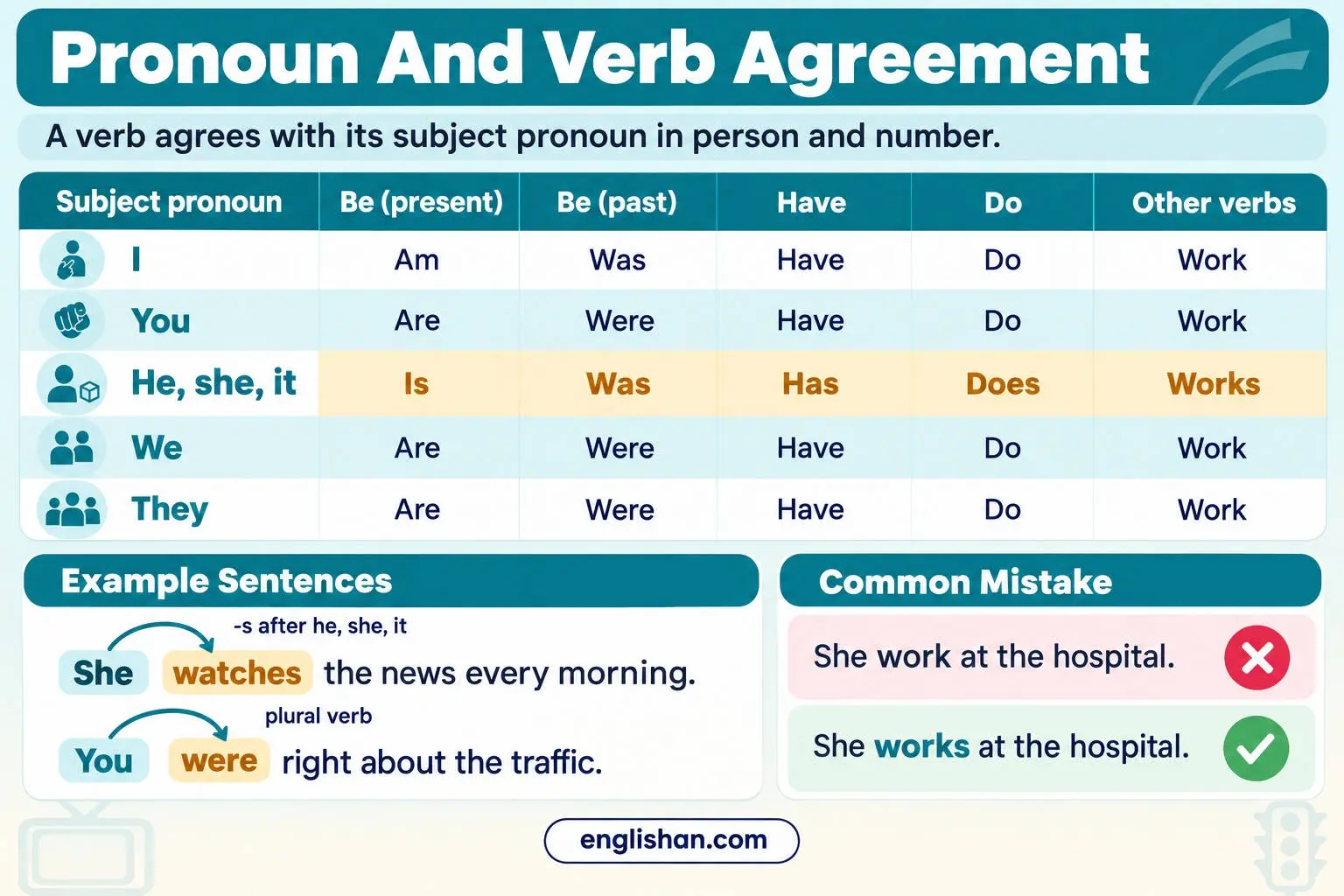
The verbs “be”, “have”, and “do” have special forms for different pronouns, and other verbs add “-s” only after a third person singular pronoun.
| Subject pronoun | Be (present) | Be (past) | Have | Do | Other verbs |
|---|---|---|---|---|---|
| I | Am | Was | Have | Do | Work |
| You | Are | Were | Have | Do | Work |
| He, she, it | Is | Was | Has | Does | Works |
| We | Are | Were | Have | Do | Work |
| They | Are | Were | Have | Do | Work |
- I am on my way.
- You were right about the traffic.
- The new phone is light, and it has a large screen.
- He does the shopping on Saturdays.
- We have a spare room for guests.
- She watches the news every morning.
The “-s” ending follows the spelling of plural nouns. Verbs ending in “-s”, “-sh”, “-ch”, “-x”, or “-o” add “-es” (“watches”, “goes”), and a verb ending in a consonant and “-y” changes to “-ies” (“studies”). The verb “have” changes to “has”, never “haves”.
She work at the hospital. ❌
She works at the hospital. ✅
A third person singular subject pronoun takes the “-s” form of the verb in the present simple.
Pronoun Verb Agreement Rules
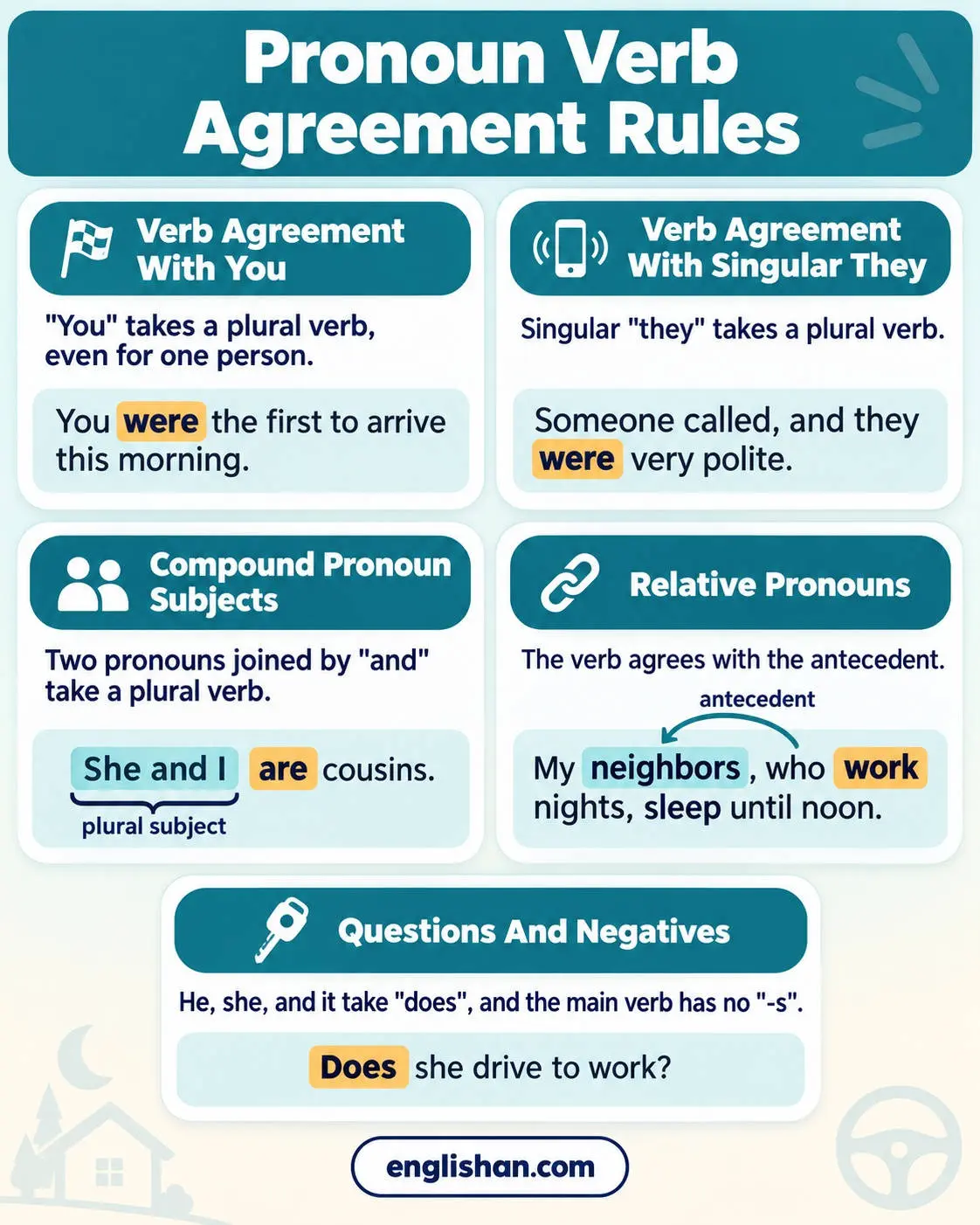
Pronoun verb agreement rules follow one principle: the verb takes the person and number of its subject. The harder cases come from pronouns whose number is not obvious, such as “you”, singular “they”, and “who”, and from compound subjects of two pronouns.
Indefinite pronouns: Indefinite pronoun agreement depends on the word: “everyone”, “nobody”, and “something” take a singular verb, as in “Everyone is here”, while “both”, “few”, and “many” take a plural verb. Some indefinite pronouns, such as “all”, “some”, and “none”, take a singular or a plural verb, depending on the noun after “of”.
Verb Agreement With You
The pronoun “you” takes a plural verb, even when it refers to one person. The present of “be” after “you” is “are”, the past is “were”, and other verbs take the base form with no “-s”.
- Are you ready, Daniel? (one person)
- You were the first to arrive this morning. (one person)
- You were all very patient with the delay. (a group)
- Do you need a receipt?
You was late again this morning. ❌
You were late again this morning. ✅
The past of “be” after “you” is “were” for one listener and for a group.
Verb Agreement With Singular They
Singular “they” refers to one person, often after “someone”, “anyone”, or a noun such as “a customer”, and it takes the same plural verb as plural “they”.
- Someone called, and they were very polite.
- If a student is absent, they need a note from home.
- Ask the driver whether they have change.
The new tenant says they is moving in on Friday. ❌
The new tenant says they are moving in on Friday. ✅
Singular “they” takes “are”, “were”, “have”, and the base form, never “is”, “was”, or “has”.
Compound Pronoun Subjects
A compound subject of two pronouns joined by “and” is plural, so the verb is plural too, as in “He and I are neighbors”. A pronoun joined to a noun by “and” also takes a plural verb.
- She and I are cousins.
- You and he have the same birthday.
- He and his brother share a car.
With “or” or “nor”, the verb agrees with the pronoun closer to it. That rule gives “Either you or she has the key” and “Neither she nor I am ready”.
Him and me are on the same team. ❌
He and I are on the same team. ✅
A compound subject takes subject pronouns such as “he” and “I”, and the verb agrees with the whole subject.
Relative Pronouns And Verb Agreement
A relative pronoun such as “who”, “which”, or “that” has one form for both numbers. When it is the subject of a relative clause, the verb agrees with its antecedent, the noun or pronoun before it.
- My neighbor, who works nights, sleeps until noon.
- My neighbors, who work nights, sleep until noon.
- I want a phone that lasts all day.
- The trains that stop here are often late.
The antecedent changes after “one of the” and “the only one”. After “one of the” and a plural noun, “who” refers to the plural noun, so the verb is plural in formal writing, although a singular verb is common in speech. After “the only one”, “who” refers to “one”, so the verb is singular.
- Maria is one of the nurses who speak Spanish.
- Maria is the only one of the nurses who speaks Spanish.
The students who was in the library missed the bus. ❌
The students who were in the library missed the bus. ✅
The relative pronoun “who” refers to “students”, so the verb in the relative clause is plural.
Pronouns In Questions And Negatives
In questions and negatives, the auxiliary verb agrees with the subject pronoun, and the main verb stays in the base form. Present simple questions and negatives take “does” and “doesn’t” after a third person singular pronoun, and “do” and “don’t” after “I”, “you”, “we”, and “they”.
- Does she drive to work?
- Do they know the address?
- It doesn’t open until nine.
- Are you coming to dinner tonight?
- Has he finished the report yet?
The auxiliary comes before the pronoun in a question, so the auxiliary agrees with the pronoun. The “-s” ending moves to the auxiliary, and “She works” becomes “Does she work?”, not “Does she works?”.
Do she work on Saturdays? ❌
Does she work on Saturdays? ✅
A third person singular pronoun takes “does”, and the main verb after it has no “-s”.
Subject Pronoun And Verb Agreement
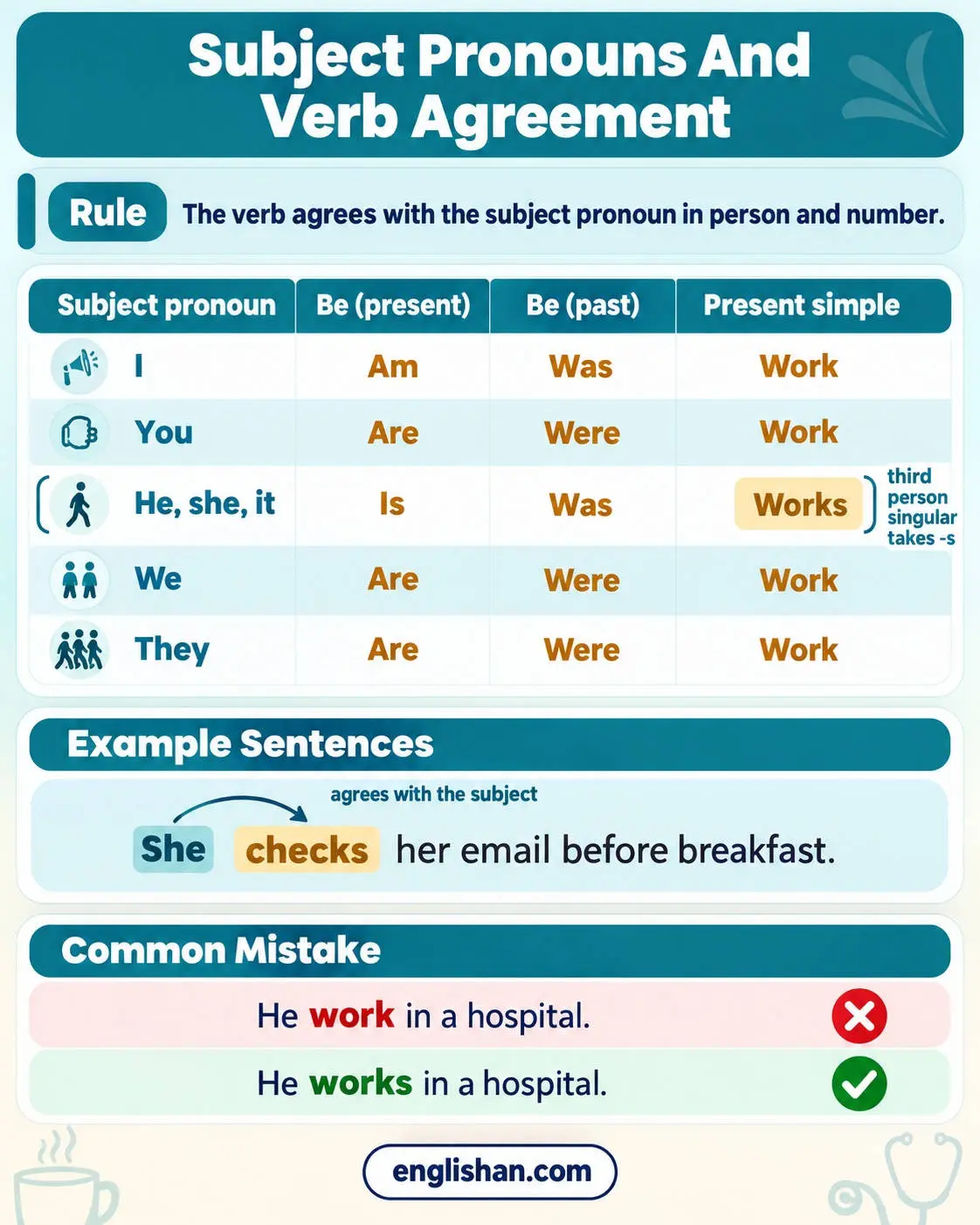
In subject pronoun and verb agreement, the verb agrees with the pronoun that is the subject of its clause, not with a noun or pronoun that comes between the subject and the verb. Phrases with “along with”, “as well as”, “like”, and “with” describe or add to the subject, but they are not part of it.
- She, along with her two brothers, runs the bakery.
- He, like his parents, speaks three languages.
- They, as well as their coach, were on the bus.
- The noise from the street bothers them at night.
The object in the last example is “them”, and the subject is “noise”, so the verb is singular. In a sentence that opens with “there”, the verb agrees with the noun after it, because “there” is a dummy pronoun with no number of its own, as in “There is a problem” and “There are two problems”.
She, along with her sisters, own the shop. ❌
She, along with her sisters, owns the shop. ✅
The subject is “she”, so the verb takes the “-s” form, and “along with her sisters” is not part of the subject.
FAQs
Not exactly. Pronoun and verb agreement is the part of subject-verb agreement where the subject is a pronoun. Subject-verb agreement also applies to noun subjects, as in "The bus leaves" and "The buses leave", and a singular noun takes the same verb form as "it".
Both, depending on the sentence. As a question word, "who" usually takes a singular verb, as in "Who wants coffee?", but "be" is plural before a plural noun, as in "Who are those people?" As a relative pronoun, "who" takes the number of the noun it refers to.
The correct form is "I who am", because "who" refers to "I" and the verb agrees with "I". The same rule gives "you who are" and "It is I who am responsible". In everyday speech, "It’s me who’s late" is also common, with a third person verb after "who".
Only with the verb "be". In the past simple, "I", "he", "she", and "it" take "was", and "you", "we", and "they" take "were", but other verbs keep one past form after every pronoun, as in "I worked" and "she worked". In an unreal condition after "if", "were" is standard with every pronoun in formal English, as in "If I were you".
No, modal verbs such as "can", "will", "must", and "should" keep one form after every pronoun, so "she can" never takes "-s". The main verb after a modal also stays in the base form, so "He can swim" is correct and "He can swims" is not.
Related:
- Pronouns
- Pronoun Rules and Correct Usage
- Singular and Plural Pronouns
- Third Person Pronouns
- Second Person Pronouns
- Distributive Pronouns
