

Subject pronouns are the personal pronouns that function as the subject of a verb: “I”, “you”, “he”, “she”, “it”, “we”, and “they”. A subject pronoun replaces a noun phrase that names the person or thing doing the action, as in “She works nights” and “They live in Ohio.”
Most of these pronouns have a separate object form, such as “me” for “I” and “them” for “they”, and the function of the pronoun in the clause shows which form is correct. Before the verb in a statement, the choice is usually plain, so the harder cases come after “than” and “as”, after a linking verb, and inside a subject of two or more parts.
What Are Subject Pronouns?
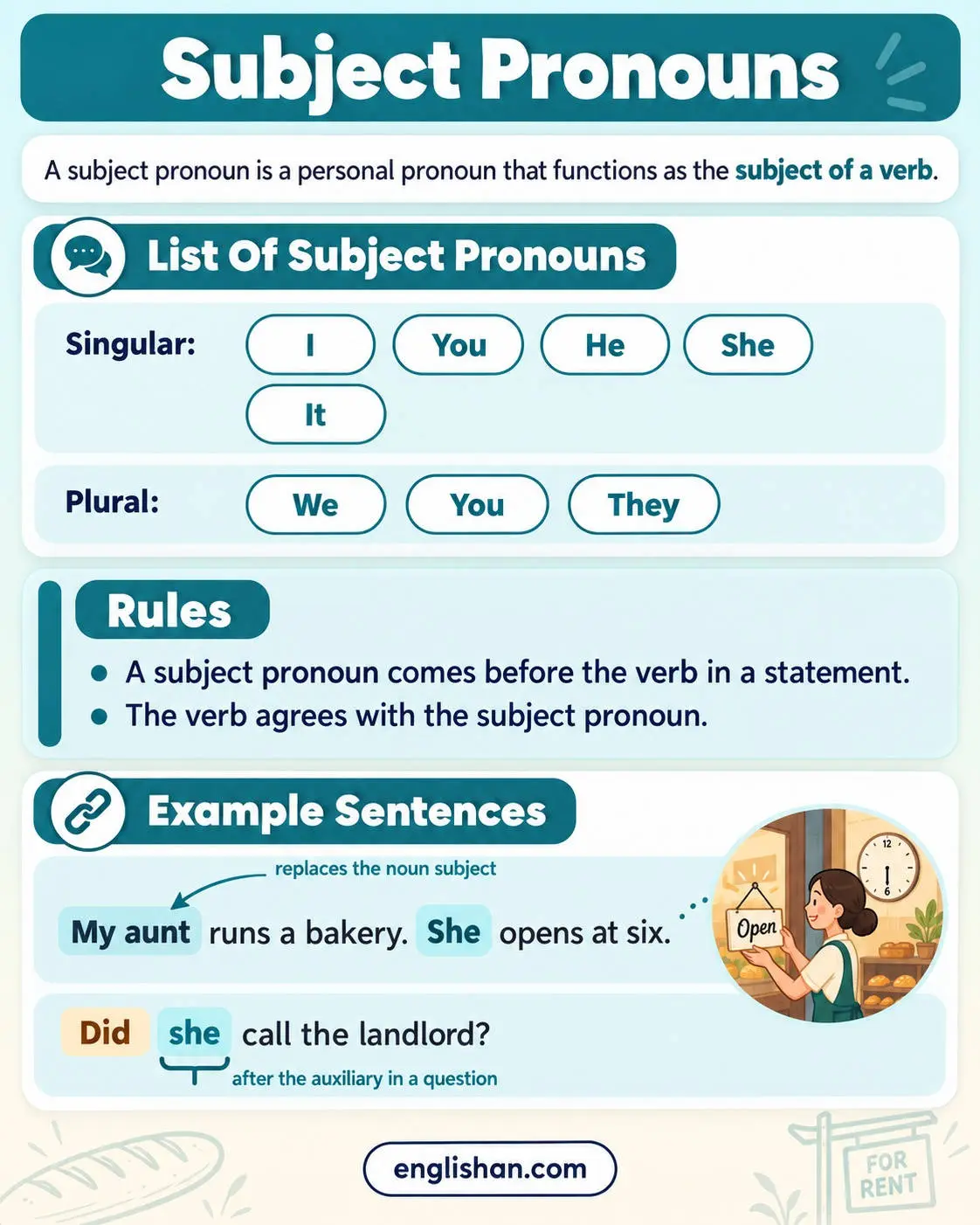
A subject pronoun is a personal pronoun that functions as the subject of a verb, the person or thing that does the action or is in the state the verb describes. Subject pronouns are also called subjective pronouns. The pronoun takes the place of a noun subject that the listener already knows:
- My aunt runs a bakery. She opens at six.
- The printer is jammed again. It needs a new roller.
- Omar and Lucia moved to Denver. They rent a small apartment.
- You and I work the same shift. We start at noon.
In each second sentence, the noun subject from the first sentence is replaced, and the verb that follows agrees with the pronoun. Object pronouns such as “me”, “him”, and “them” function as the object of a verb or a preposition instead, as in “Lucia called him.”
List Of Subject Pronouns
There are seven personal subject pronouns, and each one shows a person and a number:
| Subject pronoun | Person | Number | Refers to |
|---|---|---|---|
| I | First | Singular | The speaker |
| You | Second | Singular or plural | The listener or listeners |
| He | Third | Singular | A man or a boy |
| She | Third | Singular | A woman or a girl |
| It | Third | Singular | A thing, an animal, or an idea |
| We | First | Plural | The speaker and one or more others |
| They | Third | Plural | Two or more people or things |
A weekend camping trip has a sentence for every subject pronoun:
- I packed the tent.
- You forgot the flashlight again.
- He set up the stove.
- She found a spot near the lake.
- It rained all night.
- We stayed dry inside.
- They arrived the next morning.
First person pronouns refer to the speaker, second person pronouns to the listener, and third person pronouns to everyone and everything else. The pronoun “who” is also a subject form, both in a question such as “Who called?” and in a relative clause such as “the nurse who called”, and its object form is “whom“.
Uses Of Subject Pronouns
Subject pronouns function as the subject of a verb that shows tense, such as “works”, “worked”, or “will work”. The same forms appear in a main clause, in a question, and in a clause that begins with “because”, “when”, or “that”:
- We finished the report on Friday.
- Did she call the landlord?
- The bus was late, so I took a taxi.
- Marco says he will drive.
A subject pronoun keeps its form in all of these clauses, so the choice of form depends only on its function as the subject.
Position Of Subject Pronouns In A Sentence
In a statement, the subject pronoun comes before the verb. In a question, the first auxiliary verb comes before the subject pronoun, and the main verb follows it. The auxiliary is a form of “be”, “do”, or “have”, or a modal verb such as “can”, and so does the main verb “be”:
- They usually eat dinner at seven.
- Are you ready for the interview?
- Where did he put the receipt?
- Can we park here?
Where a statement has no auxiliary verb, a question adds “do”, “does”, or “did” before the pronoun.
Where you put the receipt? ❌
Where did you put the receipt? ✅
In a question, the auxiliary comes before the subject pronoun, even after a question word such as “where”.
Compound Subject Pronouns
A compound subject is a subject with two or more parts joined by “and” or “or”, and every pronoun in it takes the subject form. By convention, “I” comes last when the speaker names another person too:
- My sister and I share a car.
- He and his partner run a small café.
- Either you or she will lead the meeting.
Me and my sister share a car. ❌
My sister and I share a car. ✅
To choose the form, leave out the other person: “I share a car” is correct, and “Me share a car” is not.
The subject form belongs to the subject only. After a preposition, a pair of pronouns takes the object form, so “between you and me” is correct and “between you and I” is not.
Subject Pronouns After Than And As
In formal English, a subject pronoun follows “than” or “as” when the pronoun is the subject of a verb, and the verb is usually stated after it. In everyday English, the object form follows “than” or “as” with no verb:
- Nadia types faster than I do.
- Our team worked as hard as they did.
- My brother is taller than I am.
- My brother is taller than me. (everyday)
Nadia types faster than me do. ❌
Nadia types faster than I do. ✅
With a verb after it, the pronoun is the subject of that verb, so only “I” is correct.
The choice of form can change the meaning when the main verb has an object. In “Sam likes Ana more than I”, the meaning is more than I like Ana, while “more than me” can mean more than Sam likes me. Adding the verb, as in “more than I do”, keeps the meaning plain in formal and everyday English.
Subject Pronouns After Linking Verbs
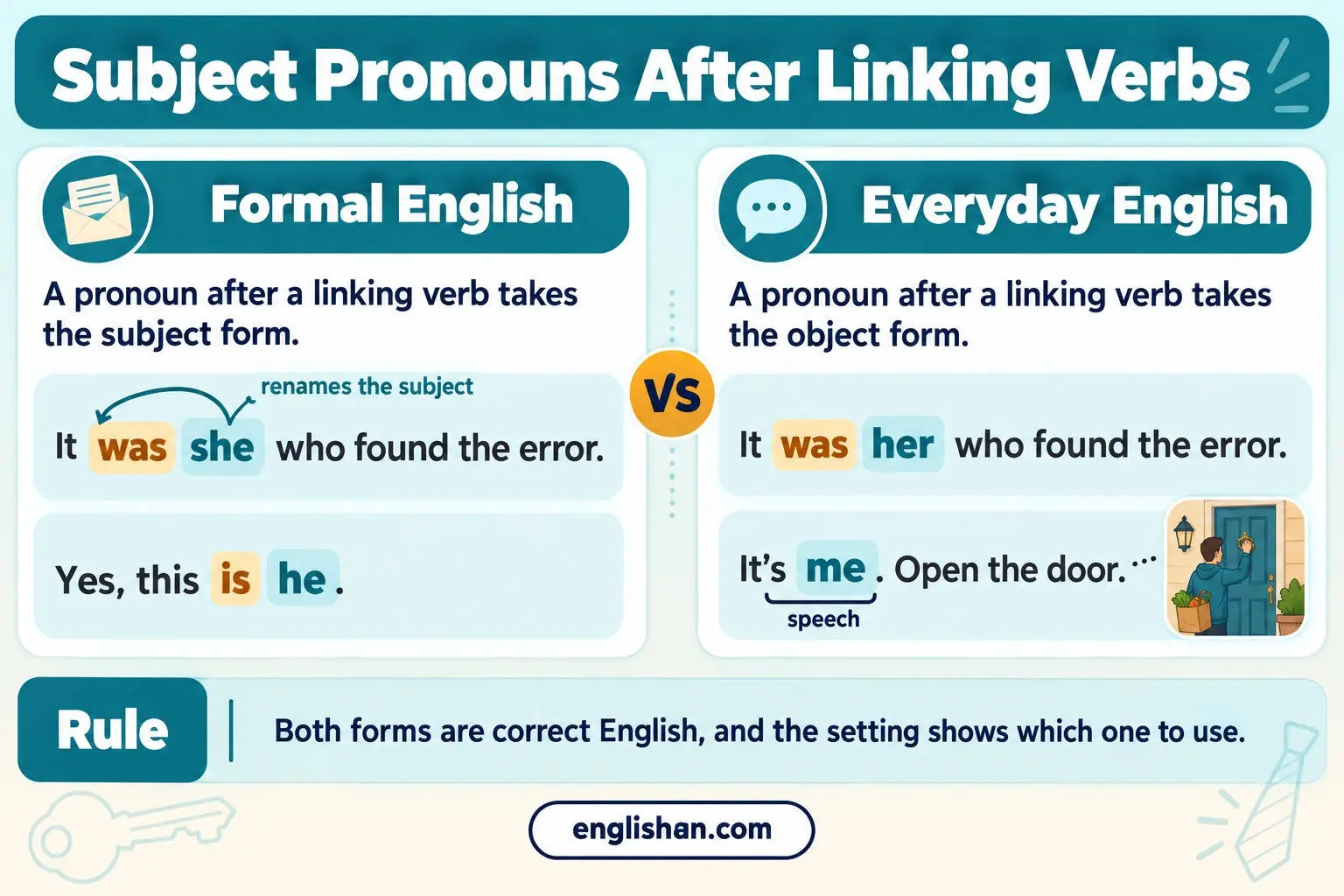
A linking verb such as “be” joins the subject to a word that describes or renames it, called a subject complement. In formal English, a pronoun after a linking verb takes the subject form, because it renames the subject. In everyday speech and informal writing, the object form is standard:
- It was she who found the error. (formal)
- It was her who found the error. (everyday)
- Yes, this is he. (formal, on the phone)
- It’s me. Open the door. (everyday)
Both forms are correct English, and the setting shows which one to use. Formal writing, such as a report or a letter, takes “It was she” and “This is he”, while conversation takes “It’s me” and “That’s him”.
Subject Pronouns And Their Antecedents
An antecedent is the noun or noun phrase that a pronoun refers to, usually mentioned earlier in the sentence or in the sentence before. A subject pronoun agrees with its antecedent in number, and “he”, “she”, and “it” also match the person or thing they refer to:
- The pharmacist checked the label before she handed over the bottle.
- The old laptop still turns on, but it runs slowly.
- My cousins visited in June, and they stayed for a week.
The pronoun “they” also refers to one person when the antecedent is “someone”, “anyone”, or a person the speaker does not name, as in “Someone left a message, but they didn’t give a name.” With this antecedent, “they” still takes a plural verb.
A subject pronoun replaces its antecedent, so a clause has either the noun subject or the pronoun, not both.
My brother he works at the airport. ❌
My brother works at the airport. ✅
The noun phrase “my brother” is already the subject of “works”, so a second subject is wrong. In casual speech, a speaker sometimes names the subject and then repeats it as a pronoun, but written English keeps one subject for each verb.
Subject Pronouns And Verb Agreement
The verb agrees with the subject pronoun in person and number. In the present simple, “he”, “she”, and “it” take a verb ending in “-s”, and the other subject pronouns take the base form. The verb “be” has three present forms and two past forms:
| Subject pronoun | Be (present) | Be (past) | Present simple |
|---|---|---|---|
| I | Am | Was | Work |
| You | Are | Were | Work |
| He, she, it | Is | Was | Works |
| We | Are | Were | Work |
| They | Are | Were | Work |
Only present forms and the past of “be” change with the subject pronoun, so other past forms and modal verbs have one form for every person:
- She checks her email before breakfast.
- It has two bedrooms and a balcony.
- They were at the gym all afternoon.
- We worked late on Friday.
He work in a hospital. ❌
He works in a hospital. ✅
A third person singular subject pronoun takes the “-s” form of the verb in the present simple.
Omission Of Subject Pronouns
An English statement or question has a stated subject, so the subject pronoun stays in the sentence even when the verb form already shows the person. Weather, time, and distance take “it” as the subject, a dummy pronoun with no meaning of its own:
- It is raining again.
- It is almost midnight.
- How far is it to the station?
Is raining again. ❌
It is raining again. ✅
A verb in a statement takes a subject, so “it” functions as the subject when no person or thing does the action.
An imperative, the verb form for an order or a request, has no stated subject, as in “Close the window”. In informal messages and speech, “I” or “it” is often dropped at the start, as in “Hope you’re well” and “Sounds good”, but formal writing keeps the pronoun.
The subject of a second verb can be left out when “and”, “but”, or “or” joins two verbs with one subject:
- She locked the door and left.
After “because”, “when”, or “if”, the clause has its own subject pronoun, even when the subject is the same person.
I stayed home because was sick. ❌
I stayed home because I was sick. ✅
The word “because” introduces a new clause, and a new clause takes its own subject.
Identification Of Subject Pronouns In A Sentence
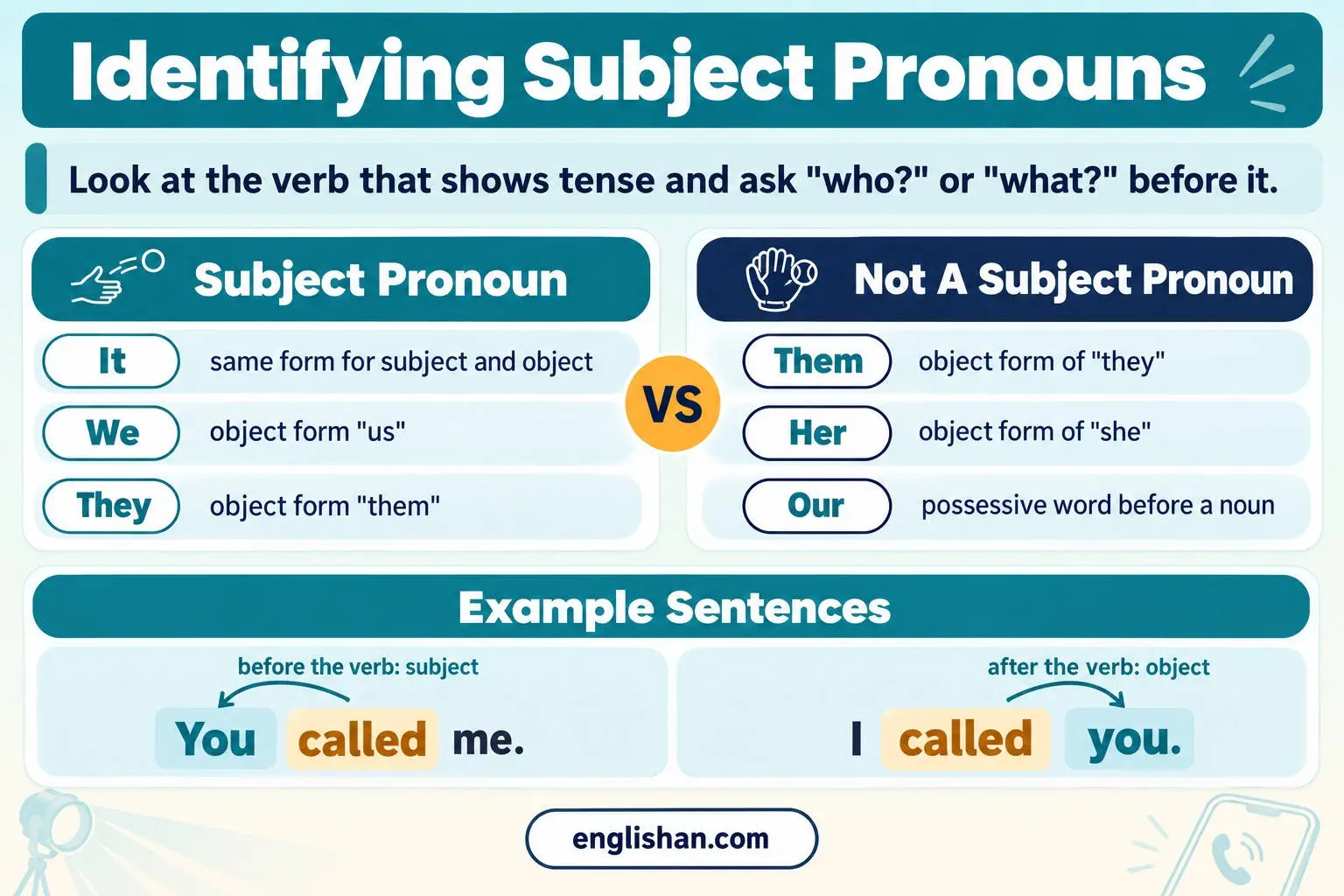
A subject pronoun is one of the seven forms in the list, and in a statement it comes before the verb and names who or what does the action. To find it, look at the verb that shows tense and ask “who?” or “what?” before it. Words that look similar are often object forms, possessive words, or other pronoun types:
| Word | Subject pronoun? | Reason |
|---|---|---|
| It | Yes | The subject and object forms are the same: “It broke.” / “I fixed it.” |
| We | Yes | Subject form of the first person plural; the object form is “us” |
| They | Yes | Subject form of the third person plural; the object form is “them” |
| Them | No | Object form of “they”: “I called them.” |
| Her | No | Object form of “she”, and a possessive word before a noun: “her bag” |
| Our | No | Possessive word before a noun: “our car” |
| Whose | No | Possessive form of “who”: “Whose coat is this?” |
| That | Not a personal pronoun | Demonstrative or relative pronoun; it can still be the subject: “That is my bus.” |
The pronouns “you” and “it” have one form for the subject and the object, so only the position shows the function. In “You called me”, “you” comes before the verb and is the subject pronoun, and in “I called you”, it comes after the verb and is the object.
FAQs
No, subject pronouns are one form of the personal pronouns. The personal pronouns also have object forms such as "me" and "them" and possessive forms such as "mine" and "theirs". So "I" and "me" are both personal pronouns, but only "I" is a subject pronoun.
No. Pronouns are a word class of their own, separate from nouns. A subject pronoun replaces a noun or noun phrase and functions as the subject, just as a noun can. Unlike a noun, it takes no article and changes form for case, as in "he" and "him".
Yes, "nominative" and "subjective" are two names for the same case, the form of a pronoun used as the subject. Both names describe the forms "I", "you", "he", "she", "it", "we", and "they", and the object forms belong to the objective case.
Both, because "you" addresses one listener or several with the same form. It always takes a plural verb, as in "You are late" and "You were right", even when it refers to one person. To show the plural, everyday speech often adds a word, as in "you all" or "you two".
Related:
- Pronouns
- Types of Pronouns
- Second Person Pronouns
- Third Person Pronouns
- Pronoun Case
- Singular and Plural Pronouns
- Subject vs Object Pronouns
- Pronoun and Verb Agreement
- Pronoun Antecedent Agreement
