

The words “who” and “whom” are pronouns that refer to people, and both introduce questions and relative clauses. The form “who” is the subject of a verb, while “whom” is the object of a verb or a preposition. The choice of who vs whom depends on the job of the pronoun in its own clause, as in “Who called?” and “Whom did you call?”.
Word order alone does not show that job, because both forms usually come at the start of the question or clause. A short answer with “he” or “him” shows the case of the pronoun, and the formal and everyday forms differ only in the object position.
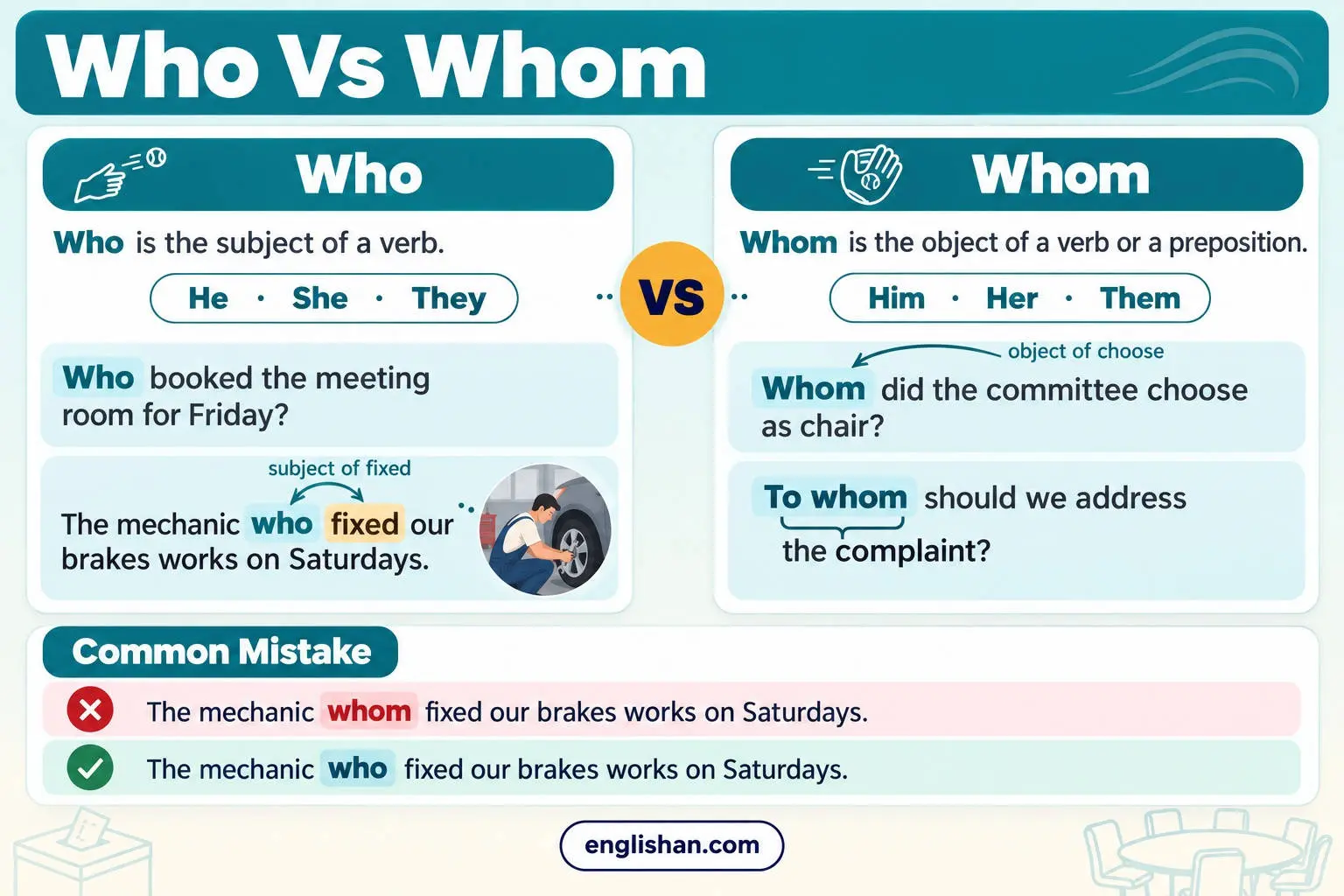
What Is The Difference Between Who And Whom?
The difference in who vs whom is case: “who” is in the subjective case, and “whom” is in the objective case. Both words have one form for singular and plural, and both usually refer to people, while “which” refers to things. The two forms compare point by point in one table:
| Point | Who | Whom |
|---|---|---|
| Case | Subjective | Objective |
| Function in its clause | Subject of a verb | Object of a verb or a preposition |
| Matching personal pronouns | He, she, they | Him, her, them |
| Object of a preposition placed before it | Not standard | Standard |
| As the object of a verb | Everyday English | Formal English |
| In a question | Who booked the room? | Whom did the manager thank? |
| In a relative clause | The guest who booked the room | The guest whom the manager thanked |
The pair follows the same rule of pronoun case as “he” and “him”. In a question, “who” and “whom” are interrogative pronouns. In a relative clause, they are relative pronouns that refer back to a noun for a person.
A third form, “whose”, is the possessive, as in “Whose bag is this?”. The spelling question of who’s vs whose is a separate point: “who’s” is the short form of “who is” or “who has”.
Uses Of Who
The pronoun “who” functions as the subject of a verb, so the verb in its clause has no other subject. In a question, “who” asks about the person doing the action, and the verb follows it directly:
- Who booked the meeting room for Friday?
- Who hasn’t paid for the concert tickets yet?
- Who wants the last slice of pizza?
A question with “who” as the subject keeps statement word order. The auxiliary “do” is not added in the present simple or the past simple, except for emphasis, so the question “Who called you?” has no “did”.
Who did call you this morning? ❌
Who called you this morning? ✅
In the correct question, “who” is the subject of “called”, so the question takes the same word order as the answer “She called me”.
In a relative clause, “who” is the subject of the verb inside the clause, and it refers to the noun before it:
- The mechanic who fixed our brakes works on Saturdays.
- Students who finish the exam early can leave the room.
- My cousin, who lives in Toronto, is visiting in May.
A common error with this pronoun is the objective form in subject position:
The mechanic whom fixed our brakes works on Saturdays. ❌
The mechanic who fixed our brakes works on Saturdays. ✅
As the subject of “fixed”, the pronoun takes the subjective form.
Uses Of Whom
The pronoun “whom” functions as the object of a verb or a preposition, so another word in its clause is the subject. In a question, “whom” comes first, and the auxiliary and the subject follow it:
- Whom did the committee choose as chair?
- Whom will you invite to the launch party?
- Whom are they interviewing this afternoon?
In a relative clause, “whom” is the object of the verb inside the clause, and the subject of that verb comes after it:
- The tenant whom the landlord warned has moved out.
- The two engineers whom we hired last spring both left in June.
- Ms. Ortiz, whom most parents know from the soccer club, runs the school library.
A defining relative clause, one with no commas, can leave the object pronoun out or replace it with “that”, as in “the tenant the landlord warned” and “the tenant that the landlord warned”. A non-defining clause, between commas, keeps the pronoun and never takes “that”. In that position, the object pronoun is “whom” in formal writing and “who” in everyday English.
Use Of Whom After Prepositions
When a preposition comes directly before the pronoun and the pronoun is its object, the standard form is “whom”. The preposition and “whom” together come at the start of the question or relative clause:
- To whom should we address the complaint?
- The family for whom we cooked dinner arrived an hour late.
- Mr. Shah, from whom we rent the apartment, lives upstairs.
- She asked with whom I had traveled.
The pronoun is the object of the preposition, so the subject form “who” is not standard in this position:
With who did you travel to Lisbon? ❌
With whom did you travel to Lisbon? ✅
After “with”, the pronoun is an object, so it takes the objective form.
The one exception is a pronoun that is the subject of its own verb after the preposition, as in “We argued about who should pay”. There, “who” is the subject of “should pay”, and the preposition has the whole clause as its object.
Preposition at the end: In everyday English, the preposition usually comes at the end of the question or clause, and the pronoun then takes the form “who”:
- Who did you talk to at the bank?
- Who is this parcel for?
- That’s the colleague who I share a desk with.
With the preposition at the end, “whom” is grammatical but rare outside formal writing, as in “Whom did you speak to?”. In a defining relative clause, the pronoun is often left out, so “the colleague I share a desk with” is a common everyday form.
He And Him For Who Vs Whom
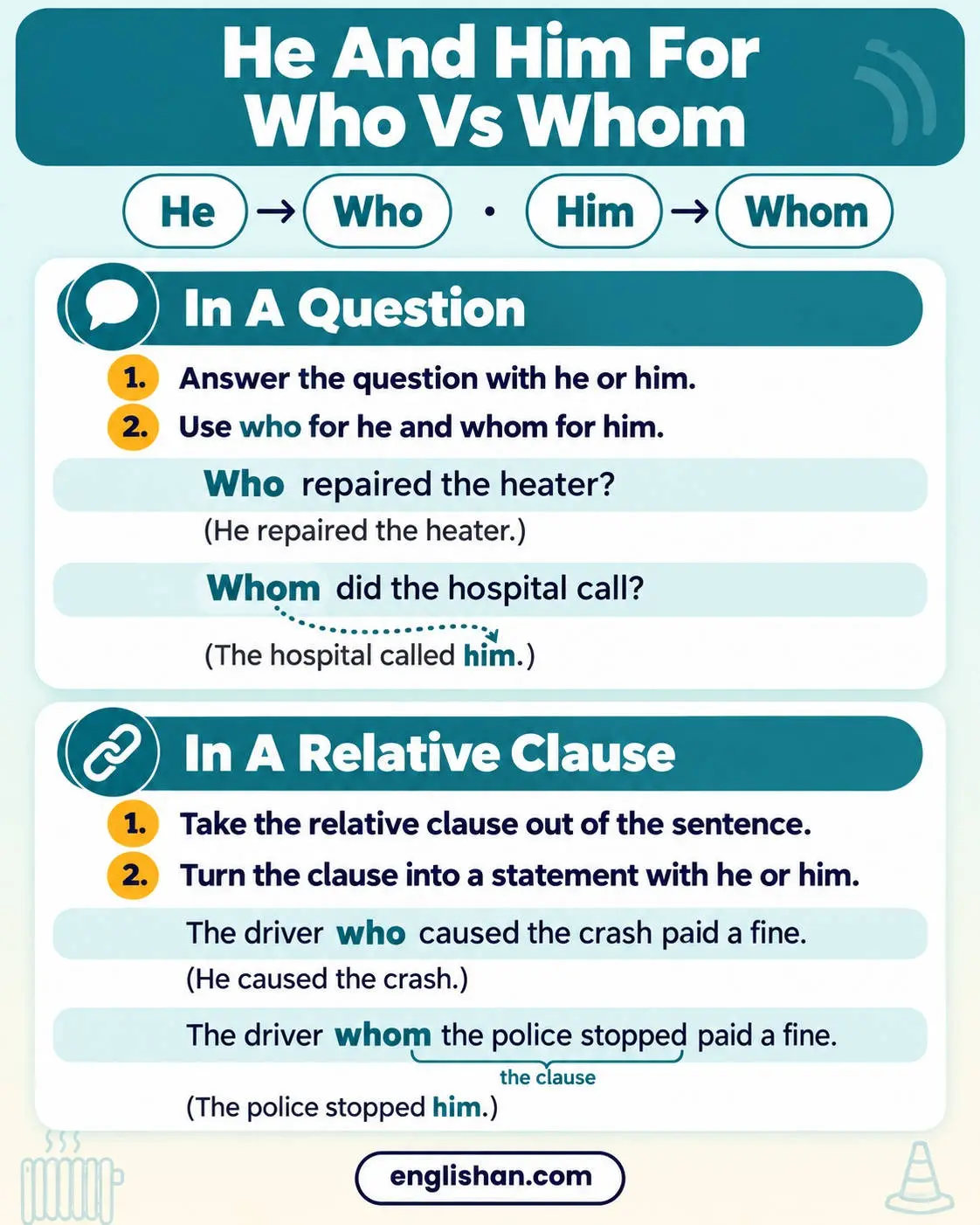
The personal pronouns “he” and “him” have the same subject and object split as “who” and “whom”, so a version of the sentence with “he” or “him” shows the right form. Both “him” and “whom” end in “m”, and both are objective forms. For a plural noun, “they” and “them” replace “he” and “him” in the same steps.
In a question: The answer to a who vs whom question shows the case.
- Answer the question with “he” or “him”.
- Use “who” where the answer takes “he”.
- Use “whom” where the answer takes “him”.
The answers show the form in three questions:
- Who repaired the heater? (He repaired the heater.)
- Whom did the hospital call? (The hospital called him.)
- Whom should we thank for the flowers? (We should thank him.)
In a relative clause: The clause becomes a short statement of its own.
- Take the relative clause out of the sentence, from “who” or “whom” to the end of the clause.
- Turn the clause into a statement with “he” or “him” in place of the pronoun.
- Use “who” for “he” and “whom” for “him”.
The short statements show the form in three relative clauses:
- The driver who caused the crash paid a fine. (He caused the crash.)
- The driver whom the police stopped paid a fine. (The police stopped him.)
- Is this the tutor whom my sister recommended? (My sister recommended him.)
In most relative clauses, a verb directly after the pronoun shows “who”, and a subject and a verb after it show “whom”. That shortcut fails when a verb such as “think” or “believe” comes between the pronoun and its own verb.
I Think And I Believe With Who Or Whom
After words such as “I think”, “I believe”, “she said”, and “they know”, the pronoun takes the form that matches its own verb in the inner clause. The words “I think” do not change the case, because the object of “think” is the whole clause after it, not the pronoun:
- The candidate who I think is best qualified withdrew her application.
- Ask the nurse who you believe is on duty tonight.
- Who do you think will win the election?
- Who did they say called the office?
Without “I think”, the first example reads “who is best qualified”, and the statement “he is best qualified” takes “he”. The pronoun is the subject of “is”, so it takes the subjective form even though a subject and a verb come straight after it.
The candidate whom I believe was best qualified withdrew her application. ❌
The candidate who I believe was best qualified withdrew her application. ✅
The verb “was” has the pronoun as its subject, so “I believe” leaves it in the subjective case.
The form changes only when the pronoun is the object of the inner verb. In “the candidate whom I think we should hire”, the statement is “we should hire him”, so the formal form is “whom”, and “who” is the everyday form:
- The candidate whom I think we should hire lives nearby.
- Whom do you think the jury believed?
Use Of Who Instead Of Whom
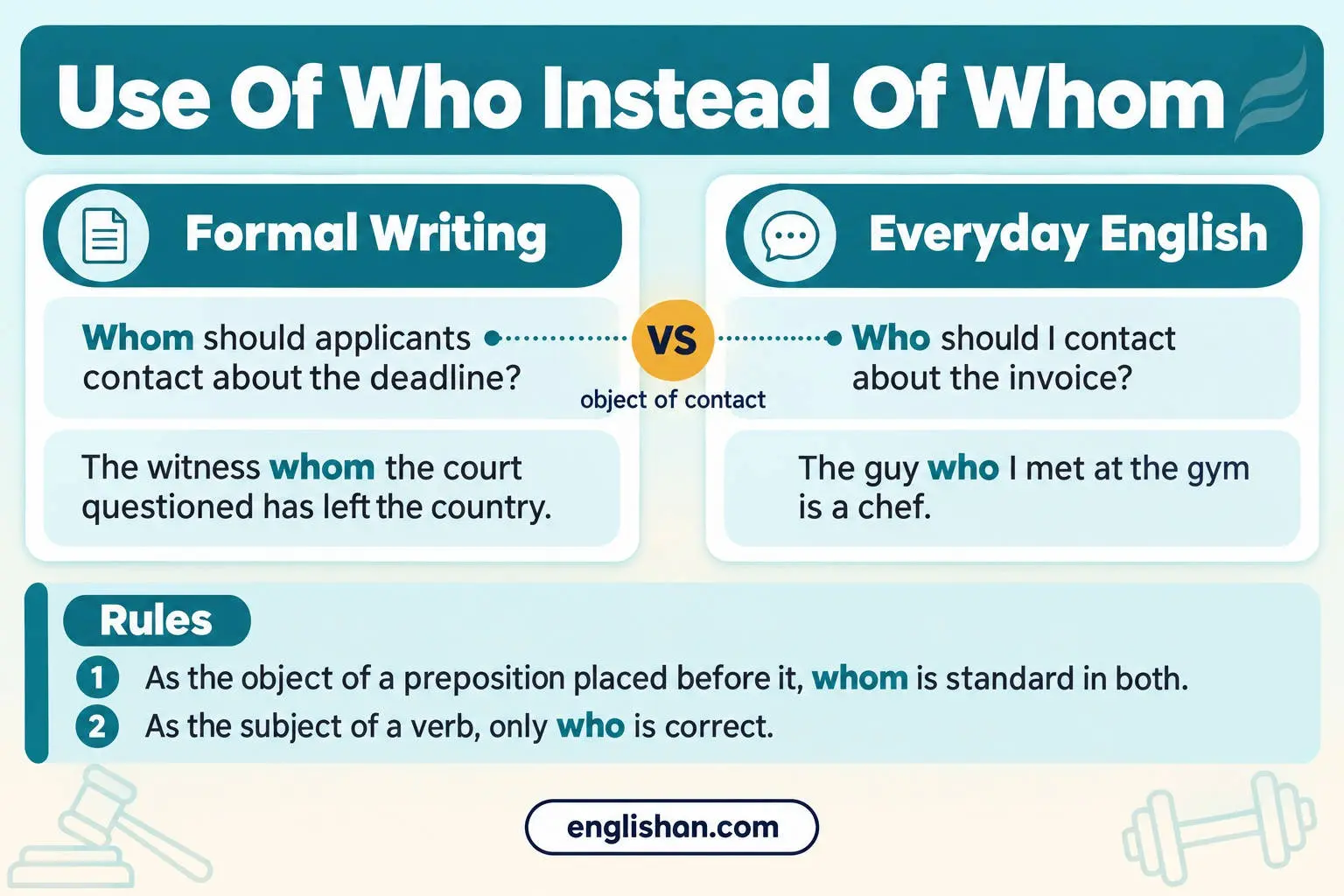
In who vs whom, the use of “who” instead of “whom” is standard for the object of a verb in everyday English. Both forms are correct in that position, and the choice depends on the setting. In formal writing, such as reports, academic essays, and official letters, “whom” is the usual object form. In conversation, messages, and most informal writing, “who” is the usual object form, and “whom” is rare:
- Whom should applicants contact about the deadline? (formal writing)
- Who should I contact about the invoice? (everyday)
- The witness whom the court questioned has left the country. (formal writing)
- The guy who I met at the gym is a chef. (everyday)
The split does not apply in two positions. As the object of a preposition placed before it, “whom” is the standard form in both settings, and in subject position, only “who” is correct. A subject “whom” is an error in formal writing as well, as in “whom I believe was” for “who I believe was”.
The same split between formal and everyday English applies to whoever vs whomever, where the pronoun begins a clause that functions as a noun.
FAQs
Use "who are" when "are" follows the pronoun directly, because the pronoun is then the subject of "are", as in "the volunteers who are on duty". The same applies to "who was", "who will be", and "who have been". The form "whom are" is correct only when "are" is an auxiliary before another subject, as in "Whom are they interviewing?".
The correct question is "Who is he?", because the verb "be" is a linking verb and takes no object. The pronoun "who" is a subject complement in this question, and a subject complement takes the subjective form. The question keeps "who" in formal and everyday English alike.
No, both words have one form for one person and for several people. The verb after "who" agrees with the noun it refers to, as in "the nurse who works nights" and "the nurses who work nights".
Only "both of whom" is standard, because the pronoun is the object of the preposition "of". The same form follows "all of", "some of", "many of", and "none of" in a non-defining relative clause, as in "She has two brothers, both of whom live in Chicago." In this position, "who" is not standard even in everyday English.
Related:
- Pronouns
- Pronoun Rules and Correct Usage
- Subject vs Object Pronouns
- Relative vs Interrogative Pronouns
- Object of Preposition
- Common Pronoun Errors
- I vs Me
- Pronouns With Prepositions
