

Subject and object pronouns are the two forms of a personal pronoun: a subject pronoun is the subject of a verb, and an object pronoun is the object of a verb or a preposition. The pair “she” and “her” refers to one person, so the choice in subject vs object pronouns depends only on the job of the word in its clause, as in “She called” and “Tom called her“.
Most pairs have two different forms, as “I” and “me” or “they” and “them” do, while “you” and “it” keep one form for both jobs. The question word “who” changes form in the same way, with “whom” as its object form.
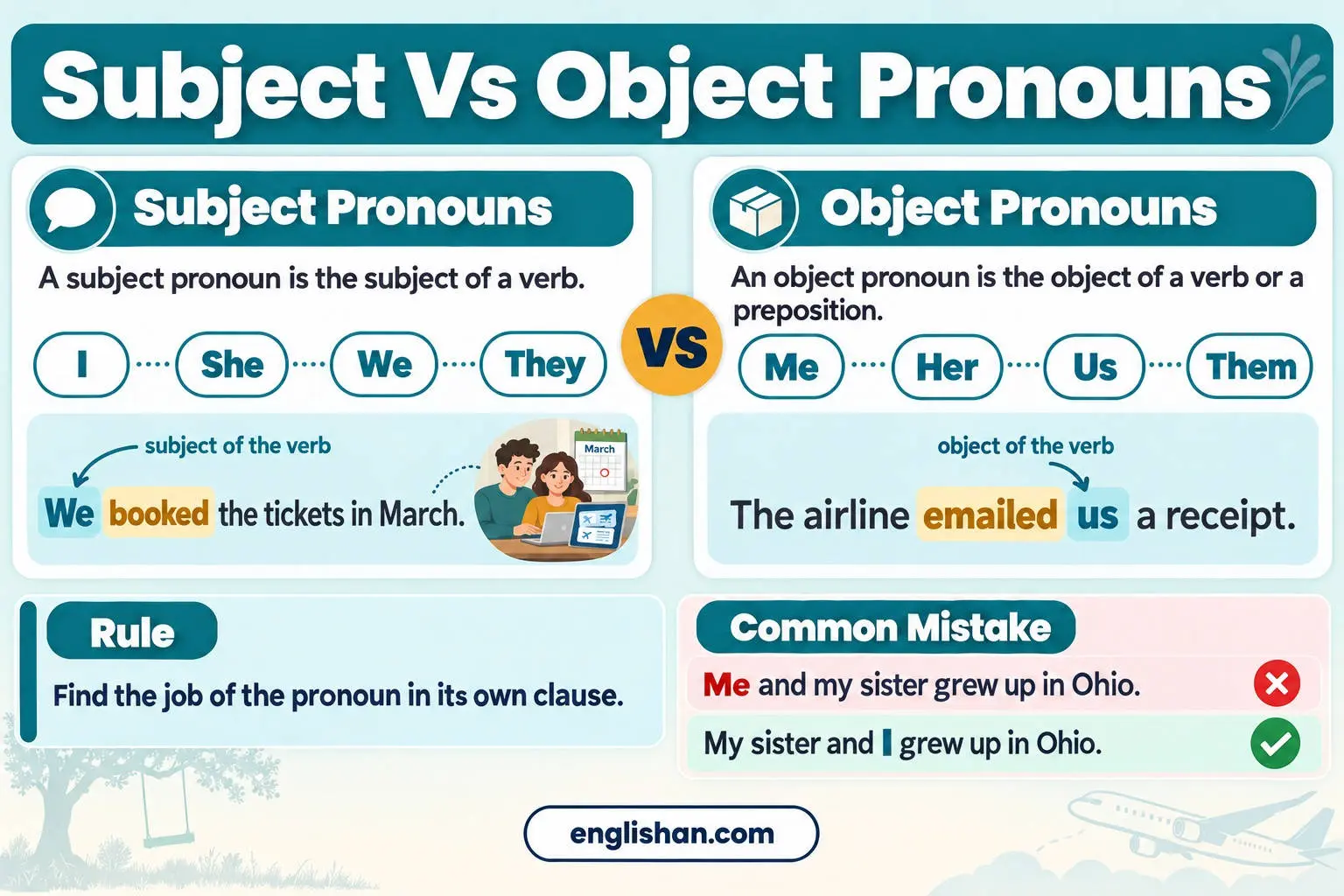
What Are Subject And Object Pronouns?
Subject pronouns are pronouns that function as the subject of a verb, the person or thing that does the action or is described. Object pronouns are pronouns that function as the object of a verb or of a preposition, so they receive the action or come after a word such as “to”, “with”, or “for”. The two forms are also called subjective and objective pronouns, after the subjective case and the objective case.
- We booked the tickets in March.
- The airline emailed us a receipt.
- They lost my suitcase in Madrid.
- A driver carried the bags for them.
The pronouns “we” and “us” in the first two sentences refer to the same people, and only their jobs differ. A pronoun keeps the person and number of the noun it replaces, so its form changes only with its job in the clause.
List Of Subject And Object Pronouns
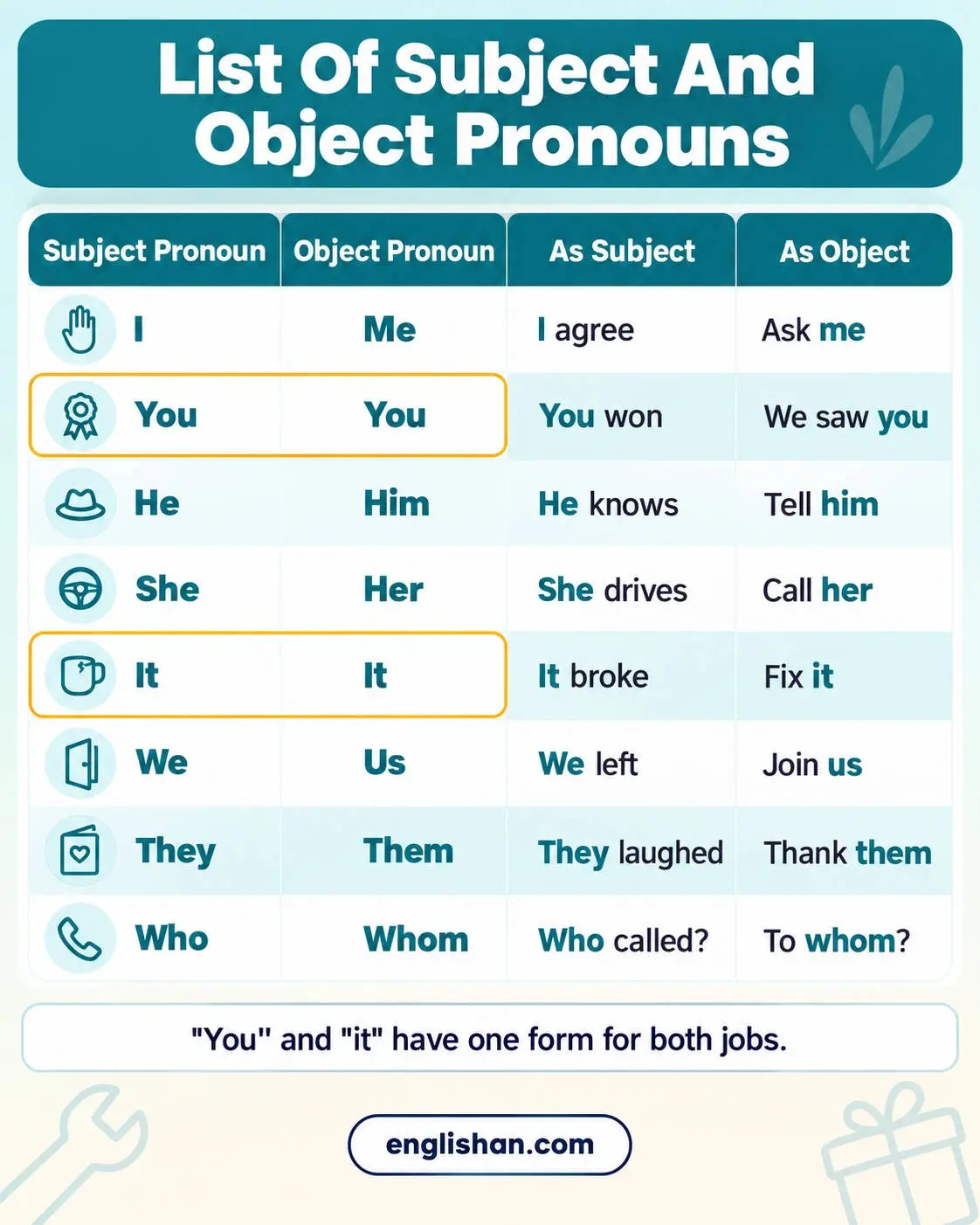
Each subject pronoun has a matching object pronoun in the chart of subject vs object pronouns:
| Subject pronoun | Object pronoun | Person and number | As subject | As object |
|---|---|---|---|---|
| I | Me | First person singular | I agree | Ask me |
| You | You | Second person singular and plural | You won | We saw you |
| He | Him | Third person singular | He knows | Tell him |
| She | Her | Third person singular | She drives | Call her |
| It | It | Third person singular | It broke | Fix it |
| We | Us | First person plural | We left | Join us |
| They | Them | Third person plural | They laughed | Thank them |
| Who | Whom | Questions and relative clauses | Who called? | To whom? |
The pronouns “you” and “it” have the same form in both columns, so only their position shows the job. In “You startled it”, the subject is “you” and the object is “it”, and swapping the two words swaps their jobs.
The pair “who” and “whom” follows the same rule in questions and relative clauses. In everyday English, “who” is common in object positions too, as in “Who did you invite?”, while formal English keeps “whom” there.
Difference Between Subject And Object Pronouns
The difference between subject and object pronouns shows in the job of the pronoun and in its position. A statement has the word order subject, verb, object, so a subject pronoun usually comes before the verb and an object pronoun after it.
Subject Pronouns
A subject pronoun is the subject of a verb, and in a statement it usually comes before the verb. In a question, it comes after the auxiliary, as in “Did she reply?”, and it keeps the subject form there. The subject of a passive verb also takes the subject form, as in “He was promoted in May”.
- I start my new job on Monday.
- Does he take the early train?
- They were invited to the wedding.
Subject pronouns agree with the verb in person and number, so the verb changes in “she works” and “they work”.
Object Pronouns
An object pronoun is the object of a verb or a preposition, and it usually comes after the verb or the preposition. It can be a direct object, an indirect object, or the object of a preposition, and an indirect object is the person who receives something:
- The teacher thanked us after class.
- Can you send me the photos?
- Rita sat next to him at dinner.
- I bought flowers for her on her birthday.
An object pronoun stays after the verb in a question too, as in “Did you call them?” The verb does not agree with an object pronoun, so “She likes them” and “She likes him” take the same verb form.
Uses Of Subject Vs Object Pronouns
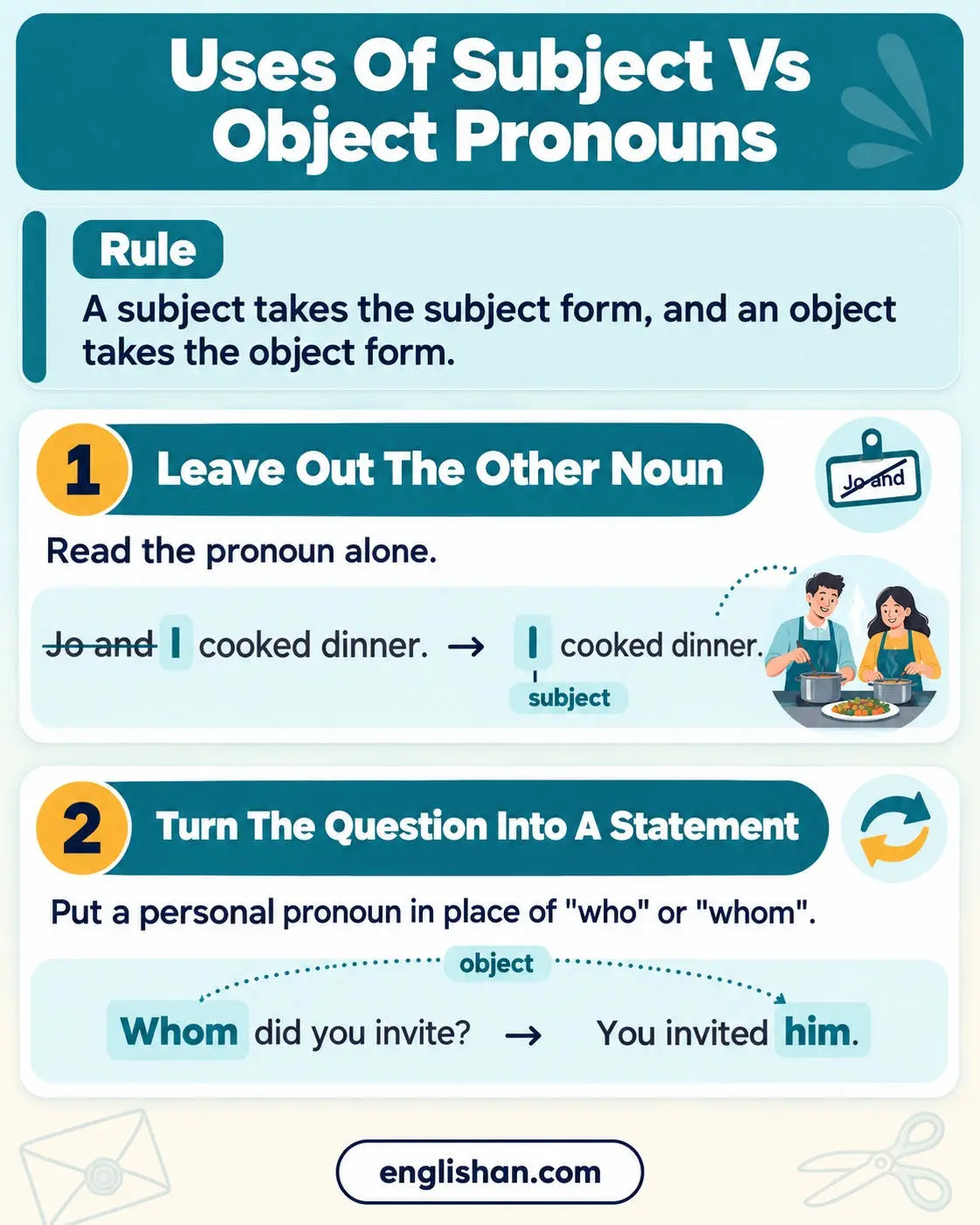
The use of subject vs object pronouns depends on one question: is the pronoun the subject of a verb, or the object of a verb or a preposition? A subject takes the subject form, and an object takes the object form. In a short sentence such as “She helped me“, the job is plain. Where other words come between the pronoun and its verb, a shorter version of the sentence shows the job:
- Leave out the other noun or pronoun in a pair joined by “and” or “or”, and read the sentence with the pronoun alone. “Jo and (I or me) cooked dinner” becomes “I cooked dinner”, so “I” is correct.
- Turn a question into a statement, with a personal pronoun in place of “who” or “whom”. “(Who or whom) did you invite?” becomes “You invited him”, so the object form “whom” is correct in formal English.
Where the pronoun is the subject in the question, the statement shows that as well. The question “Who called you?” becomes “He called you”, so “who” is the subject of “called”, and “whom” is wrong there in every setting.
Compound Subjects And Objects
A compound subject or object is two or more nouns or pronouns joined by “and” or “or”. Each pronoun in it takes the form it would take alone:
- My sister and I grew up in Ohio.
- She and Leo run a bakery together.
- The bakery hired Leo and her last spring.
- Please email the team or me before Friday.
Without the other person, the sentences read “I grew up in Ohio” and “The bakery hired her”, and each form stays the same in the full sentence. A common error puts the object form in a compound subject:
Me and my sister grew up in Ohio. ❌
My sister and I grew up in Ohio. ✅
The pronoun is part of the subject of “grew up”, so it takes the subject form. The subject “me and my sister” is common in informal speech, but it is not standard in writing.
Pronouns After Prepositions
A pronoun after a preposition is the object of that preposition, so it takes the object form, as in “with me”, “for them”, “next to us”, and “by her”. The agent after “by” in a passive sentence follows the same rule:
- Sami left a note for us on the fridge.
- Everyone except him stayed late.
- The report was written by her and checked by me.
- The dog walked between you and me the whole way.
A pair of pronouns after one preposition takes the object form in both places, and the usual error comes after “between”:
Keep this between you and I. ❌
Keep this between you and me. ✅
Both pronouns after “between” are objects of the preposition, so “me” is the standard form even after “and”. The form “you and I” is correct as a subject, and “between you and I” comes from carrying that subject form into an object position.
Pronouns After Than And As
After “than” and “as” in a comparison, the form depends on the setting. In everyday English, an object pronoun follows “than” or “as” when no verb comes after it, as in “She’s taller than me“. In formal writing, a subject pronoun with its verb is the standard form:
- My brother cooks better than me. (everyday)
- My brother cooks better than I do. (formal)
- Nobody in the office works as hard as her. (everyday)
- Nobody in the office works as hard as she does. (formal)
A subject pronoun with no verb after it, as in “taller than I”, is grammatical but sounds formal in conversation. With the verb added, the subject form is correct in any setting.
The form changes the meaning when the verb before “than” has an object:
- Our dog likes Sam more than me.
- Our dog likes Sam more than I do.
In the first sentence, “me” is compared with “Sam”, so the dog likes Sam more than it likes me. In the second, “I” is compared with “our dog”, so the sentence compares how much the dog and I like Sam.
Pronouns After Be
After the verb “be”, the pronoun renames the subject instead of receiving an action. In everyday English, the object form is standard in that position, as in “It’s me” and “That was him“. In formal writing, the subject form is the traditional choice, and it is most common before a “who” clause:
- Who’s at the door? It’s me. (everyday)
- That’s her in the red coat. (everyday)
- It was he who signed the contract. (formal)
- This is she. (formal, on the phone)
Both forms are grammatical in their own settings, so “It’s me” is not an error in conversation. Outside formal writing, “It is I” sounds stiff.
FAQs
Yes, the pairs "I" and "me", "he" and "him", "she" and "her", "we" and "us", and "they" and "them" are the subject and object forms of the personal pronouns, along with "you" and "it". The pair "who" and "whom" is the one pair outside the personal pronouns, since "who" introduces questions and relative clauses.
Not in standard written English, where "Sam and I left early" is correct and "Me and Sam left early" belongs to informal speech. An object pronoun can stand alone in a short reply with no verb, as in "Who wants tea? Me." and "Me too."
The personal pronouns "you" and "it" have one form for both jobs, as in "You found it" and "It found you". Most other pronouns keep one form, including "this", "that", "someone", "everyone", "what", and "which", so "Someone saw me" and "I saw someone" use the same word.
The word "who" is the subject form, and its object form is "whom". The pair shows its two jobs in "Who called?" and "Whom did you call?" in formal English. In everyday English, "who" is common as an object too, as in "Who did you call?", while "whom" stays standard directly after a preposition, as in "to whom".
The pronoun "I" is a subject pronoun, and its object form is "me". Use "I" as the subject of a verb, as in "Kai and I are neighbors", and "me" after a verb or a preposition, as in "Kai invited me" and "a gift for me".
Possessive forms show who owns something, while subject and object forms show the job of the pronoun in the clause. In "She lent him her bike", "she" is the subject, "him" is the object, and "her" is the possessive form before the noun "bike". The possessive pronouns that stand alone are "mine", "yours", "his", "hers", "ours", and "theirs", as in "The bike is hers."
Related:
- Pronouns
- Pronoun Rules and Correct Usage
- Types of Pronouns
- Pronoun Case
- I vs Me
- Who vs Whom
- Whoever vs Whomever
- Possessive Adjectives vs Possessive Pronouns
- Object of Preposition
- Active and Passive Voice
- Linking Verbs
- Subject Complement
- Common Pronoun Errors