

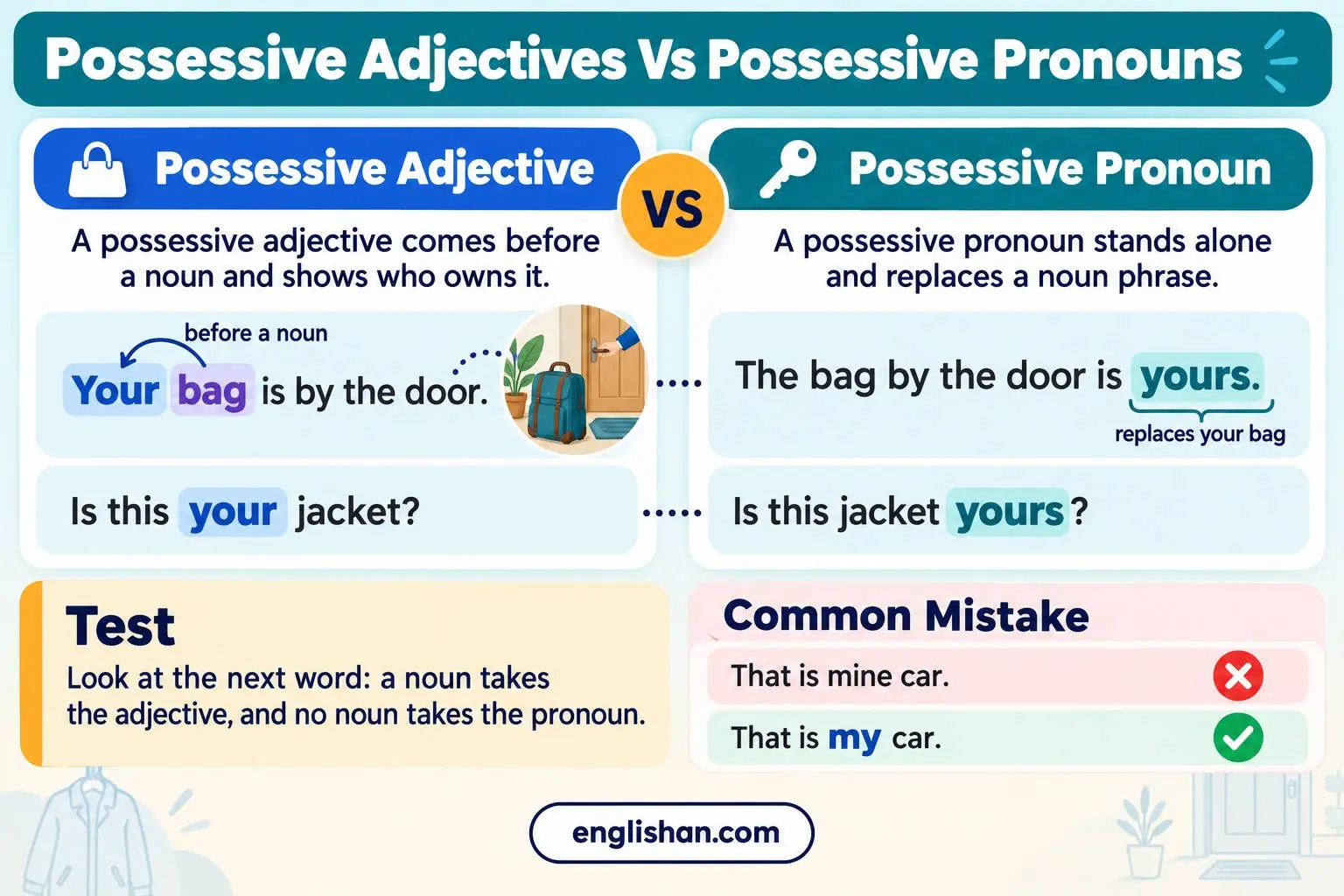
A possessive adjective is a word such as “my”, “your”, or “their” that comes before a noun and shows who owns it. A possessive pronoun is a word such as “mine”, “yours”, or “theirs” that stands alone and replaces a whole noun phrase. In the choice between possessive adjectives vs possessive pronouns, the deciding point is the noun: the adjective is followed by a noun, and the pronoun never is.
The two forms can refer to the same owner and the same thing, so “my bike” in one sentence and “mine” in the next can refer to one bike. For most owners, the two forms have different spellings, while “his” keeps one spelling for both.
Possessive Adjectives And Possessive Pronouns Chart
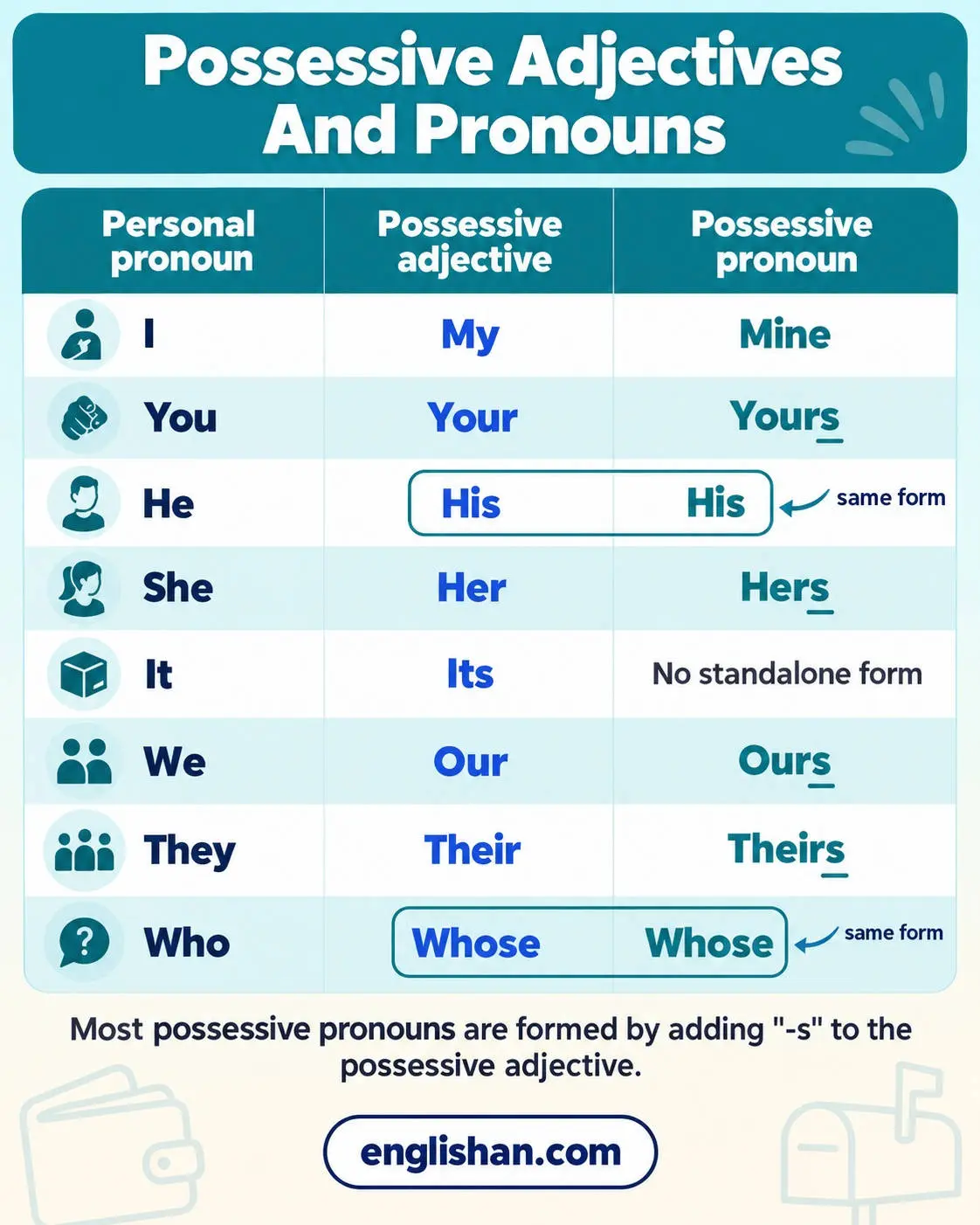
Each personal pronoun has a possessive adjective and, apart from “it”, a possessive pronoun. The two forms change with the person and number of the owner:
| Personal pronoun | Possessive adjective | Possessive pronoun |
|---|---|---|
| I | My | Mine |
| You | Your | Yours |
| He | His | His |
| She | Her | Hers |
| It | Its | No standalone form |
| We | Our | Ours |
| They | Their | Theirs |
| Who | Whose | Whose |
A family packing the car for a trip uses both forms in the same conversation:
- Your bag is by the door. The bag by the door is yours.
- Her sunglasses are on the seat. The sunglasses are hers.
- Our car is the blue one. The blue car is ours.
- Their tent is bigger. The bigger tent is theirs.
Most possessive pronouns are formed by adding “-s” to the possessive adjective, so “your”, “her”, “our”, and “their” become “yours”, “hers”, “ours”, and “theirs”. The exceptions are “my”, which changes to “mine”, and “his”, which already ends in “-s” and keeps the same spelling.
The pronoun “it” has a possessive adjective, “its”, but no possessive pronoun in everyday English. A sentence with a thing or an animal as the owner keeps “its” before a noun, as in “The cat licked its paw”, and does not use “its” alone in place of a noun.
Difference Between Possessive Adjectives And Possessive Pronouns
Possessive adjectives vs possessive pronouns is a contrast of position. Both forms show who owns something, but a possessive adjective comes before a noun, while a possessive pronoun replaces the noun phrase.
| Point | Possessive adjective | Possessive pronoun |
|---|---|---|
| Position | Before a noun | Alone, in place of a noun phrase |
| Followed by a noun | Yes: my coat | No: mine |
| Function | Part of a noun phrase | Subject, object, or complement |
| Apostrophe | None: its, your | None: yours, hers |
Each pair keeps the same owner and the same thing, first with the adjective and then with the pronoun:
- His phone is on the charger.
- The phone on the charger is his.
- Is this your jacket?
- Is this jacket yours?
The noun after a possessive adjective names the thing owned. A possessive pronoun includes that noun in its meaning, so “yours” in the last example means ‘your jacket’.
Possessive Adjectives
A possessive adjective is also called a possessive determiner, because it takes the position of an article such as “the” or “a” in the noun phrase. The owner can be a person, an animal, a thing, or a group.
A possessive adjective agrees with the owner, not with the thing owned. Its form changes for the person, number, and gender of the owner, and it never adds a plural ending for the noun after it:
- My brothers live in Texas.
- Mr. Lee parked his car outside.
- The company changed its logo.
- Their children walk to school.
The choice between “his” and “her” depends on the gender of the owner, whatever noun follows.
Ana called his father. (Ana’s father) ❌
Ana called her father. ✅
Ana is the owner, so the possessive adjective is “her”.
Position Of Possessive Adjectives In A Sentence
A possessive adjective comes at the start of a noun phrase, before the noun and before any other adjective that describes the noun. A noun phrase takes either “the” or “my” before the noun, not both:
- Our old neighbor still sends birthday cards.
- She lost her new blue umbrella.
- Your two best ideas were in the last email.
A few words can come before a possessive adjective, such as “all”, “both”, and “half”, as in “all my friends” and “both their parents”.
I met the my new manager today. ❌
I met my new manager today. ✅
A possessive adjective and an article do not appear together before one noun.
Possessive Pronouns
A possessive pronoun replaces a possessive adjective and its noun together, so “mine” means ‘my’ plus a noun the listener already knows. The noun is part of its meaning, so a possessive pronoun is never followed by a noun:
- That coffee is mine, and the tea is yours.
- Our flight was late, but theirs left on time.
- I forgot my charger, so Leo lent me his.
- Whose seat is this? It’s hers.
The noun that a possessive pronoun replaces is usually stated earlier in the sentence or in the sentence before, as with “flight” and “charger”.
Possessive Pronouns As Subjects And Objects
A possessive pronoun functions as a full noun phrase, so it can be the subject of a verb, the object of a verb or a preposition, or a complement after “be”:
- Yours is the last name on the list. (subject)
- I like your plan, but Kim prefers ours. (object)
- She compared her answers with mine. (after a preposition)
- The idea was theirs from the start. (after “be”)
A possessive adjective has none of these functions, since it is only one part of a noun phrase.
Kim prefers our. ❌
Kim prefers ours. ✅
With no noun after it, the word is the object of “prefers”, so the possessive pronoun is correct.
Verb Agreement With Possessive Pronouns
The verb after a possessive pronoun agrees with the noun that the pronoun replaces, the thing owned, not with the owner. So “mine” takes a singular verb when it means one thing and a plural verb when it means two or more:
- My phone is old, but yours is new. (your phone)
- My shoes are dry. Yours are wet. (your shoes)
- Theirs is the house on the corner. (their house)
- Her parents live nearby, and his live in Chicago. (his parents)
The number of the owner has no effect on the verb, so “theirs” takes “is” when it replaces one house, and “his” takes “live” when it replaces “his parents”.
Our garden is small, but theirs are huge. ❌
Our garden is small, but theirs is huge. ✅
The pronoun “theirs” replaces “their garden”, one garden, so the verb is singular.
Double Possessive With Possessive Pronouns
A double possessive is the pattern noun + “of” + possessive pronoun, as in “a friend of mine”. We use it when the noun already has “a”, “this”, “that”, “some”, or a number before it, because that noun phrase cannot take a possessive adjective as well:
- A friend of mine works at the hospital.
- I borrowed a book of hers last week.
- That dog of yours barks at night.
- Two colleagues of ours moved to Denver.
The pattern presents the person or thing as one of several, so “a friend of mine” is one of my friends, while “my friend” is a friend the listener can identify.
A my friend works at the hospital. ❌
A friend of me works at the hospital. ❌
A friend of mine works at the hospital. ✅
After “of” in this pattern, the possessive pronoun is the correct form, not the possessive adjective “my” or the object pronoun “me”.
Uses Of Possessive Adjectives Vs Possessive Pronouns
In possessive adjectives vs possessive pronouns, the choice depends on what follows the possessive word. Use a possessive adjective when a noun follows in the same noun phrase, and use a possessive pronoun when the noun is already known and does not appear:
- This is our table.
- This table is ours.
- Their coffee arrived first.
- Theirs arrived first.
With “his”, the spelling is the same, so only the position shows the function. In “His bike is red”, the word comes before a noun and is a possessive adjective, and in “The red bike is his“, it stands alone and is a possessive pronoun.
Where the form is unclear, look at the word right after the gap. A noun, or an adjective and a noun, takes the possessive adjective, while a verb, a preposition, or the end of the sentence takes the possessive pronoun.
That is mine car. ❌
That is my car. ✅
A noun follows the gap, so the possessive adjective “my” is correct.
Theirs cars are outside. ❌
Their cars are outside. ✅
The noun “cars” shows the plural, and the possessive adjective “their” keeps one form for one car or many.
Possessive Pronouns And Apostrophes
The possessive forms of personal pronouns never take an apostrophe, because the forms show possession without one. A noun adds “‘s” for possession, as in “Maya’s”, but possessive pronouns and possessive adjectives do not:
- The decision is yours.
- Is this umbrella hers?
- The dog wagged its tail.
Is this pen your’s? ❌
Is this pen yours? ✅
The final “-s” in “yours”, “hers”, “ours”, and “theirs” is part of the pronoun, so no apostrophe comes before it.
Its Vs It’s
The word “its” is the possessive adjective of “it”, and “it’s” is the short form of “it is” or “it has”. The apostrophe in “it’s” shows missing letters, not possession:
- The hotel updated its website.
- It’s raining again. (it is)
- It’s been a long week. (it has)
The café lost it’s license. ❌
The café lost its license. ✅
To choose the spelling, replace the word with “it is” or “it has”. If the sentence still reads correctly, write “it’s”, and if it does not, write “its”.
FAQs
Possessive adjectives are forms of the personal pronouns, since "my" refers to the speaker just as "I" does. In a sentence, though, a possessive adjective functions as a determiner before a noun, and only "mine", "yours", and the other standalone forms replace a whole noun phrase.
No, a possessive pronoun does not come before a noun, so "mine car" and "hers book" are incorrect. The one overlap is "his", which has the same spelling in both forms, as in "his book" and "The book is his."
Both, because "whose" has one spelling for the two forms. Before a noun, "whose" is the possessive adjective of "who", as in "Whose keys are these?", and alone it is the possessive pronoun, as in "These keys are mine. Whose are those?" Like the other possessive forms, it has no apostrophe, and "who’s" means ‘who is’.
Yes, in function, because a possessive noun such as "Maya’s" can come before a noun, as in "Maya’s bike", in the position of a possessive adjective. It can also stand alone, as in "The bike is Maya’s", in the position of a possessive pronoun, and one form with "’s" takes both positions.
Related:
- Pronouns
- Types of Pronouns
- Pronoun vs Adjective
- Who’s vs Whose
- Demonstrative Adjectives vs Demonstrative Pronouns
- Noun vs Pronoun
- Pronoun Case
