

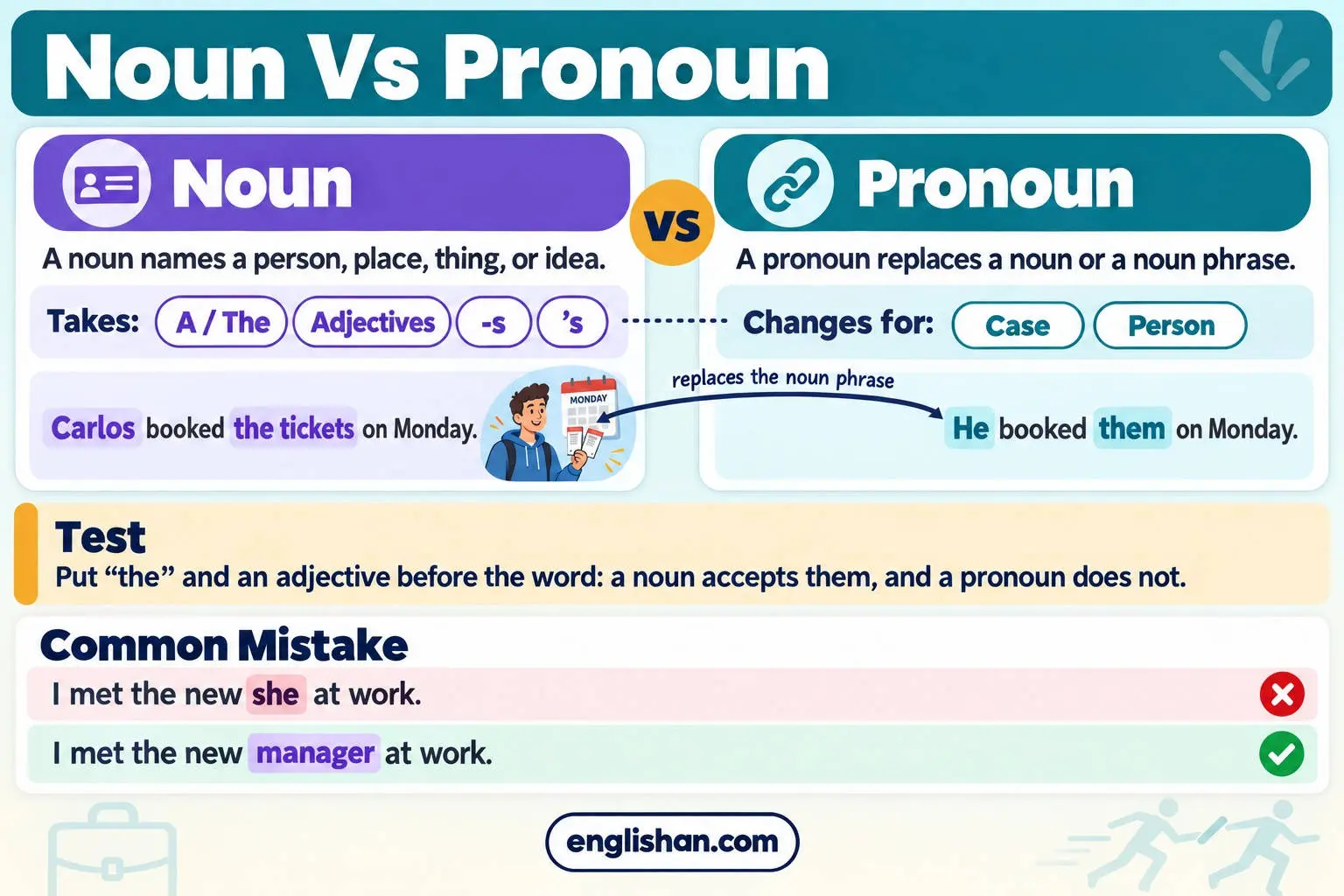
A noun is a word that names a person, place, thing, or idea, and a pronoun is a word that replaces a noun or a whole noun phrase. In “Maya lost the keys, and she found them later”, the nouns “Maya” and “keys” name the person and the thing, and the pronouns “she” and “them” replace them. For any noun vs pronoun question, the class follows from the function of the word: a noun names, and a pronoun replaces something already named or clear from the situation.
The two classes also differ in form. A noun takes an article, adjectives, and a plural ending, as in “the old keys”, while most pronouns take none of these and change their form for case instead, as in “she” and “her”. Those forms identify the class even for “one”, which is a noun in some sentences and a pronoun in others.
Difference Between A Noun And A Pronoun
Nouns and pronouns are two of the eight parts of speech, and both can be the subject or the object of a verb, so the noun vs pronoun contrast shows mainly in form:
| Feature | Noun | Pronoun |
|---|---|---|
| Function | Names a person, place, thing, or idea | Replaces a noun or a noun phrase |
| Article before it | Yes: “a teacher”, “the teacher” | No: “she”, not “the she” |
| Adjective before it | Yes: “a new teacher” | Usually not: “the new one” is the main exception |
| Plural form | Adds “-s” or “-es”: “teachers” | A different word: “she” to “they” |
| Subject and object forms | One form: “the teacher” in both positions | Two forms: “she” as subject, “her” as object |
| Possessive form | Adds ‘s: “the teacher’s desk” | A separate word: “her desk”, “hers” |
| Person | Third person | First, second, or third: “I”, “you”, “she” |
A noun and the pronoun that replaces it can be the subject or the object of the same verb, so the sentence keeps its meaning when one replaces the other.
- Carlos booked the tickets on Monday.
- He booked them on Monday.
- The train to Bristol left an hour late.
- It left an hour late.
Noun And Pronoun Definition
A noun is a word that names a person, place, thing, or idea, such as “nurse”, “Lisbon”, “phone”, or “patience”. A pronoun is a word that replaces a noun or a noun phrase, which is a noun together with its article and describing words. The noun phrase a pronoun replaces is its antecedent, and it usually comes earlier in the text.
- The woman in the blue coat asked for directions, and she thanked us.
- I bought a cheap umbrella, but it broke the same day.
- Our neighbors have a dog, and they walk it twice a day.
- The report from the finance team is late because it needs one more signature.
In the first example, “she” replaces all of “the woman in the blue coat”, not only the noun “woman”.
Some pronouns replace no earlier noun. The pronouns “I” and “we” refer to the speaker, “you” refers to the listener, and indefinite pronouns such as “someone” and “nothing” refer to a person or thing that is not named at all. These words are still pronouns, because they function in the same positions as a noun phrase: as a subject or an object.
In standard English, a clause takes either the noun phrase or the pronoun as its subject, not both.
My sister she lives in Leeds. ❌
My sister lives in Leeds. ✅
The subject of “lives” is “my sister”, so a second subject, “she”, is not added after it.
Articles And Adjectives With Nouns And Pronouns
A noun can take an article and adjectives before it, as in “a quiet street” and “the old bridge”. Most pronouns take neither, because a pronoun already replaces a complete noun phrase with its article and adjectives. When the description is needed, the noun phrase stays in the sentence, or the adjective comes after a linking verb such as “be”.
- The new manager starts on Monday.
- She starts on Monday.
- She is very experienced.
I met the new she at work. ❌
I met the new manager at work. ✅
A personal pronoun takes no article or adjective before it, so the noun “manager” stays where the description “new” is needed.
Indefinite pronouns and the pronoun “one” take adjectives, and the position of the adjective differs for each. An indefinite pronoun ending in “-thing”, “-one”, or “-body” takes an adjective after it, not before.
- Let’s try something new for dinner.
- The doctor said it was nothing serious.
- We need someone reliable for the night shift.
I want to try new something. ❌
I want to try something new. ✅
After “something” and the other indefinite pronouns, the adjective follows the pronoun.
The pronoun “one”, with its plural “ones”, replaces a countable noun and takes an article and an adjective before it, in the same positions as a noun. It does not replace an uncountable noun such as “milk” or “advice”.
- I don’t like this jacket, but the blue one is nice.
- These shoes hurt, so I wore my old ones.
- Which cake do you want, the big one or the small one?
In spoken exclamations, an adjective also comes before a personal pronoun, as in “Lucky you.” and “Silly me.” This pattern is fixed to short exclamations and does not appear in ordinary statements.
Plural Of Nouns And Pronouns
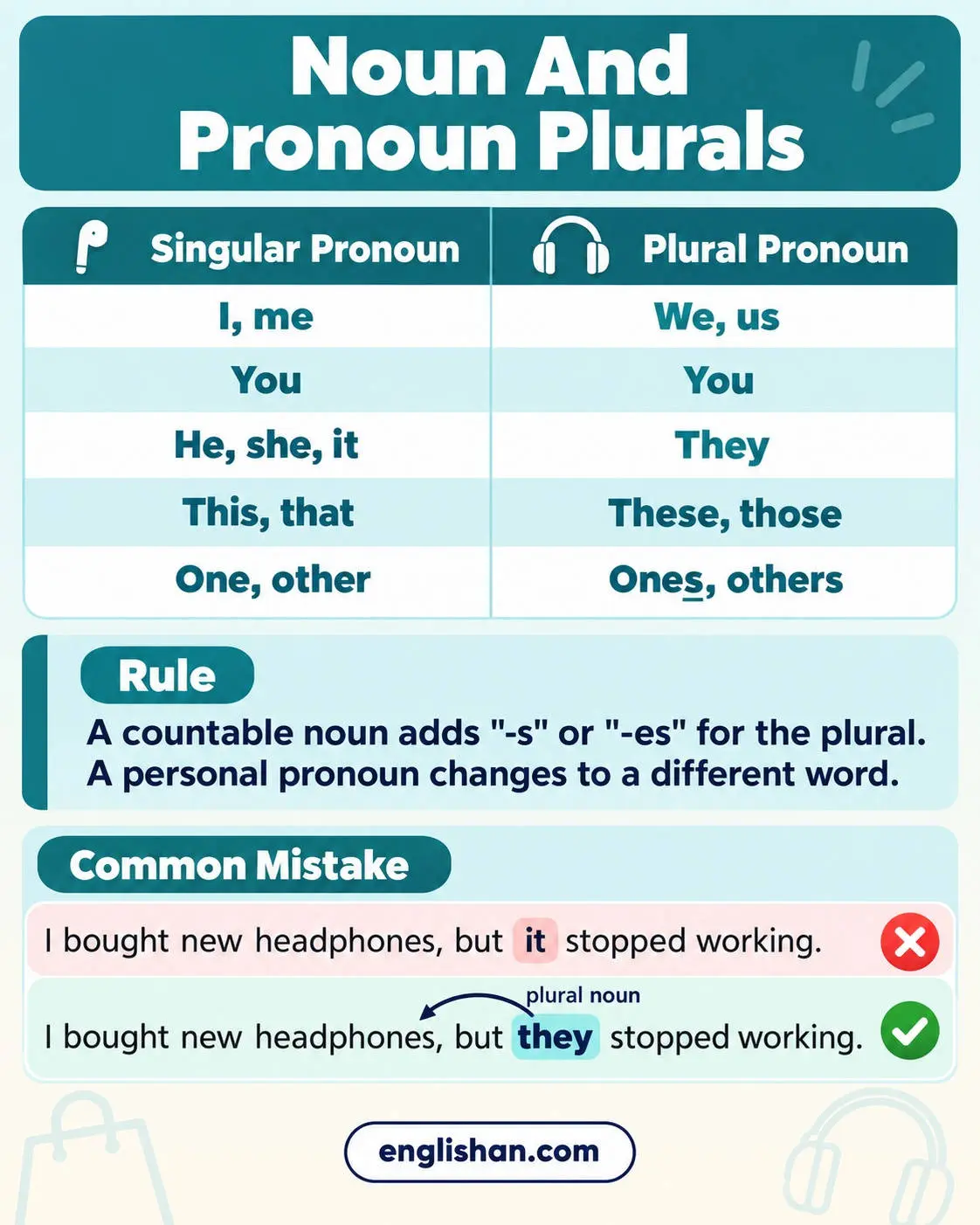
A countable noun forms its plural by adding “-s” or “-es”, as in “bus” and “buses”, or by an irregular change, as in “child” and “children”. A personal pronoun does not add “-s”; it changes to a different word for the plural:
| Singular pronoun | Plural pronoun |
|---|---|
| I, me | We, us |
| You | You |
| He, she, it | They |
| Him, her, it | Them |
| This, that | These, those |
| One, other | Ones, others |
The pronouns “one” and “other” are the exception, because they add “-s” for the plural in the same way as a noun: “ones” and “others”.
A pronoun agrees in number with the noun phrase it replaces. A singular noun phrase takes a singular pronoun, and a plural noun phrase takes a plural pronoun.
- The package arrived, but it was damaged.
- The packages arrived, but they were damaged.
- My cousin visited, and we took her to the museum.
I bought new headphones, but it stopped working. ❌
I bought new headphones, but they stopped working. ✅
The noun “headphones” is plural, so the pronoun that replaces it is the plural “they”.
Case Forms Of Nouns And Pronouns
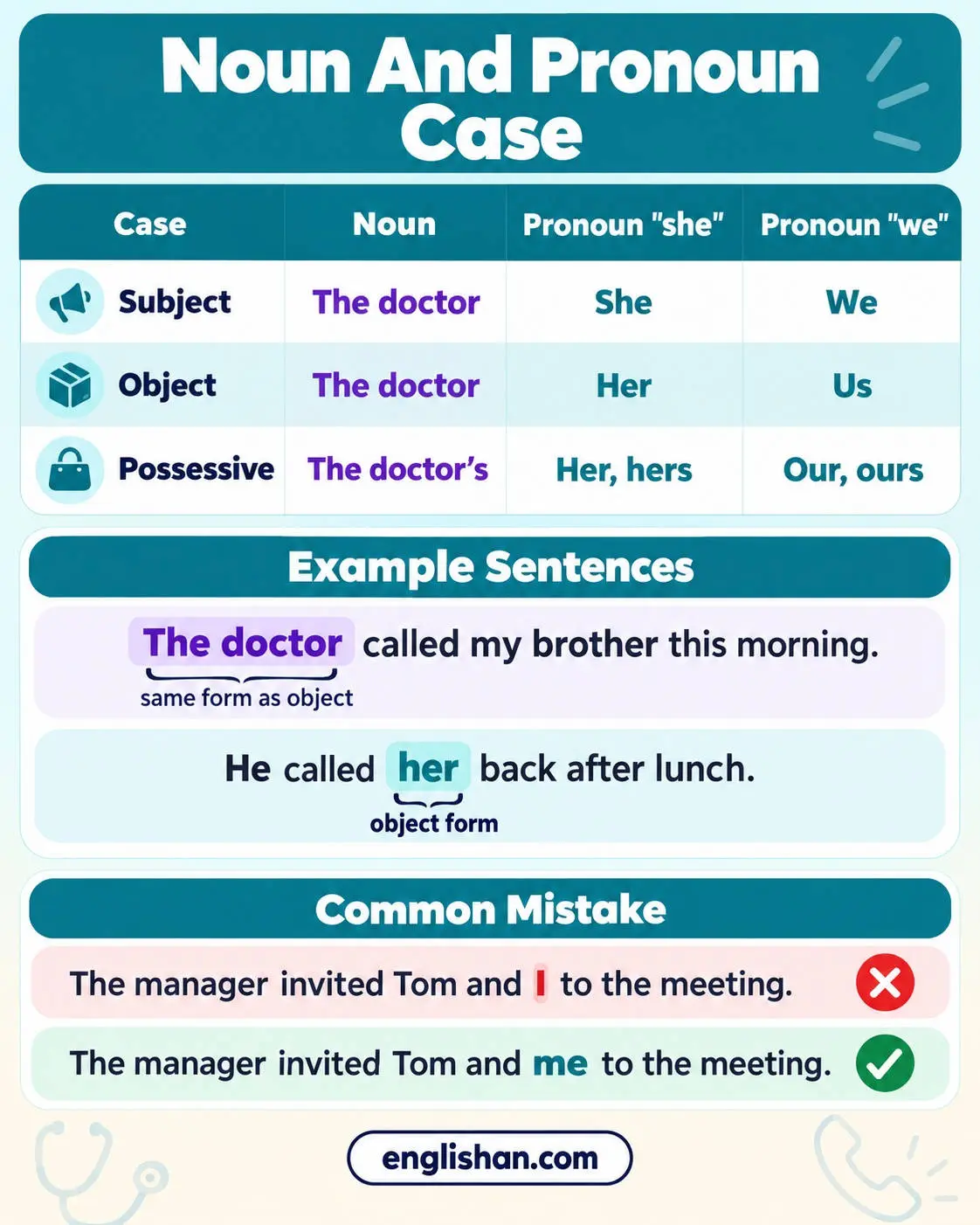
Case is the form a word takes for its job in the sentence: subject, object, or possessive. Personal pronouns have a separate form for most cases, while a noun keeps one form as subject and object and changes only for the possessive, by adding ‘s.
| Case | Noun | Pronoun “she” | Pronoun “we” |
|---|---|---|---|
| Subject | The doctor | She | We |
| Object | The doctor | Her | Us |
| Possessive | The doctor’s | Her, hers | Our, ours |
- The doctor called my brother this morning.
- My brother called the doctor back.
- He called her back after lunch.
The noun “the doctor” has one form in both positions, but the pronoun changes from “she” to “her” when it becomes the object.
The manager invited Tom and I to the meeting. ❌
The manager invited Tom and me to the meeting. ✅
The pronoun is an object of “invited”, so it takes the object form “me”, while the noun “Tom” stays the same.
Possessive forms: A noun forms its possessive with an apostrophe and “s”, as in “the cat’s bowl”. Personal pronouns have their own possessive words with no apostrophe, such as “its”, “hers”, “ours”, and “theirs”. Indefinite pronouns, “one”, and “each other” take ‘s in the same way as a noun, as in “someone’s coat” and “each other’s names”.
The cat knocked over it’s bowl. ❌
The cat knocked over its bowl. ✅
The possessive of the pronoun “it” is “its”, and “it’s” is the short form of “it is”.
Person: Pronouns also change for person, and nouns do not. A personal pronoun is first person for the speaker (“I”, “we”), second person for the listener (“you”), or third person for anyone or anything else (“he”, “she”, “it”, “they”). A noun subject always takes the third-person verb form, the same form as “he”, “she”, “it”, or “they”.
- I work nights.
- The nurse works nights.
- She works nights.
Proper Noun Vs Pronoun
A proper noun is the name of one particular person, place, or organization, such as “Priya”, “Chicago”, or “the Red Cross”. A pronoun replaces a proper noun as it replaces any other noun phrase, so “Priya” becomes “she” and “Chicago” becomes “it” once the name is known.
Like a pronoun, a proper noun usually comes without an article and refers to one particular person or thing. In form, though, a proper noun stays on the noun side of the noun vs pronoun contrast. A proper noun keeps one form in every position, takes possessive ‘s, and can take an adjective before it, as in “young Priya”. A pronoun changes form for case and takes no adjective before it.
- Priya moved to Chicago in May.
- She loves it there.
- Priya’s new apartment is near the lake.
- Her new apartment is near the lake.
Identification Of Nouns And Pronouns In A Sentence
A noun names something, and it can usually take “the”, an adjective, or a plural ending. A pronoun replaces a noun phrase or refers to the speaker or listener, and it belongs to a small fixed set of words, such as “he”, “them”, “mine”, “herself”, “who”, and “everyone”. Where the noun vs pronoun class of a word is unclear, put “the” and an adjective before it: a noun accepts them, as in “the busy nurse”, and a pronoun does not, with the exception of “one”.
- Everyone at the party brought food.
- Mine is the blue bag by the door.
- The children washed themselves after the game.
The word “food” accepts “the” and an adjective (“the cold food”), so it is a noun, but “everyone” and “mine” accept neither, so they are pronouns.
A word that comes before a noun is not a pronoun, even when the same word is a pronoun in other sentences. In “This book is mine”, “this” is a determiner that comes before the noun “book”. In “This is my book”, “this” replaces a noun phrase, so it is a pronoun. The word “his” divides the same way: it is a determiner in “his car” and a pronoun in “The car is his”.
Pronouns Used As Nouns
A noun does not become a pronoun; a pronoun replaces it. A few pronoun words, though, are also used as nouns, and in that use they take an article, an adjective, or a plural ending like any noun.
The words “nobody” and “somebody” are nouns when they mean ‘an unimportant person’ and ‘an important person’. As nouns, “he” and “she” mean ‘a male’ and ‘a female’, usually of an animal.
- He was a nobody before the film came out.
- Is your new puppy a he or a she?
The word “one” is a noun in some sentences and a pronoun in others. As a noun, it names the number 1. As a pronoun, it replaces a countable noun or means ‘any person’ in formal speech and writing.
- The last digit of the code is a one.
- This mug is cracked, so I’ll take the other one.
- One should read a contract before signing it.
Outside these fixed meanings, “he”, “she”, and “nobody” are pronouns, and they take no article or adjective.
FAQs
No, a pronoun is a separate part of speech, though it functions in the same positions as a noun phrase: as a subject, an object, or after a preposition. A pronoun does not name anything itself. It replaces a noun phrase or refers to the speaker or the listener.
The word "we" is a personal pronoun in the first person plural, not a noun. It refers to the speaker together with other people, and it changes to "us" as an object and to "our" or "ours" for the possessive, forms that no noun has.
Neither, because "my" is a possessive determiner, also called a possessive adjective, and it comes before a noun, as in "my phone". The possessive pronoun is "mine", which replaces the whole noun phrase: "The phone is mine."
A pronoun usually refers to an earlier noun phrase that agrees with it in number and, for "he" and "she", in gender. Sometimes the noun phrase comes after the pronoun, as in "When she arrived, Maya called her mother."
Yes, but most adjectives describe a pronoun from after a linking verb, as in "She is tired", not from before it. An indefinite pronoun takes an adjective right after it, as in "something cold", and an adjective comes before a pronoun mainly with "one" and "ones", as in "the red one".
Related:
- Types of Pronouns
- What Do Pronouns Replace
- Pronoun Case
- Subject vs Object Pronouns
- Singular and Plural Pronouns
- I vs Me
- Possessive Adjectives vs Possessive Pronouns
- Demonstrative Adjectives vs Demonstrative Pronouns
- Pronoun vs Adjective
- Common Noun and Proper Noun
