

A relative pronoun is a pronoun that introduces a relative clause and refers back to a noun before it. An interrogative pronoun is a pronoun that asks a question about an unknown person or thing. The words “who”, “whom”, “whose”, “which”, and “what” belong to both types. In relative vs interrogative pronouns, the type depends on the job of the word in its sentence, not on its form.
The two jobs differ in the antecedent, the noun a pronoun refers to. A relative pronoun has one, as “the chef” is the antecedent in “the chef who cooked dinner”, while an interrogative pronoun has none, because the person or thing it asks about is still unknown. The word “that” has only the relative job, and the other five words change type with the sentence around them.
What Is The Difference Between Relative And Interrogative Pronouns?
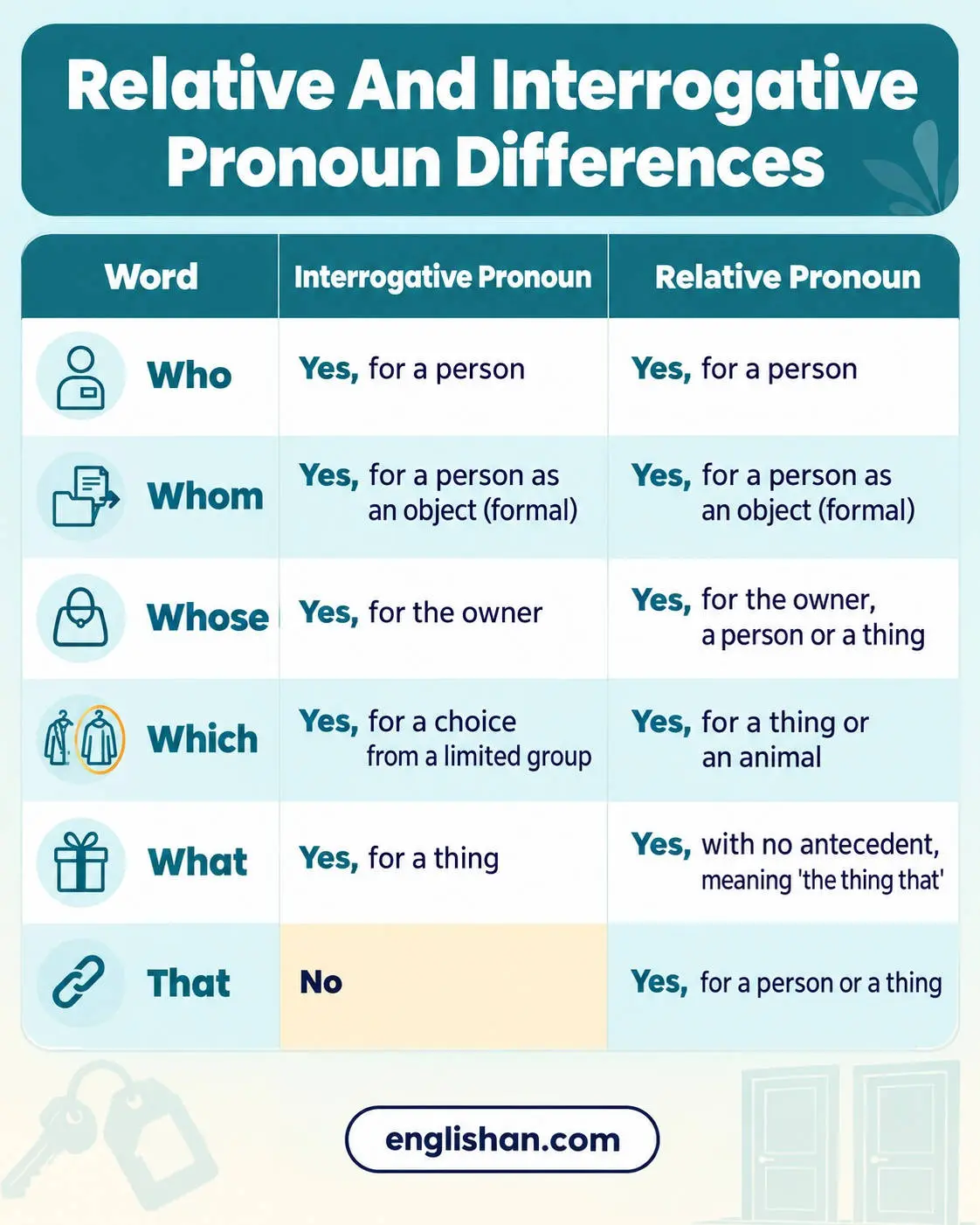
The difference between relative and interrogative pronouns is their job: an interrogative pronoun asks a question, and a relative pronoun introduces a relative clause that describes a noun. The same word can be interrogative in one sentence and relative in the next. The six words in a comparison of relative vs interrogative pronouns have these jobs:
| Word | Interrogative pronoun | Relative pronoun |
|---|---|---|
| Who | Yes, for a person | Yes, for a person |
| Whom | Yes, for a person as an object (formal) | Yes, for a person as an object (formal) |
| Whose | Yes, for the owner | Yes, for the owner, a person or a thing |
| Which | Yes, for a choice from a limited group | Yes, for a thing or an animal |
| What | Yes, for a thing | Yes, with no antecedent, meaning ‘the thing that’ |
| That | No | Yes, for a person or a thing |
Position follows the job. An interrogative pronoun usually comes at the start of a direct question, while a relative pronoun follows its antecedent directly, so it is often placed in the middle of a sentence.
Interrogative Pronouns In Questions
Interrogative pronouns ask about a person or thing the speaker does not know, so they have no antecedent. In a direct question, the interrogative pronoun usually opens the question, and the answer is a noun phrase that takes its place:
- Who booked the meeting room for Friday?
- Whom did the committee choose? (formal)
- Whose is the umbrella by the door?
- Which of these trains stops at Albany?
- What did the dentist say about your tooth?
The answer to “Who booked the meeting room for Friday?” is a noun phrase such as “Priya”, and no noun earlier in the question names that person. A direct question ends with a question mark, because the whole sentence is a question.
In both jobs, “who” is the subject form and “whom” is the object form. In everyday questions, “who” often replaces “whom” as the object, as in “Who did the committee choose?”, while formal writing keeps “whom”.
Relative Pronouns In Relative Clauses
Relative pronouns introduce a relative clause, a dependent clause that describes a noun, and they refer back to that noun. The noun is the antecedent, and it usually comes directly before the relative pronoun:
- The nurse who took my blood pressure was very gentle.
- Our neighbors, whom we rarely see, have sold their house.
- I met a writer whose first novel is set in Maine.
- The museum, which opens at nine, is free on Sundays.
- He sent a reply that answered every question.
In the first sentence, the antecedent is “the nurse”, and the clause “who took my blood pressure” describes that nurse. A relative clause is part of a statement, so the sentence ends with a full stop unless the main clause is itself a question.
Relative “whose” and “which” also have uses with no match in questions. Relative “whose” refers to things as well as people, as in “a house whose roof leaks”. The pronoun “which” can refer back to a whole clause, as in “She passed the exam, which surprised nobody.”
The relative pronoun is part of its own clause, often as the subject, so the clause takes no second pronoun for the same person or thing:
The tenant who she lives upstairs complained about the noise. ❌
The tenant who lives upstairs complained about the noise. ✅
The relative pronoun “who” is the subject of “lives”, so “she” repeats the subject and is removed.
That As A Relative Pronoun
The word “that” is a relative pronoun but never an interrogative pronoun, so it introduces relative clauses and never asks a question. As a relative pronoun, “that” refers to people or things, and the clause it introduces identifies which one the speaker means:
- The keys that you lost were in the car.
- She is the coach that trained both sisters.
- Is this the form that needs a signature?
The last example is a question, but “that” still refers back to “the form” and introduces a relative clause, so it stays relative. The question comes from the main clause “Is this the form?”, not from the pronoun.
Outside relative clauses, “that” has two other uses that ask nothing. In “Is that your car?”, it is a demonstrative pronoun, and after a verb such as “know” or “say”, as in “She knows that the store is closed”, it is a conjunction, because no antecedent comes before it.
Relative Pronoun What
The pronoun “what” can introduce a clause that asks no question, and in that use it means ‘the thing that’ or ‘the things that’. Relative “what” has no antecedent, because the meaning of the antecedent is already part of the word:
- I know what you mean.
- What the landlord wants is a longer lease.
- We ate what was left in the fridge.
- She showed me what she had painted that week.
Each of these sentences keeps its meaning with “the thing that” or “the things that” in place of “what”, as in “I know the thing that you mean”. Because relative “what” includes its antecedent, it never comes after a noun in standard English:
The thing what I need is a phone charger. ❌
The thing that I need is a phone charger. ✅
After a noun, the relative pronoun is “that”, “which”, or “who”, and after “everything”, “all”, or “something”, it is usually “that”.
Relative Or Interrogative Pronoun
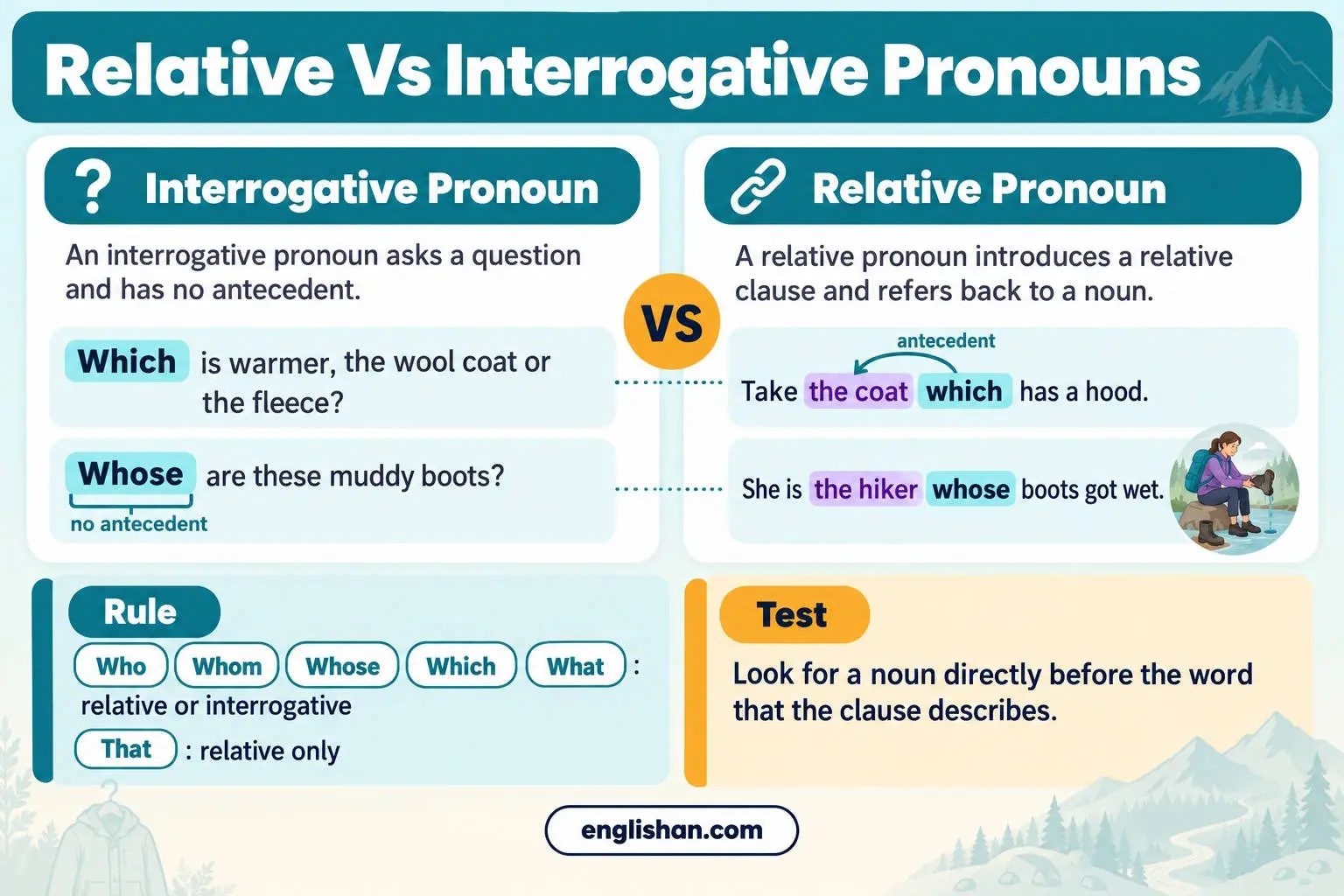
A pronoun is relative when a noun comes before it and the clause it introduces describes that noun, and it is interrogative when it asks about something unknown. Where the type is unclear, look for a noun directly before the word that the clause describes:
- Which is warmer, the wool coat or the fleece? (interrogative)
- Take the coat which has a hood. (relative)
- Whose are these muddy boots? (interrogative)
- She is the hiker whose boots got wet. (relative)
In “Take the coat which has a hood”, the clause describes “the coat”, so “which” is relative. The question “Which is warmer?” has no such noun, and “which” asks the listener to choose.
Punctuation is a sign of the sentence type, not of the pronoun type. A question mark shows that the whole sentence asks something, so a relative pronoun can come inside a question, as “that” does after “the form” in the signature example. In the same way, an interrogative pronoun can come inside a statement with no question mark at all.
Indirect Questions Vs Relative Clauses
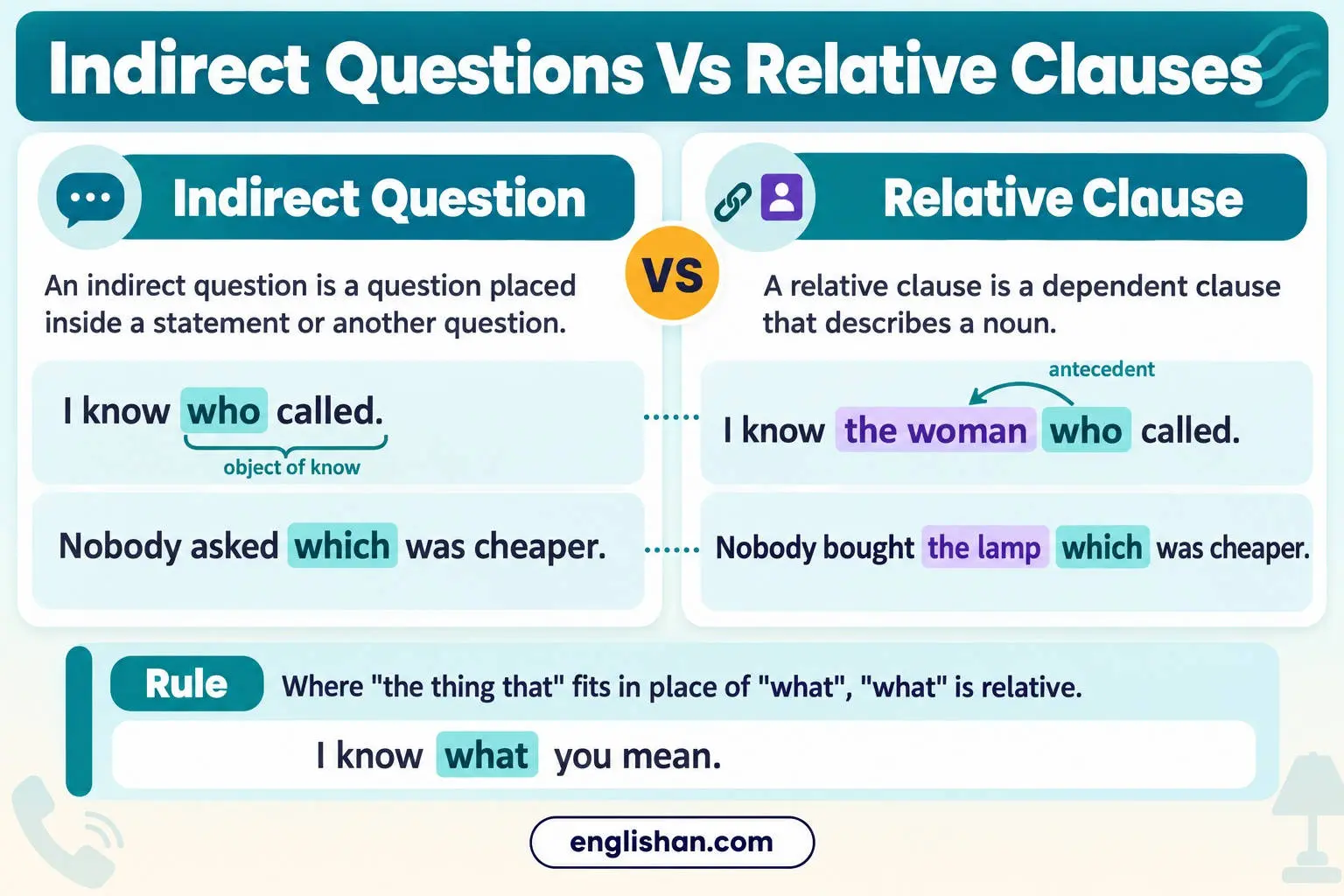
An indirect question is a question placed inside a statement or another question, as in “I wonder who called”, and the interrogative pronoun inside it still asks about something unknown. In relative vs interrogative pronouns inside one statement, the noun before the word shows the type:
- I know who called. (indirect question)
- I know the woman who called. (relative clause)
- Nobody asked which was cheaper. (indirect question)
- Nobody bought the lamp which was cheaper. (relative clause)
- We still don’t know whose this is. (indirect question)
In “I know who called”, no noun comes before “who”, and the clause “who called” is the object of “know”, so “who” is interrogative. An indirect question functions as a noun clause in the sentence. In “I know the woman who called”, the clause describes “the woman”, so “who” is relative.
With “what”, no noun comes before the pronoun in either job, so put “the thing that” in its place. The sentence “I know what you mean” keeps its meaning as “I know the thing that you mean”, so “what” is relative. The sentence “I wonder what she bought” cannot become “I wonder the thing that she bought”, so “what” introduces an indirect question.
FAQs
Not quite: they are two types of pronouns with different jobs, though most of their words are the same. The words "who", "whom", "whose", "which", and "what" can be relative or interrogative, depending on whether they introduce a relative clause or ask a question, and "that" is relative only.
No, an interrogative pronoun has no antecedent, because the noun it would refer to is the unknown answer. In "What broke?", no earlier noun names the broken thing, and the answer supplies it. A relative pronoun has an antecedent, apart from "what" and the "-ever" forms such as "whoever", which include their own.
Yes, "who", "what", "which", and "whose" can be the subject of a question. The verb then follows the pronoun directly with no "do", as in "Who sent this?" A relative pronoun can also be the subject of its own clause, as "who" is the subject of "sent" in "the man who sent this".
Both, depending on the sentence. In "Whose is this scarf?", "whose" asks about an owner, so it is interrogative. In "the student whose scarf was lost", it refers back to "the student" and introduces a relative clause, so it is relative.
No, "where", "when", and "why" are relative adverbs when they introduce a relative clause, as in "the town where I grew up". In a question such as "Where did you park?", they are interrogative adverbs, because they ask about place, time, or reason instead of replacing a noun.
Related:
