

Combining sentences with relative pronouns is a method of joining two sentences that mention the same noun into one sentence, with the second sentence turned into a relative clause. The relative pronoun “who”, “whom”, “whose”, “which”, or “that” replaces the repeated noun in the second sentence, and the new clause follows that noun in the first sentence.
A relative clause, also called an adjective clause, is a dependent clause, so it cannot stand alone as a sentence once the pronoun joins it to the main clause. The right pronoun depends on two facts about the repeated noun: whether it names a person or a thing, and whether it is the subject, the object, or the owner in the second sentence.
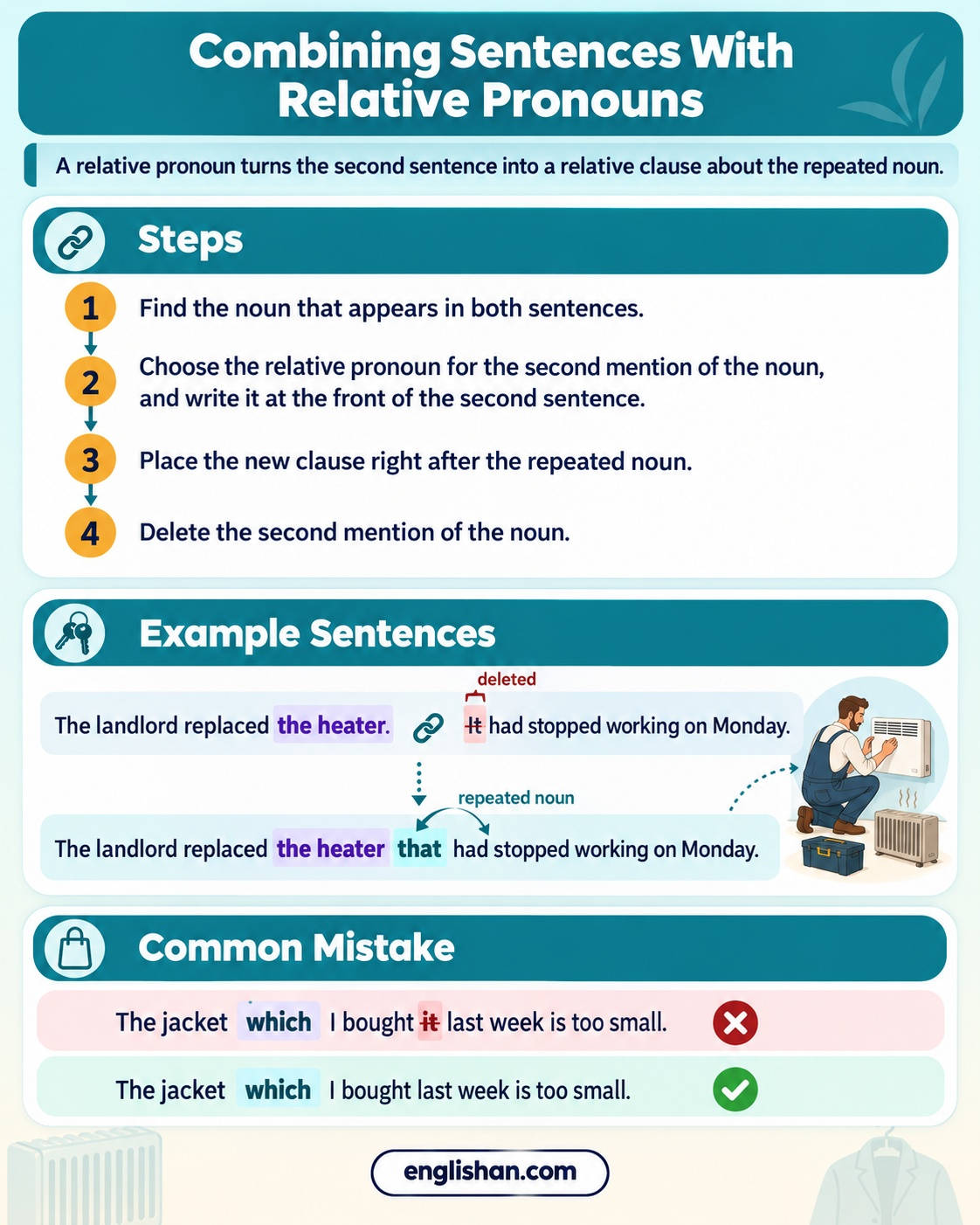
Steps To Combine Sentences Using Relative Pronouns
Combining sentences with relative pronouns takes four steps, in the same order for every pair of sentences:
- Find the noun that appears in both sentences. In the second sentence, the repeated noun is often a pronoun such as “he”, “it”, or “them”.
- Choose the relative pronoun for the second mention of the noun, and write it at the front of the second sentence.
- Place the new clause right after the repeated noun in the first sentence.
- Delete the second mention of the noun, together with any pronoun that repeats it.
In the pair “The landlord replaced the heater. It had stopped working on Monday.”, the repeated noun is “the heater”, and “it” is its second mention. The heater is a thing and “it” is the subject of “had stopped”, so the pronoun is “which” or “that”:
- The landlord replaced the heater. It had stopped working on Monday.
- The landlord replaced the heater that had stopped working on Monday.
The combined sentence has one main clause, “The landlord replaced the heater”, and one relative clause, “that had stopped working on Monday”. The noun “heater” is now written once, and the relative pronoun refers back to it.
Use Of Who Which And That In Combined Sentences
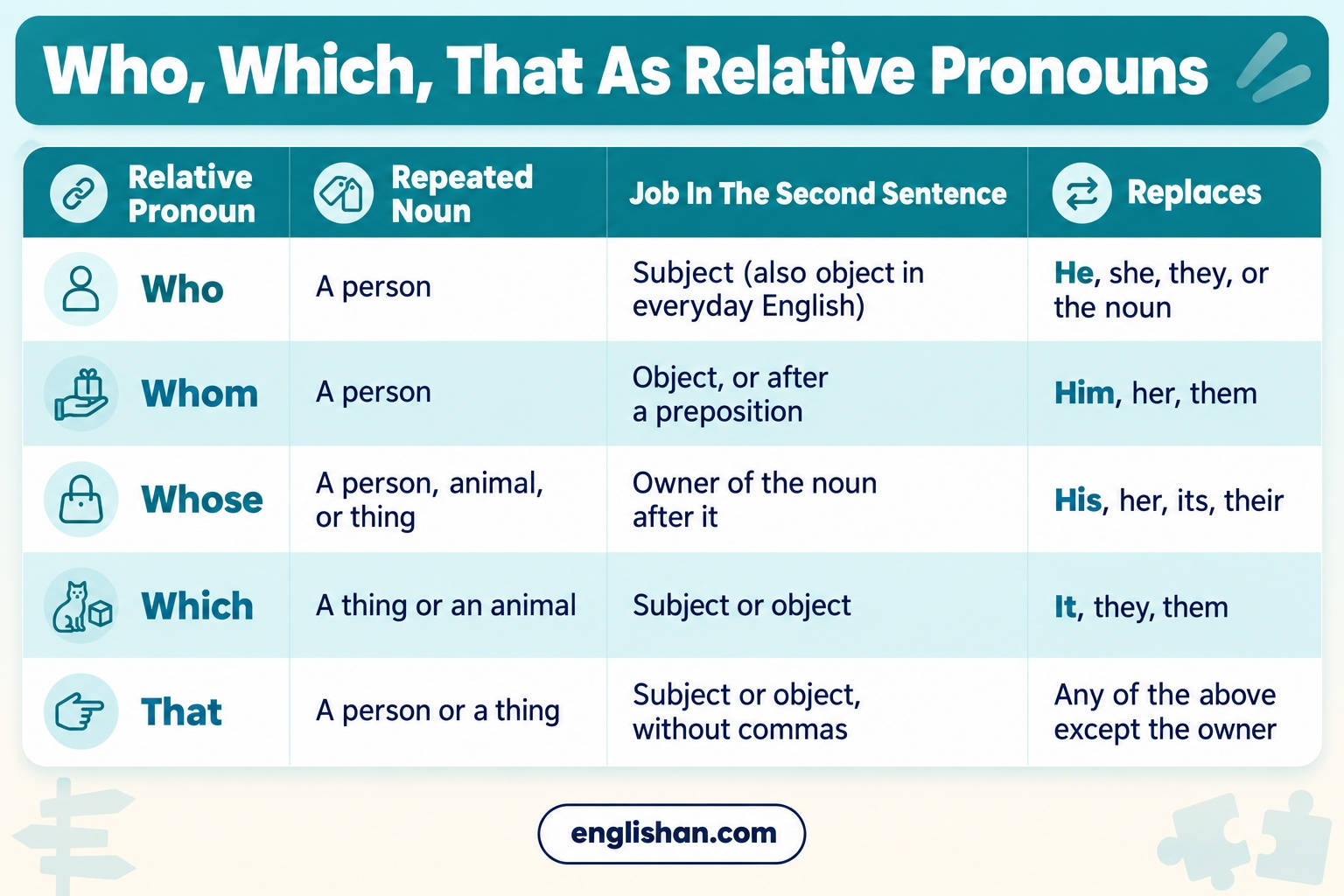
The relative pronoun in a combined sentence agrees with the repeated noun: “who” and “whom” refer to people, “which” refers to things and animals, and “that” refers to people or things. The job of the noun in the second sentence then narrows the choice:
| Relative pronoun | Repeated noun | Job in the second sentence | Replaces |
|---|---|---|---|
| Who | A person | Subject (also object in everyday English) | He, she, they, or the noun |
| Whom | A person | Object, or after a preposition | Him, her, them |
| Whose | A person, animal, or thing | Owner of the noun after it | His, her, its, their |
| Which | A thing or an animal | Subject or object | It, they, them |
| That | A person or a thing | Subject or object, without commas | Any of the above except the owner |
A repeated noun for a person takes “who”, and a repeated noun for a thing takes “which” or “that”:
- Our team has a new manager. She used to work in Denver.
- Our team has a new manager who used to work in Denver.
- The museum is closed today. It opened last spring.
- The museum which opened last spring is closed today.
- I need the cable. It connects the printer.
- I need the cable that connects the printer.
In a clause without commas about a thing, both “that” and “which” are correct, and “that” is the more common choice in American English. For a person, “who” is the usual pronoun, and “that” is also correct when the clause has no commas. Under the rule for who vs whom, “who” is the subject form and “whom” is the object form.
The pronoun “which” never refers to a person:
The dentist which cleaned my teeth was very gentle. ❌
The dentist who cleaned my teeth was very gentle. ✅
A dentist is a person, so the relative pronoun is “who” or “that”.
Subject And Object Relative Pronouns
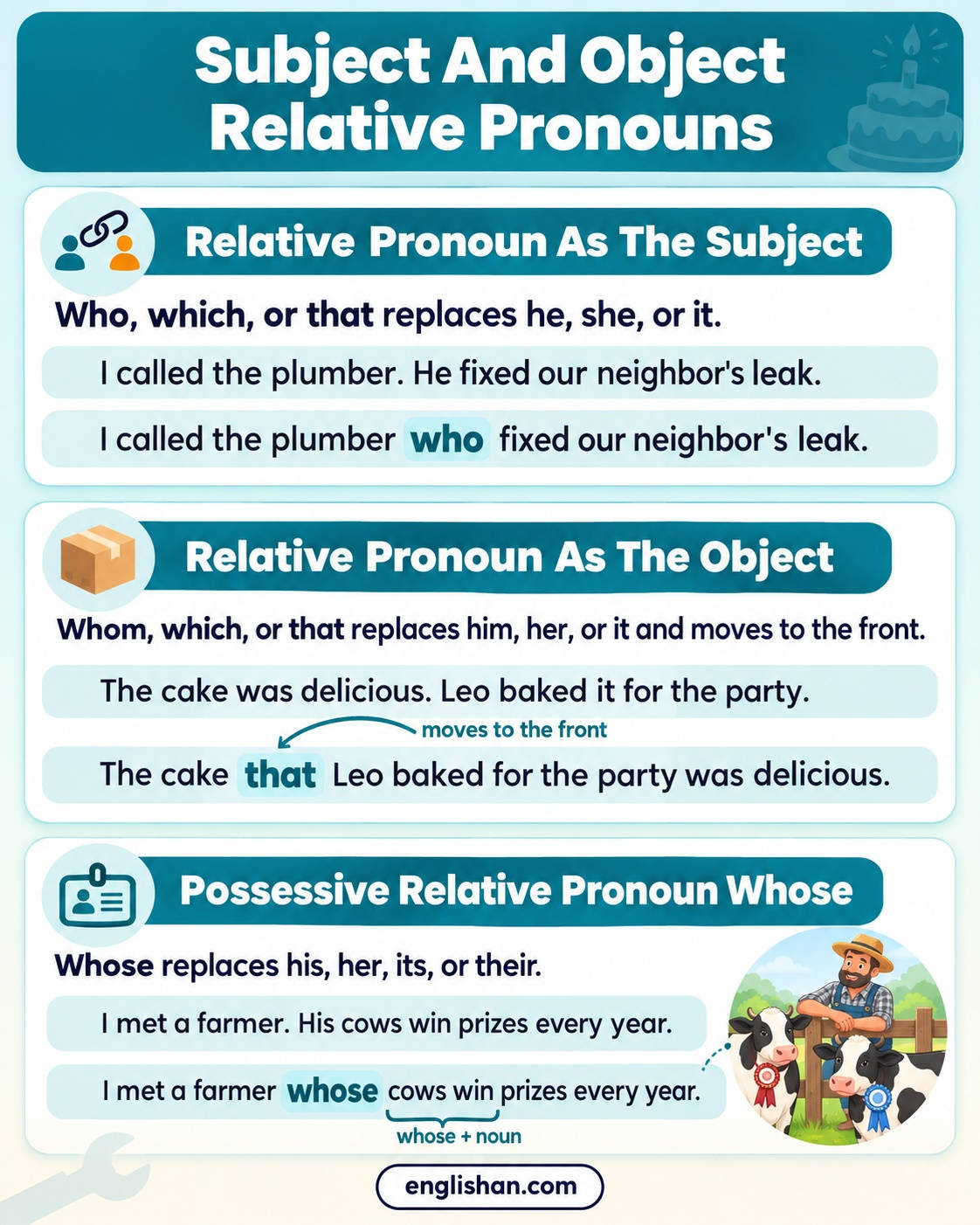
The relative pronoun and the word order of the clause both depend on the job of the repeated noun in the second sentence. The noun can be the subject of the second sentence, its object, or the owner of another noun.
Relative Pronoun As The Subject
When the repeated noun is the subject of the second sentence, the relative pronoun replaces a subject pronoun such as “he” or “it”, and the verb follows the relative pronoun directly. The pronoun is “who”, “which”, or “that”:
- I called the plumber. He fixed our neighbor’s leak.
- I called the plumber who fixed our neighbor’s leak.
- The bus was late again. It goes to the hospital.
- The bus that goes to the hospital was late again.
- We stayed at a hotel. It had a pool on the roof.
- We stayed at a hotel which had a pool on the roof.
When the repeated noun is the subject of the first sentence, as “the bus” is above, the relative clause goes in the middle of the combined sentence, between that subject and its verb. A clause added at the end of the sentence, far from its noun, is a common error:
The chef won an award who runs the café on Elm Street. ❌
The chef who runs the café on Elm Street won an award. ✅
A relative clause comes directly after the noun it describes, so it goes between “the chef” and “won”.
Relative Pronoun As The Object
When the repeated noun is the object of the second sentence, the relative pronoun replaces an object pronoun such as “him”, “her”, or “it”. The relative pronoun moves from the end of the clause to the front. The clause then has its own subject after the pronoun:
- The cake was delicious. Leo baked it for the party.
- The cake that Leo baked for the party was delicious.
- She hired the designer. We recommended him.
- She hired the designer whom we recommended. (formal)
- I finally returned the drill. I borrowed it from Sam in May.
- I finally returned the drill which I borrowed from Sam in May.
In everyday English, “who” also replaces “whom” as the object, as in “the designer who we recommended”. Because the relative pronoun moves to the front, the object pronoun in the clause has nothing left to replace, and it is deleted in step 4. A leftover object pronoun is a frequent error in combined sentences:
The jacket which I bought it last week is too small. ❌
The jacket which I bought last week is too small. ✅
The relative pronoun “which” is already the object of “bought”, so the clause takes no second object for the same jacket.
Possessive Relative Pronoun Whose
When the repeated noun is the owner in the second sentence, the possessive relative pronoun “whose” replaces the possessive word “his”, “her”, “its”, or “their”. The noun after the possessive word moves with “whose” to the front of the clause:
- I met a farmer. His cows win prizes every year.
- I met a farmer whose cows win prizes every year.
- The neighbors are away. We are watering their plants.
- The neighbors whose plants we are watering are away.
- They rescued a dog. Its leg was broken.
- They rescued a dog whose leg was broken.
In the second pair, “their plants” is the object of “are watering”, so “whose plants” comes first and the subject “we” follows it. Relative “whose” is always followed by a noun, and the clause never keeps a second possessive word:
I met a farmer who his cows win prizes every year. ❌
I met a farmer whose cows win prizes every year. ✅
The pronoun “whose” replaces both “who” and “his”, so “his” is deleted. The contraction “who’s” means ‘who is’ or ‘who has’, so it never replaces “whose” in a combined sentence.
Prepositions With Relative Pronouns
When the repeated noun follows a preposition in the second sentence, as in “in it” or “to her”, the preposition stays in the relative clause. There are two correct positions for it. In formal English, the preposition goes before “which” or “whom” at the front of the clause, and in everyday English, it stays at the end of the clause:
- This is the house. We lived in it for ten years.
- This is the house in which we lived for ten years. (formal)
- This is the house that we lived in for ten years. (everyday)
- The colleague is on vacation. I sent the report to her.
- The colleague to whom I sent the report is on vacation. (formal)
- The colleague who I sent the report to is on vacation. (everyday)
Only “which” and “whom” come directly after a preposition. With “that” or “who”, the preposition goes at the end of the clause, so “in that we lived” and “to who I sent” are not standard. For places, the relative adverb “where” can replace “in which”, as in “the house where we lived”.
The preposition goes in only one of the two positions, never both:
This is the house in which we lived in for ten years. ❌
This is the house in which we lived for ten years. ✅
The preposition “in” already comes before “which”, so the second “in” at the end of the clause is deleted.
Defining And Non-Defining Relative Clauses
When combining sentences with relative pronouns, you choose between a defining and a non-defining relative clause, and the choice depends on the repeated noun in the first sentence. A defining clause shows which person or thing the speaker means, and it takes no commas. A non-defining clause adds extra information about a noun that is already identified, such as a name or “my grandmother”, and commas go around it:
- My grandmother turns ninety next week. She still swims every morning.
- My grandmother, who still swims every morning, turns ninety next week.
- Lisbon is built on hills. We visited it in April.
- Lisbon, which we visited in April, is built on hills.
- The runners finished early. They trained in the mountains.
- The runners who trained in the mountains finished early. (only some runners)
- The runners, who trained in the mountains, finished early. (all the runners)
In the last pair, the commas change the meaning. Without commas, the clause picks out the runners who trained in the mountains from the other runners, and with commas, all the runners trained there.
A non-defining clause takes “who”, “whom”, “whose”, or “which”, never “that”:
Lisbon, that we visited in April, is built on hills. ❌
Lisbon, which we visited in April, is built on hills. ✅
The relative pronoun after a comma is “which” for a thing and “who” or “whom” for a person.
Omission Of The Object Relative Pronoun
When the relative pronoun is the object of a defining clause, you can leave it out of the combined sentence. The clause then starts directly with its subject:
- The shoes were on sale. I wanted them.
- The shoes I wanted were on sale.
- Is this the charger? You lost it.
- Is this the charger you lost?
- The man was very helpful. I spoke to him at the bank.
- The man I spoke to at the bank was very helpful.
The relative pronoun stays when it is the subject of the clause, because the verb would then follow the noun directly with nothing to join the two clauses:
The bus goes to the hospital was late again. ❌
The bus that goes to the hospital was late again. ✅
The pronoun also stays in every non-defining clause, so “Lisbon, which we visited in April,” keeps “which” even though it is the object of “visited”.
FAQs
Yes, the result is a complex sentence, because it has one independent clause and one dependent clause, the relative clause. It is not a compound sentence, which joins two independent clauses with a conjunction such as "and" or "but".
Not a relative pronoun that refers back to a noun, because its clause follows that noun. The relative pronoun "what" and the "-ever" forms such as "whoever" have no noun before them, so they can open a sentence, as in "What she said was true." A sentence such as "Who called?" opens with an interrogative pronoun, not a relative one.
Yes, a sentence can have two relative clauses, and each relative pronoun follows its own noun. In "The nurse who treated my son works at the clinic that opened in June", "who" refers to "the nurse" and "that" refers to "the clinic".
Yes, "whose" refers to things as well as to people and animals, as in "a car whose brakes failed" or "a company whose profits rose". The form "of which", as in "a car the brakes of which failed", is also correct but much more formal and less common.
Related:
- Pronoun Rules and Correct Usage
- Types of Pronouns
- Who’s vs Whose
- Pronouns With Prepositions
- Relative vs Interrogative Pronouns
