

A demonstrative adjective is a word such as “this” or “those” that comes before a noun and shows which person or thing we mean, as in “this bag”. A demonstrative pronoun is the same word on its own, as in “This is heavy”, where it replaces the noun. In demonstrative adjectives vs demonstrative pronouns, the choice depends on one fact: whether a noun comes after the word.
The four words are “this”, “that”, “these”, and “those”, and they keep the same meanings of number and distance as adjectives and as pronouns. The near forms are “this” and “these”, and the far forms are “that” and “those”. Only the job of the word in the sentence changes: it either modifies a noun or replaces one.
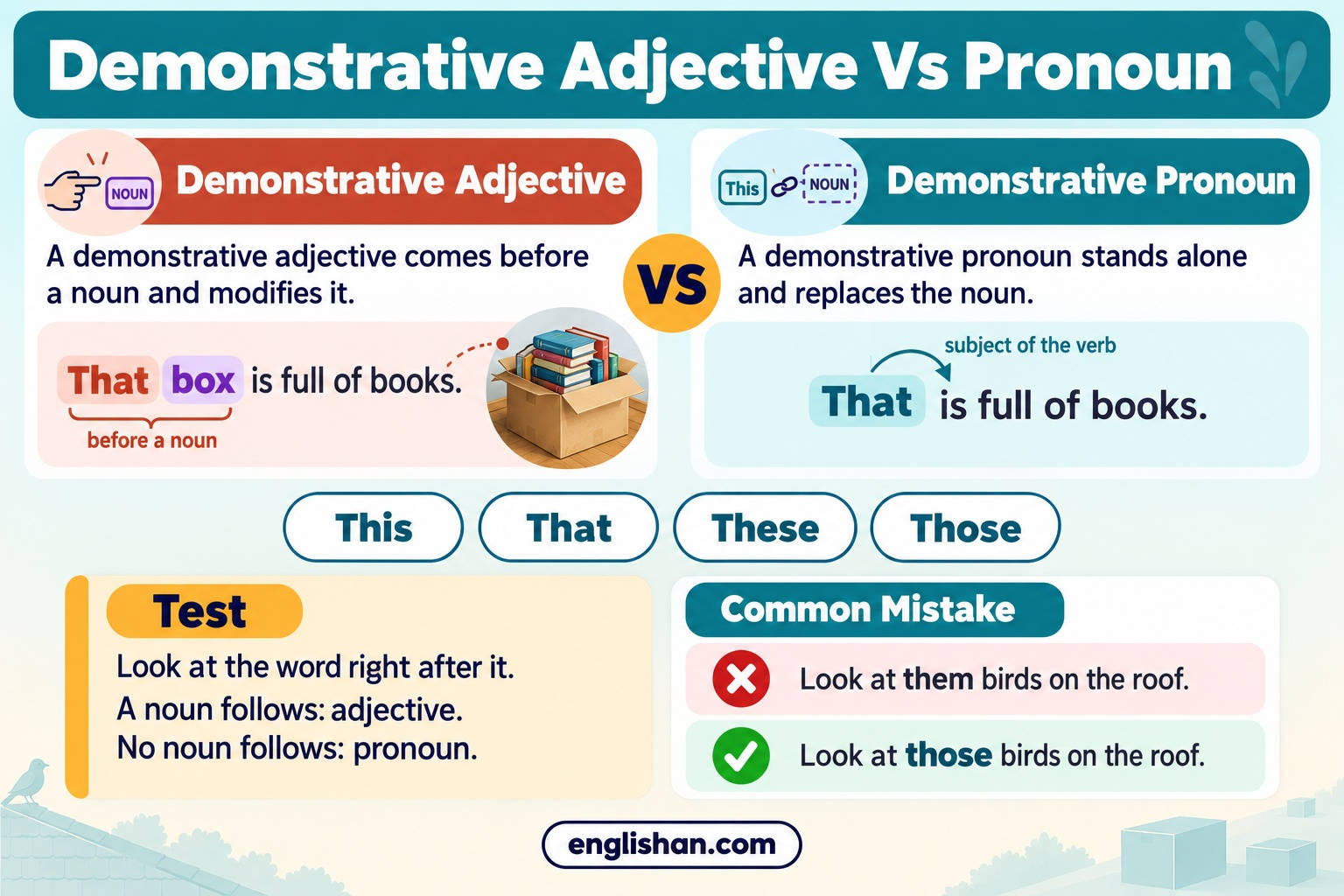
Difference Between Demonstrative Adjectives And Pronouns
In demonstrative adjectives vs demonstrative pronouns, the difference is the position of the word: a demonstrative adjective comes before a noun, and a demonstrative pronoun takes the place of the noun. The four words as adjectives and as pronouns:
| Word | Number | Distance | Before a noun (adjective) | Alone (pronoun) |
|---|---|---|---|---|
| This | Singular | Near | This jacket | Try this on |
| That | Singular | Far | That window | Open that |
| These | Plural | Near | These keys | Take these |
| Those | Plural | Far | Those boots | Look at those |
Number and distance stay the same in both columns. A demonstrative adjective modifies the noun after it, while a demonstrative pronoun functions as the subject or the object itself:
- That box is full of books. (adjective)
- That is full of books. (pronoun)
- Can you carry these chairs to the van? (adjective)
- Can you carry these to the van? (pronoun)
In the second sentence of each pair, the pronoun replaces the whole noun phrase “that box” or “these chairs”, so no noun is left after it.
Demonstrative Adjectives Before A Noun
A demonstrative adjective comes before the noun it modifies. When the noun phrase has other adjectives or a number, the demonstrative comes before them too:
- This printer jams every morning.
- I bought those two lamps at a market in Lisbon.
- Have you read these old letters from your grandmother?
- That new manager starts on Monday.
A demonstrative adjective does not appear with an article or a possessive adjective before the same noun, because each of these words already shows which noun we mean. The words “this” and “my” do not come together before one noun:
This my phone is broken. ❌
This phone of mine is broken. ✅
A noun phrase takes only one of these words, so “this phone of mine” or “my phone” is the correct form.
In standard English, the object pronoun “them” does not come before a noun. The demonstrative adjective for far plural nouns is “those”, and “them books” is heard in some regional speech but is not standard English:
Look at them birds on the roof. ❌
Look at those birds on the roof. ✅
The word “them” is an object pronoun, so it stands alone after a verb or a preposition, as in “Look at them.”
Demonstrative Pronouns Without A Noun
A demonstrative pronoun stands alone and replaces a noun phrase that the listener already knows from the situation or from an earlier sentence. It functions as the subject of a verb, the object of a verb, or the object of a preposition:
- This is the fastest way to the airport. (subject)
- Did you order those? (object of the verb)
- I paid forty dollars for that. (object of a preposition)
- These are the receipts from the conference. (subject)
For people, a demonstrative pronoun is mainly the subject of “be”, when we introduce or identify someone. In other sentences, we use the demonstrative adjective and a noun for a person:
- This is my sister, Nadia.
- Who is that at the door?
That needs a nap. ❌
That child needs a nap. ✅
Outside introductions and identification, a demonstrative pronoun refers to a thing, so for a person we say “that child” or “that man”.
The plural “those” also refers to people before a “who” clause, as in “Those who finished early can leave.” In formal writing, “that of” and “those of” replace a noun already in the sentence and agree with it in number: “The climate of Lima is milder than that of Cusco.”
Antecedents Of Demonstrative Pronouns
An antecedent is the word or idea that a pronoun refers to. A demonstrative pronoun usually has an antecedent, and the antecedent can be a noun phrase or a whole idea: a statement, an event, or a situation. For a whole idea, the pronoun is usually the singular “this” or “that”, and the verb is singular:
- The train is late again. That is the third time this week.
- Sales doubled in May. This shows that the new prices work.
- Marta apologized to everyone, and that surprised me.
- You think the plan is too expensive, and that is true.
The pronoun “that” usually refers back to something just said or done. The near form “this” can also introduce something the speaker is about to say, as in “Listen to this: the meeting is canceled.”
A demonstrative adjective refers to a whole idea only through a noun such as “fact”, “idea”, or “problem”:
- The train is late again, and that problem started in May.
When the speaker points at something in the situation, as in “Look at that“, the pronoun has no antecedent in the text.
Demonstratives With One
The pronoun “one” can replace a singular count noun after “this” or “that”, so “this one” and “that one” mean a thing of a kind already mentioned. In “this one”, the demonstrative comes before the word “one”, so it functions as a demonstrative adjective, and “one” replaces the noun:
- I like both jackets, but this one is warmer.
- Two buses stop here. Take that one on the left.
- Is this one yours, or is it Leo’s?
- I don’t want the blue mug. Can I have that red one?
An adjective can come between the demonstrative and “one”, as in “that red one” and “this smaller one”.
In the plural, “these” and “those” usually stand alone. The forms “these ones” and “those ones” are common in everyday British English, while “these” and “those” alone are the standard written form:
- Can I try those in blue? (standard)
- Can I try those ones in blue? (everyday British English)
Singular And Plural Demonstratives
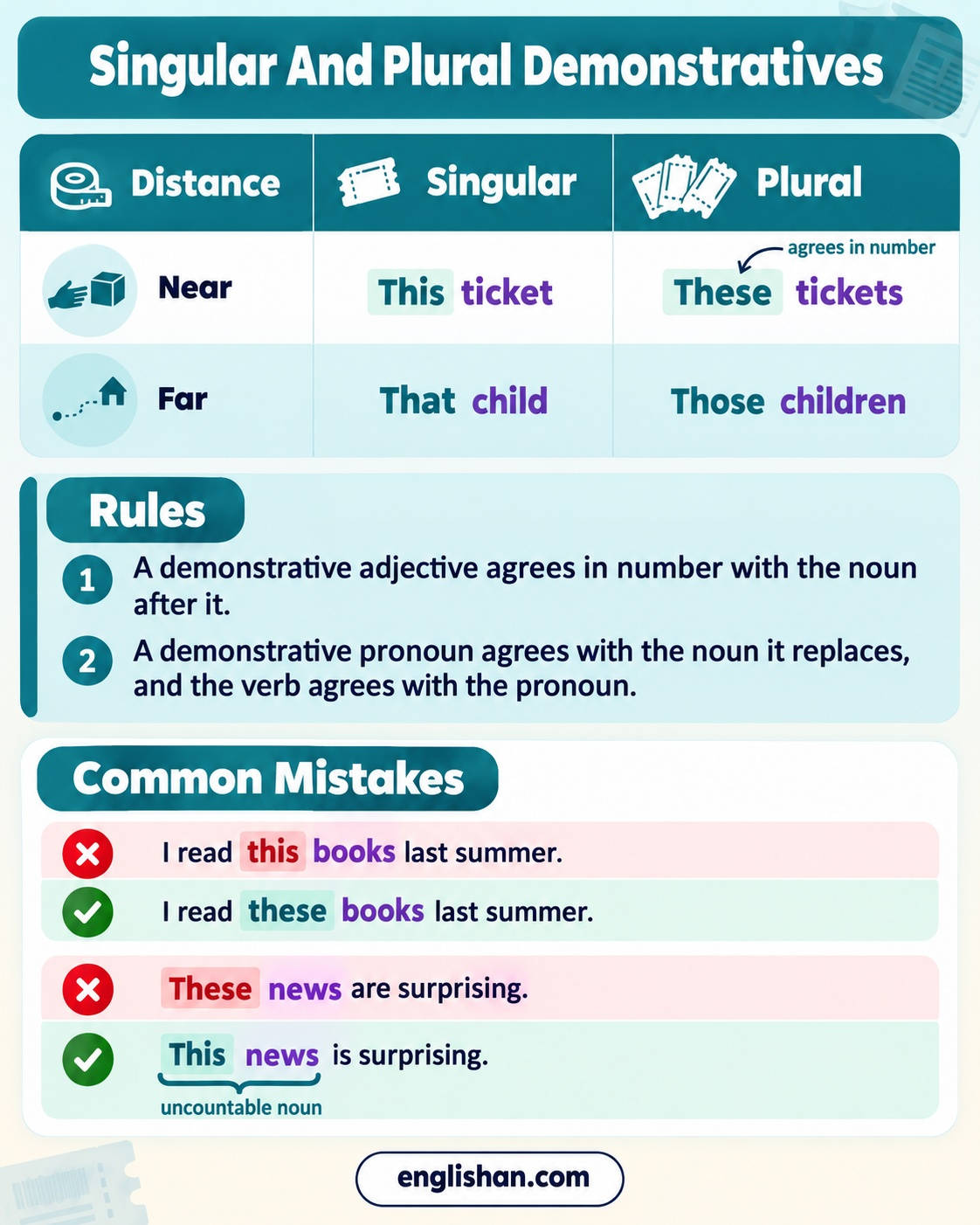
The singular demonstratives are “this” and “that”, and the plural demonstratives are “these” and “those”. As adjectives, they agree in number with the noun after them:
- This ticket is for Saturday.
- These tickets are for Saturday.
- That child is my nephew.
- Those children are my nephews.
I read this books last summer. ❌
I read these books last summer. ✅
The noun “books” is plural, so the demonstrative adjective takes the plural form.
Uncountable nouns: An uncountable noun takes “this” or “that”, even when its meaning feels plural, as with “news”, “information”, “advice”, and “furniture”.
These news are surprising. ❌
This news is surprising. ✅
Plural-only nouns: Nouns with only a plural form, such as “jeans”, “scissors”, and “pajamas”, take “these” or “those”, as in “Where did you buy those jeans?”
Kind and sort: In standard written English, the demonstrative agrees with “kind” or “sort”, so the singular is “this kind of” and the plural is “these kinds of”.
These kind of mistakes are common. ❌
These kinds of mistakes are common. ✅
As pronouns, the demonstratives agree in number with the noun they replace, and the verb agrees with the demonstrative:
- These are the photos from the wedding.
- That was a long meeting.
This are my parents. ❌
These are my parents. ✅
The pronoun replaces two people, so it takes the plural “these” and the plural verb “are”.
Identification Of Demonstrative Adjectives And Pronouns
To identify the form, look at the word right after the demonstrative. A noun after it, the word “one”, or an adjective or a number and then a noun shows a demonstrative adjective. A verb, an adverb, a preposition, a comma, or the end of the sentence shows a demonstrative pronoun:
- That song was on the radio all morning. (adjective: a noun follows)
- That was on the radio all morning. (pronoun: a verb follows)
- Who left those muddy boots in the hall? (adjective: an adjective and a noun follow)
- Who left those in the hall? (pronoun: a preposition follows)
- Can you hold this? (pronoun: the sentence ends)
Not every “that” is a demonstrative. As a relative pronoun, “that” introduces a clause after a noun. As a conjunction, it introduces a clause after a verb, and as an adverb, it means ‘so’ before an adjective:
- The bike that I sold was red. (relative pronoun)
- She said that the store was closed. (conjunction)
- The film wasn’t that long. (adverb)
A demonstrative “that” is followed by a noun or stands for one, so none of these three is a demonstrative adjective or a demonstrative pronoun.
FAQs
The four demonstrative pronouns are "this", "that", "these", and "those". The singular forms are "this" and "that", and the plural forms are "these" and "those". The same four words are demonstrative adjectives when a noun follows them.
Demonstrative adjectives come before a noun and modify it, like descriptive adjectives such as "old" and "red". Unlike descriptive adjectives, they change form for number, they have no comparative or superlative form, and they come before any other adjective in the phrase, as in "these red apples".
Use the pronoun when the listener already knows the noun from the situation or from an earlier sentence. When a friend asks which shirt you want, the answer "This" replaces "shirt". Use the adjective with a noun when the noun is new to the listener, and for a person outside introductions.
Yes, "demonstrative determiner" is another name for a demonstrative adjective. Both names describe "this", "that", "these", and "those" before a noun. The demonstratives belong with the determiners such as "the", "a", and "my", because they show which noun we mean rather than describing it.
Related:
- Pronouns
- Types of Pronouns
- Pronoun vs Adjective
- Possessive Adjectives vs Possessive Pronouns
- Singular and Plural Pronouns
- Interrogative Pronouns
- Countable and Uncountable Nouns
- Adjective
- Common Pronoun Errors
- Noun vs Pronoun
- Vague Pronoun Reference