

The pronouns “I” and “me” are the two singular first person pronouns, and both refer to the speaker or writer. The subject pronoun is “I”, the form for the person doing the action of the verb, and the object pronoun is “me”, the form that comes after a verb or a preposition.
The I vs me choice depends on the job of the pronoun in its own clause, not on its place in the sentence or on the words next to it. A pronoun in a pair such as “my sister and I”, after “between”, or after “than” follows the same rule, and those are the places where the wrong form is most common. Where everyday English and formal English differ, as after “be” and “than”, both forms are standard, each in its own setting.
What Is The Difference Between I And Me?
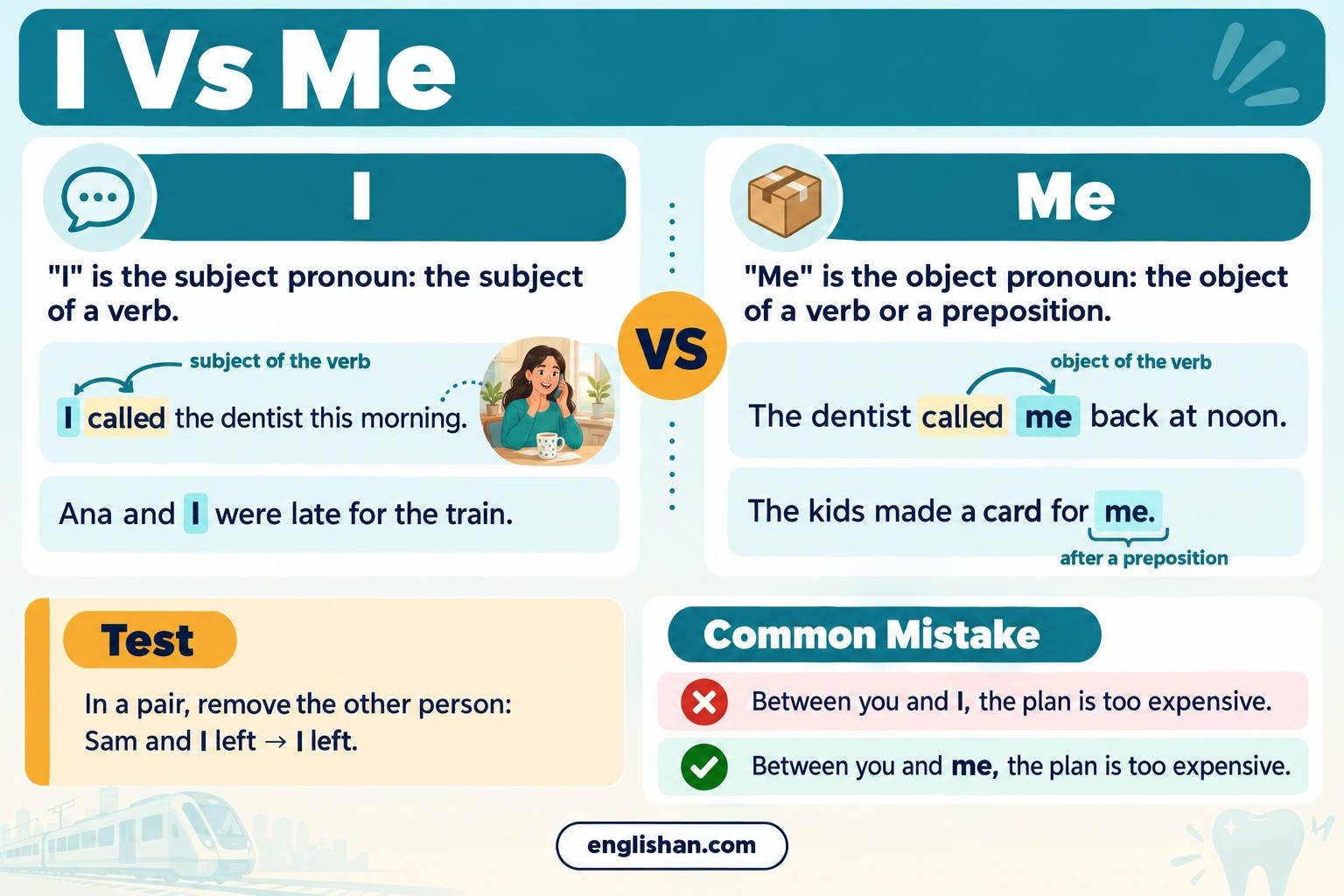
The I vs me difference comes from the job of the pronoun: “I” is the subject of a verb, and “me” is the object of a verb or of a preposition. Both words refer to the same person, so the meaning stays the same and only the grammar changes.
| Point | I | Me |
|---|---|---|
| Pronoun type | Subject pronoun | Object pronoun |
| Job in the sentence | Subject of a verb | Object of a verb or a preposition |
| Usual position | Before the verb | After the verb or the preposition |
| In a pair | My friend and I | My friend and me |
| After “between” | Not used | Between you and me |
| After “than” or “as” | Than I am | Than me (everyday English) |
| After “be” | It is I (formal) | It’s me (everyday English) |
A morning phone call to a dentist shows both forms in the same scene:
- I called the dentist this morning.
- The dentist called me back at noon.
- I gave the receptionist my new address.
- The receptionist gave me a form to sign.
Word order usually matches the job, because a subject comes before the verb and an object comes after it. When the order changes, as in a question (“Can I help?”), the form still follows the job of the pronoun.
Uses Of I
The pronoun “I” functions as the subject of a verb: the person who does the action or who is in the state the verb describes. It takes “am” and “was” as its forms of “be”, and the present simple verb after it has no “-s”, as in “I have” and “I work”.
- I work from home on Fridays.
- I am not ready yet.
- Where should I park the car?
- After the meeting, I sent everyone the notes.
- Ana and I were late for the train.
In a question, the auxiliary verb comes before “I”, but the pronoun is still the subject of that verb. As part of a pair, “I” keeps the subject form, so “Ana and I” in the last example is the subject of “were”.
Uses Of Me
The pronoun “me” functions as an object: the direct object of a verb, the indirect object, or the object of a preposition. It usually comes after the verb or after the preposition, at the end of the clause or before another object.
- My manager called me after lunch. (direct object)
- Could you send me the address? (indirect object)
- The kids made a card for me.
- Sit next to me on the bus.
- Nobody explained the rules to me.
- Everyone except me had a ticket.
After “like”, “except”, and “but” in the meaning ‘except’, the object form follows, because these words function as prepositions here: “people like me” and “everyone but me”.
My Friend And I Vs My Friend And Me
In a pair joined by “and” or “or”, the pronoun takes the same form it takes alone. A pair such as “my friend and I” is a compound subject when it does the action, and “my friend and me” is a compound object when it receives the action or follows a preposition.
- My friend and I booked a table for eight.
- The waiter brought my friend and me the wrong order.
- Sam and I are on the same team.
- The coach picked Sam and me for the final.
- Would you like to join Maya and me for lunch?
To choose the form in a pair, cover the other person and read the sentence again. The sentence “My friend and I booked a table” becomes “I booked a table”, and “The coach picked Sam and me” becomes “The coach picked me”. The I vs me rule stays the same with three or more people, as in “Leo, Ana, and I”.
A subject pair joined by “and” takes a plural verb, like “we”, so the verb is “Sam and I are”, never “Sam and I am”. The other person usually comes first and the pronoun last, as in “Sam and I” and “Sam and me”, which is a convention of politeness and does not change the form.
Me and my friend booked a table. ❌
My friend and I booked a table. ✅
The pair is the subject of “booked”, so it takes “I”, and the other person comes first.
The waiter brought my friend and I the wrong order. ❌
The waiter brought my friend and me the wrong order. ✅
The pair is the object of “brought”, so it takes “me”. The error is an over-applied rule, because “my friend and I” is correct as a subject but wrong as an object.
Between You And Me Vs Between You And I
The preposition “between” takes object pronouns, so the standard phrase is “between you and me”. The pronoun “you” has the same form as a subject and as an object, so only the second pronoun shows the case.
- Between you and me, the second hotel was better.
- The final decision is between Leo and me.
- There was a long silence between Ana and me.
- This parcel is for you and me.
- Can you come to the station with Ana and me?
Other prepositions follow the same rule in a pair, so “for you and me”, “with Ana and me”, and “to Sam and me” all take the object form.
Between you and I, the plan is too expensive. ❌
Between you and me, the plan is too expensive. ✅
All the pronouns after a preposition are objects of that preposition, so “between” is followed by “me”.
Than I Vs Than Me
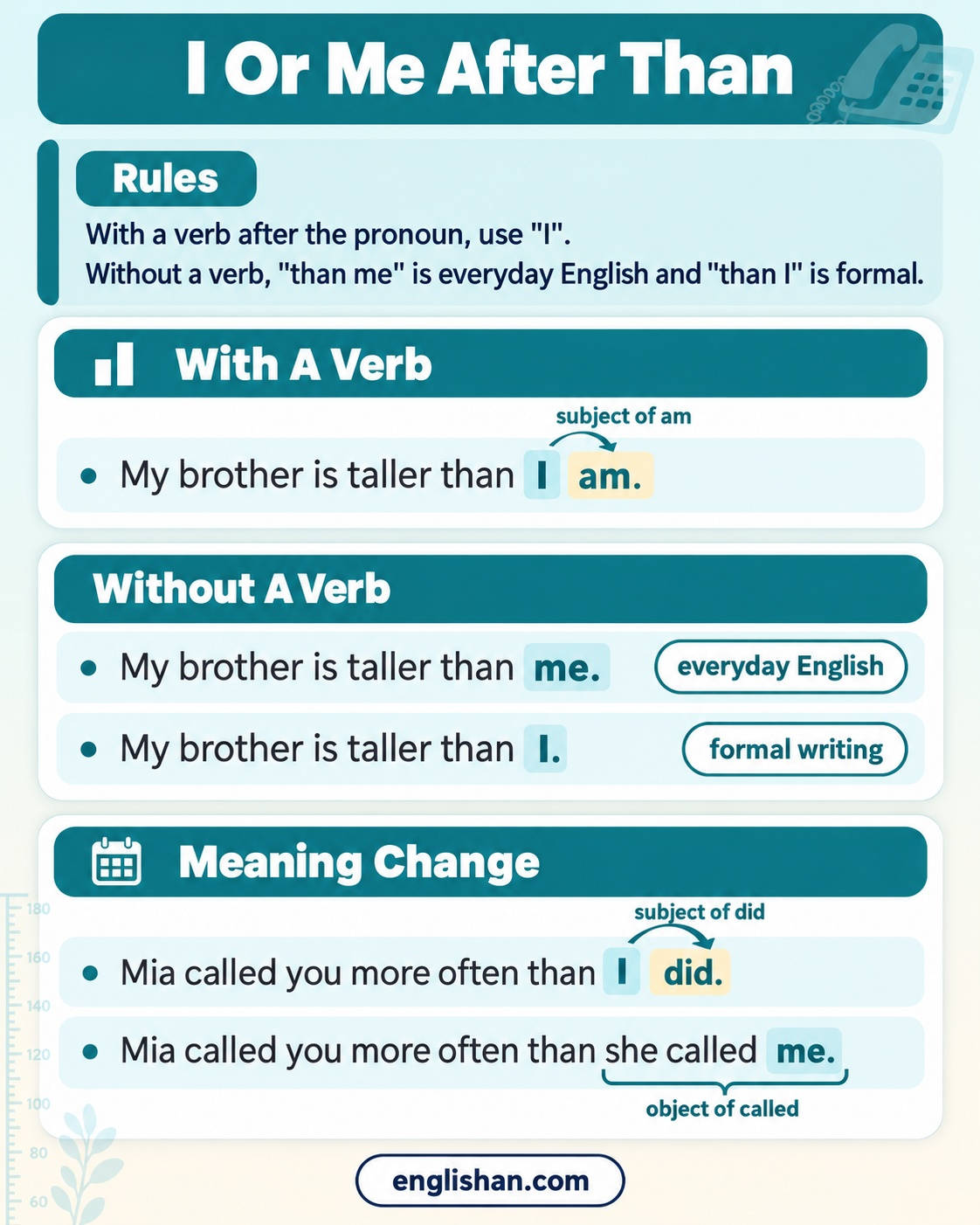
The I vs me choice after “than” and “as” in a comparison has two standard answers, and the choice depends on the setting and on whether a verb follows. With a verb after the pronoun, the subject form is the only correct one, because the pronoun is the subject of that verb.
- My brother is taller than I am.
- Nadia works as hard as I do.
- My brother is taller than me. (everyday English)
- My brother is taller than I. (formal writing)
- Nobody in the office is as busy as me. (everyday English)
Without a verb, “than me” and “as me” are standard in speech and in most everyday writing. Formal writing prefers “than I” or the full clause “than I am”, which is correct in every setting.
Where the pronoun can be the subject or the object of a missing verb, the form changes the meaning. In formal English, “Mia called you more often than I” means ‘than I did’, and “than me” means ‘than she called me’:
- Mia called you more often than I did.
- Mia called you more often than she called me.
In everyday English, “than me” is also used in the first meaning, so a sentence with no verb after the pronoun can be unclear. Adding the verb, as in “than I did”, gives only one reading.
It’s Me Vs It Is I
After a form of “be”, the pronoun refers back to the subject, and both forms are standard in their own settings. The everyday form is “It’s me”, and the formal form is “It is I”.
- Hi, it’s me. Can you open the door? (everyday English)
- That’s me in the blue jacket. (everyday English)
- It was I who signed the contract. (formal writing)
- The person you spoke to on the phone was I. (formal writing)
In formal grammar, the word after a linking verb such as “be” is a subject complement, a word that refers back to the subject, so it takes the subject form. With “who” after the pronoun, the next verb agrees with “I” in formal English, as in “It is I who am responsible”. In everyday English, the pronoun is “me” and the verb after “who” is third person: “It’s me who’s responsible.”
It is I who is responsible for the budget. ❌
It is I who am responsible for the budget. ✅
In the formal pattern, “who” refers to “I”, so the verb after it is “am”, the form of “be” that agrees with “I”.
Me Vs Myself
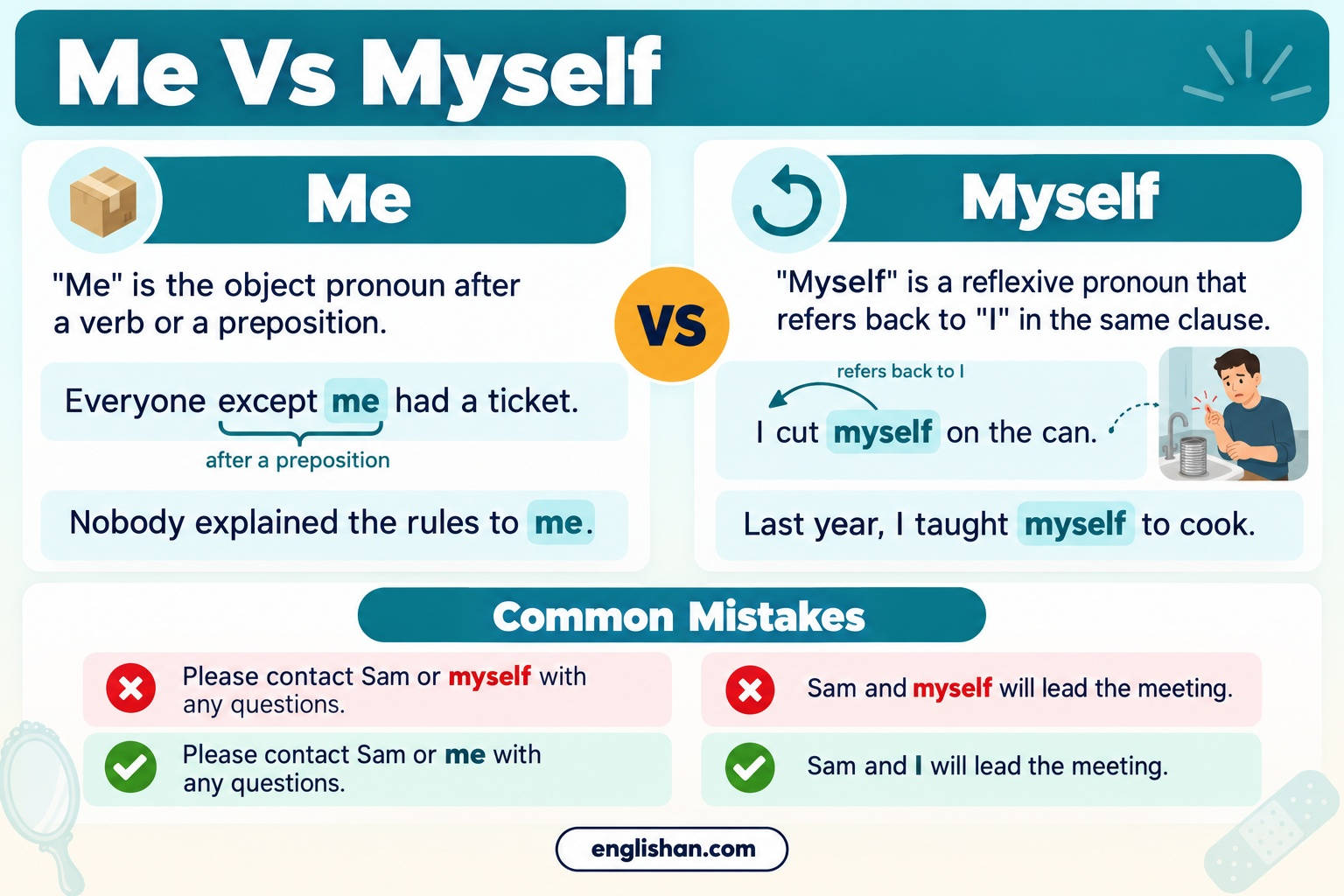
The reflexive pronoun “myself” refers back to “I” in the same clause, so in formal writing it is correct only when “I” is the subject of that clause, although “myself” for “me” is common in speech. It functions as the object when the speaker is also the person affected by the action, and it also adds emphasis or, after “by”, means ‘alone’.
- I cut myself on the can.
- Last year, I taught myself to cook.
- I painted the whole room myself.
- I went to the concert by myself.
Without “I” as the subject of the clause, the I vs me rule is the same as in any other clause, so an object is “me”, and “myself” is not a more polite or more formal choice.
Please contact Sam or myself with any questions. ❌
Please contact Sam or me with any questions. ✅
The subject of “contact” is “you”, not “I”, so the object is “me”.
Sam and myself will lead the meeting. ❌
Sam and I will lead the meeting. ✅
The pair is the subject of “will lead”, so it takes the subject form “I”.
FAQs
Both are pronouns. The words "I" and "me" are personal pronouns in the first person singular, and both refer to the speaker or writer. The subject pronoun is "I", and the object pronoun is "me".
A place at the end of a sentence does not change the form, because the form follows the job of the pronoun. An object at the end takes "me", as in "The package is for me". A subject before an understood verb takes "I" in formal English, as in "No one was more surprised than I."
Yes, as an object, because "me" is the correct form after a verb or a preposition: "The guide showed me and my friend the map." The usual order puts the other person first, as in "my friend and me". As a subject, "me and my friend" belongs to informal speech, and the standard subject is "my friend and I".
Both replies are correct, and both mean that what someone has just said is true for the speaker too. The reply "so do I" is a short clause with "I" as the subject of "do", and "me too" has no verb, so it takes the object form in everyday English. The negative pair is "neither do I" and "me neither".
The correct form is "let me", because "me" is the object of the verb "let", as in "Let me help you". A pair after "let" takes the object form too: "Let Sam and me finish the slides."
Related:
- Pronoun Rules and Correct Usage
- Subject vs Object Pronouns
- Pronoun Case
- Reflexive and Intensive Pronouns
- Who vs Whom
- Pronouns With Prepositions
